Compare
Grammarly vs Trinka: which one should check your writing?
Both tools check writing you've done, and they've gone in different directions. Grammarly now estimates your grade from a rubric and records how you wrote the draft. Trinka has gone deeper into academic style, with journal style guides and a checker that tests the references you already have.
So the short answer depends on what you're writing. A course essay marked against a rubric points to Grammarly. A thesis chapter or a manuscript with a long reference list points to Trinka, which also costs a third of Grammarly Pro on annual billing.
Prices and features checked on October 17, 2026.
At a glance
Writing assistants help you write; essay generators write the essay for you.
| Product | Type | Paid from | Free tier | Citations | Ghostwriting |
|---|---|---|---|---|---|
| Grammarly | Writing assistant | $12/month | Yes | Your sources, or papers it finds for you | Drafts text when asked |
| Trinka | Writing assistant | $48/year | Yes | Does not cite | Drafts text when asked |
A grade estimate or a style guide
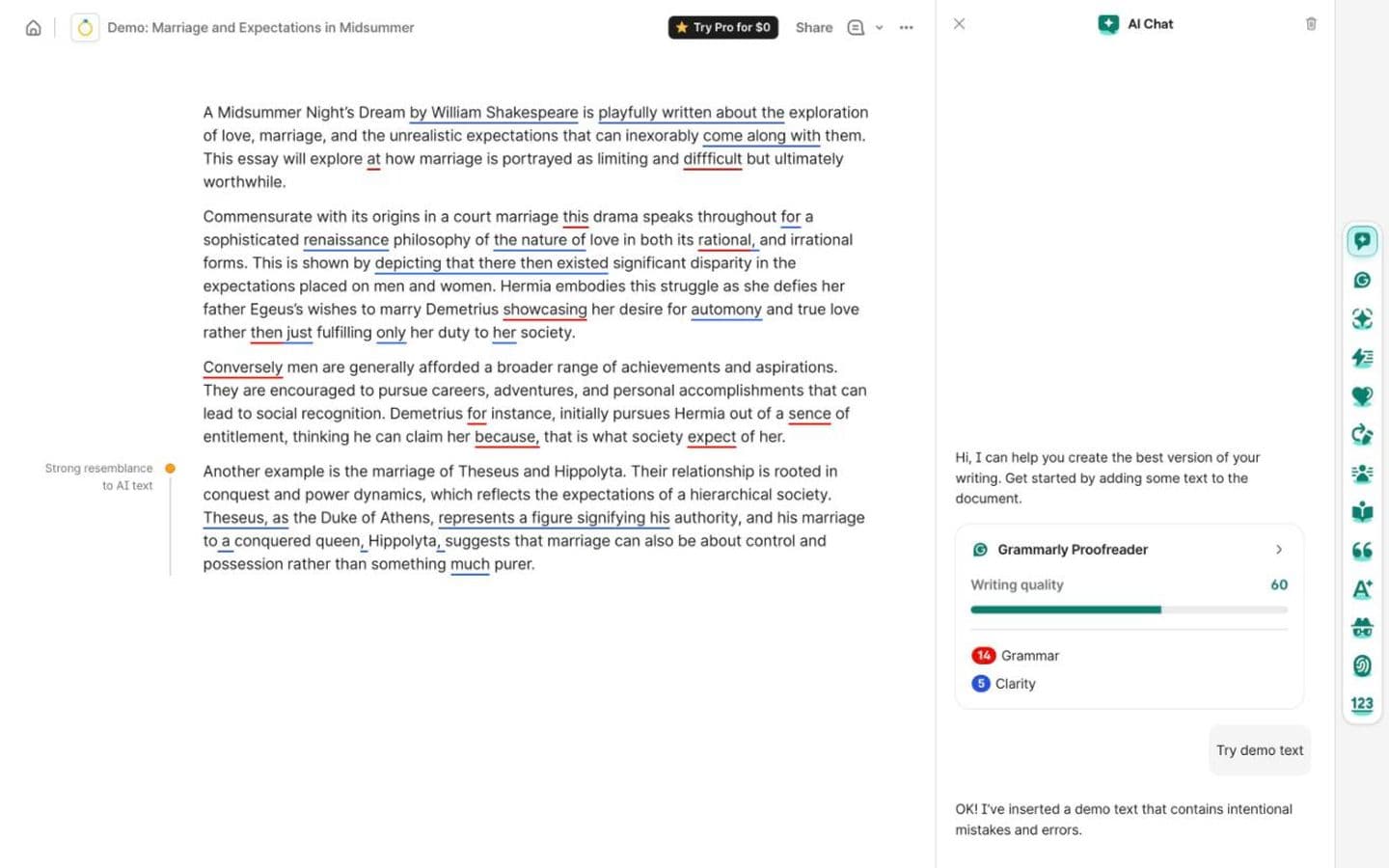
Grammarly's headline student feature is AI Grader. You give it your assignment details and rubric, and it estimates your grade and gives personalized feedback. Reader Reactions adds a second angle: what a reader is likely to take away, and where they could get lost. Grammarly is careful about the first one, saying the estimate should not be taken as your actual grade.
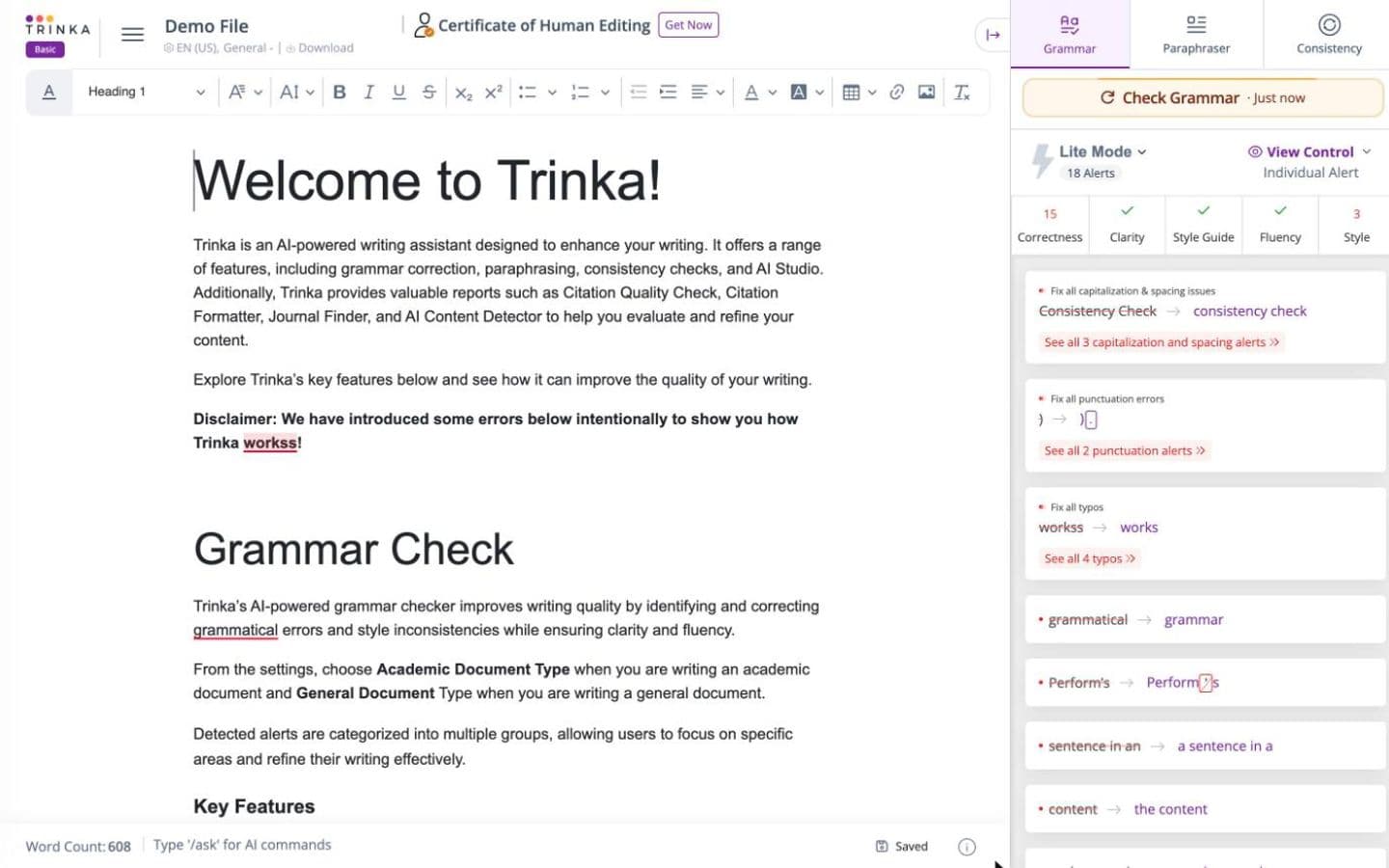
Trinka's feedback is closer to a copy editor's. It checks grammar, punctuation and academic style, and on paid plans it corrects to APA, AMA, ACS, AGU and IEEE style guides. It works on the text you've written and won't structure an argument for you. Originality.ai, which sells its own grammar checker, found it caught many basic and advanced errors in a test but missed misspellings such as “bussiness” and “atract”.
References: one finds them, the other audits them
Grammarly's Citation Finder flags claims that need support, suggests web-based sources it finds for you, then formats and inserts the citation. Two limits: it formats in APA, MLA or Chicago only, and it doesn't name the databases it searches, so open each suggestion before you keep it.
Trinka never supplies a source. Its Citation Checker works the other way round: it validates the references you already have against Crossref and flags retracted, hallucinated and predatory ones, and a Citation Formatter works on the same list. That's the more useful job if you've pulled references from several places, including an AI chat. The catch is that the citation tools run on credits, and the free plan gets 4 a month.
How much text each will write
Neither is a pure checker. Grammarly's agents can draft new text directly into the editor, and AI Grader's suggestions include AI-generated rewrites. Grammarly itself warns that using those rewrites could get your work flagged for AI use. It also sells a Humanizer to make AI-assisted writing sound more natural, while saying it is not intended to bypass AI detectors.
Trinka mainly corrects and paraphrases, but its Write & Rewrite with AI feature generates text too, rationed by plan: 5 requests a month free, 25 on Premium and 1,000 on Premium Plus. On r/UniUK and r/CheckMyTurnitin_ai, students describe high AI-detector scores on work they wrote themselves and only edited in Grammarly. Grammarly's answer is Authorship, which records what you typed, pasted or generated and gives you a report you choose whether to share.
Price and the free plans
Grammarly's free plan includes docs, Authorship and most agents, but rations them: AI Grader gives three pieces of feedback once a day, Citation Finder five citations a day, and you get 100 AI prompts a month. Plagiarism and AI-text detection need Pro. The plans page shows Pro at $12 a month, which is its $144 annual price spread over twelve months; month to month it's $30, and there's a free trial.
Trinka's Basic plan never expires and gives you 5,000 words of writing help a month, in a lite grammar mode. Premium is $48 a year, a discounted price the page shows as 40% off $80, and Premium Plus at $125 a year adds double credits and 240 pages a year of plagiarism checks, so even Trinka's second tier comes in under Grammarly Pro's $144. Billed monthly, Premium is $20. The free plan's word and credit limits are what Trustpilot reviewers complain about most.
Where they work, and your data
Trinka runs in Microsoft Word, the browser, a Windows app and on LaTeX files, and its $300-a-year Confidential Data plan promises no data storage and no AI training on your text. Grammarly's Authorship can be switched on in Word, Google Docs and Canvas submissions. If your lab or supervisor is strict about where unpublished text goes, Trinka gives you a plan written for that.
Which should you choose?
Choose Grammarly if your work is marked against a rubric and you want an estimate and feedback before you submit, plus a record of how you wrote it in case anyone asks. Start on the free plan; its daily limits are enough to try AI Grader on a real assignment.
Choose Trinka if you're polishing a thesis or manuscript, need a journal style guide such as AMA or IEEE, or want every reference checked for retractions before it goes out. Premium at $48 a year is the cheaper paid plan of the two.
Both of these mainly work on text you've already written. EthiWrite comes in earlier, while you're still writing: every citation has to come from a source you added to your Library, and Examiner Mode flags unsupported claims and thin evidence without rewriting anything. Its paper search covers one index, OpenAlex, so you'll still need your own database searches for a serious literature review.
FAQ
- Is Trinka better than Grammarly for academic writing?
- For language and style in a paper, look at Trinka. Its focus is academic style checks, journal style guides on paid plans, and a reference checker. Grammarly's edge is feedback on the assignment as a whole, through AI Grader and Reader Reactions.
- Which is cheaper, Grammarly or Trinka?
- Trinka, on annual billing: Premium is $48 a year and Premium Plus $125, against $144 a year for Grammarly Pro. Month to month, Trinka Premium is $20 and Grammarly Pro is $30.
- Can Grammarly or Trinka find sources for my essay?
- Grammarly can: Citation Finder suggests web-based sources and formats them in APA, MLA or Chicago. Trinka can't. It checks and formats references you already have.
- Will using Grammarly or Trinka get my essay flagged as AI?
- Grammarly warns that its AI rewrite suggestions could get work flagged, and students on Reddit describe high detector scores after only editing with it. Trinka also generates text through its AI writing requests. If you use either, Grammarly's Authorship report is one way to show how the draft was written.
- Do Grammarly and Trinka have free plans?
- Yes. Grammarly's free plan meters AI Grader, Citation Finder and Reader Reactions by the day and gives 100 AI prompts a month. Trinka's Basic plan gives 5,000 words of writing help, 5 AI writing requests and 4 credits a month.