Alternatives
Grammarly alternatives for academic writing in 2026
If you're looking past Grammarly, you probably want one of two things: an editor that understands academic writing, or a tool that takes sources more seriously. Those are different products, so it helps to know which one you're shopping for.
For academic polish, Paperpal and Trinka are the closest swaps, and Writefull is the pick if you write in LaTeX. For citations you can trace back to something you added, EthiWrite is our pick (we make it); Jenni AI and Paperguide are the other source-led options, each with its own search of 200M+ papers. And if you need a tough read of a long draft, try Thesify.
Prices and features checked on October 17, 2026.
What pushes students off Grammarly
The fear that comes up on r/UniUK and r/CheckMyTurnitin_ai is specific. Students say they wrote every word themselves, only edited with Grammarly, and still got a high score from an AI detector. Grammarly itself warns that using its AI rewrite suggestions could get your work flagged for AI use, so it pays to know which suggestions you're accepting.
The product sends mixed signals here. Grammarly sells a Humanizer agent to make AI-assisted writing “sound more natural” right beside its AI Detector, while saying the Humanizer “is not intended to bypass AI detectors”. If that pairing bothers you, it's a fair reason to look elsewhere.
Then there are the practical limits. Citation Finder pulls its suggestions from the web without naming the databases it searches, and it knows three styles: APA, MLA and Chicago. That's thin for a thesis. Free use is metered by the day: three pieces of AI Grader feedback, five citations, five reader reactions. Pro is displayed at $12 a month, which matches its $144 annual price spread over twelve months; month to month it's $30. Long-time users on Trustpilot add that the AI prompts and upgrade pop-ups get in the way, and that the suggestions flatten their voice.
Still, Grammarly has features worth keeping. AI Grader estimates a grade from your assignment details and rubric with personalized feedback, Reader Reactions shows where a reader could get confused, and Authorship records how you wrote (typed, pasted or AI-assisted) with a replay you decide whether to share. Docs, Authorship and most agents cost nothing. If a provable writing record matters to you, that's a good reason to stay.
What to look for in a Grammarly alternative
An editor trained on academic text
General grammar advice can fight the conventions your marker expects. Paperpal's suggestions are trained on scholarly edits and Writefull's models on published papers. Trinka adds style-guide corrections for APA, AMA, ACS, AGU and IEEE on its paid plans.
Sources you can open
A suggested reference is only useful if you know where it came from and can read it. Ask of any tool whether its papers come from your own uploads, a named index or the open web, and whether a citation takes you to the passage behind it.
Rewrites you accept one at a time
If detectors are your worry, be wary of any feature that rewrites whole sentences for you, whatever it's called. Small suggestions you approve individually, plus a saved history of your drafts, put you in a far better position if anyone asks how you wrote.
The best Grammarly alternatives
1. EthiWrite
Full disclosure: this is our tool.
EthiWrite starts from the question Grammarly's Citation Finder leaves open: where a reference comes from. Every citation is drawn from your Library (PDFs you upload, papers from the open OpenAlex index, web pages and books), and when nothing there supports a claim you get an empty result, not an invented source. Citation labels are generated from the Source record, never composed by the model.
For feedback, Examiner Mode maps your argument and flags unsupported claims, thin evidence and structural gaps, and it has no ability to rewrite your text, so it never puts its own sentences in your draft. The free plan needs no card. The limitation: every Quota is finite on every Plan, and the free Plan holds 10 Sources in your Library, which fills quickly on a long project.
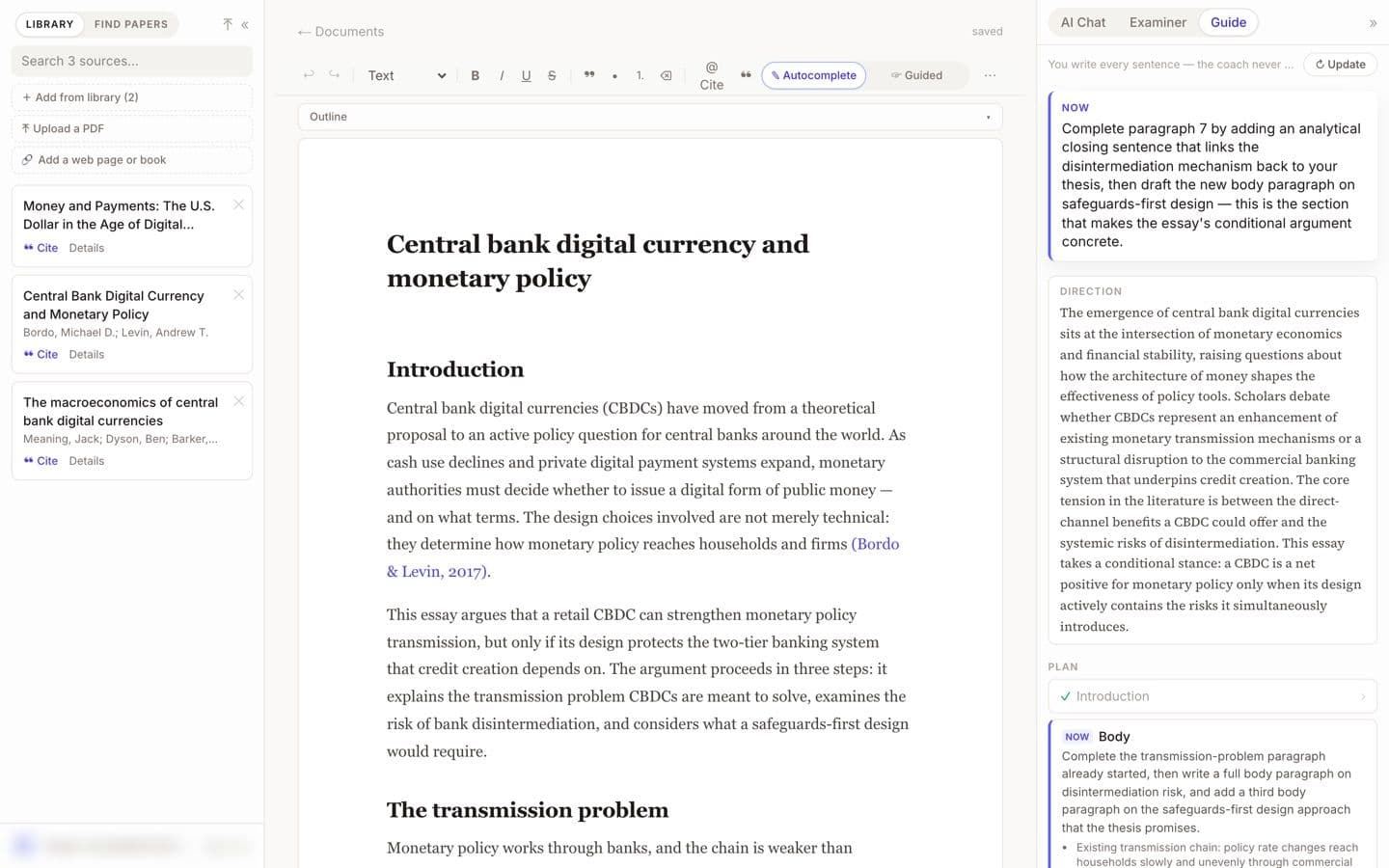
EthiWrite editor with the Guide panel open (demo account, email blurred). Best for: Students who want feedback on their argument and citations they can trace to a source they added.
2. Paperpal
Paperpal is the swap to try first if you want your editor inside Word or Google Docs. It runs as a Word add-in and as Chrome and Edge extensions that work in Google Docs and Overleaf, and its grammar and tone suggestions sit alongside 30+ pre-submission checks against journal standards and a plagiarism check against 99B+ sources.
Its Research and Cite search covers 250M+ articles and formats in 10,000+ styles, against Grammarly's three. The free plan is tight at 200 grammar edits a month, and paid prices only appear once the pricing page loads them for your region. It will also draft with suggestions grounded in your sources, so it isn't a pure editor.
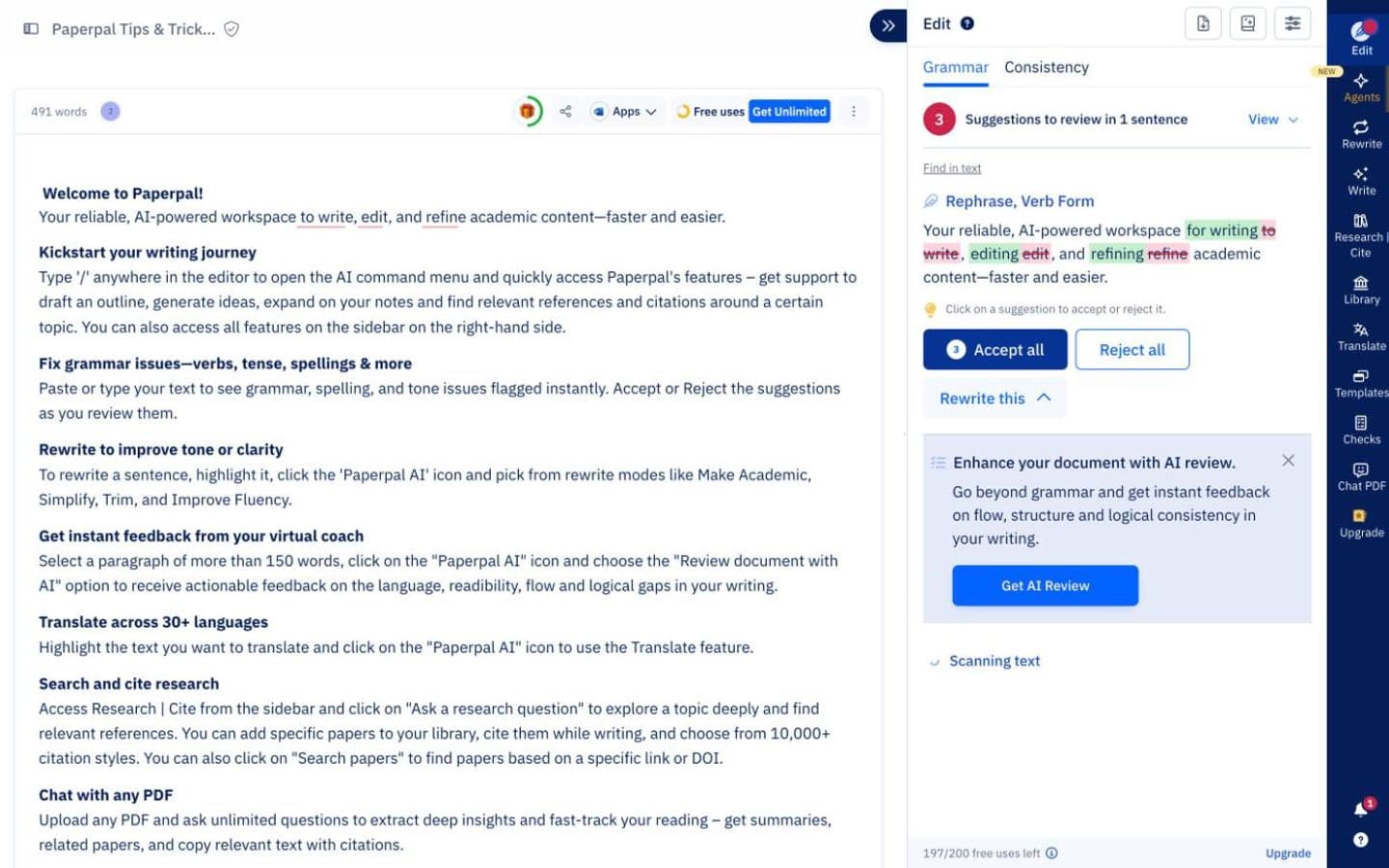
Paperpal editor on its built-in sample document, signed in to a free account. Best for: Students and researchers who want academic polish and a long list of citation styles in Word, Google Docs or Overleaf.
3. Trinka
Trinka checks grammar, punctuation and academic style, and its paid plans add style-guide corrections for APA, AMA, ACS, AGU and IEEE, and its Citation Checker tests the references you already have against Crossref, flagging retracted, hallucinated and predatory sources. That's a useful last pass before you submit.
Premium is $48 a year billed yearly, which the page shows as 40% off a listed $80, or $20 a month billed monthly. The free Basic plan gives 5,000 words of writing help a month in a lite grammar mode, and plagiarism checks run on credits, with 4 a month free. In Originality.ai's test (it sells a grammar checker of its own) Trinka caught many errors but missed misspellings such as “bussiness”.
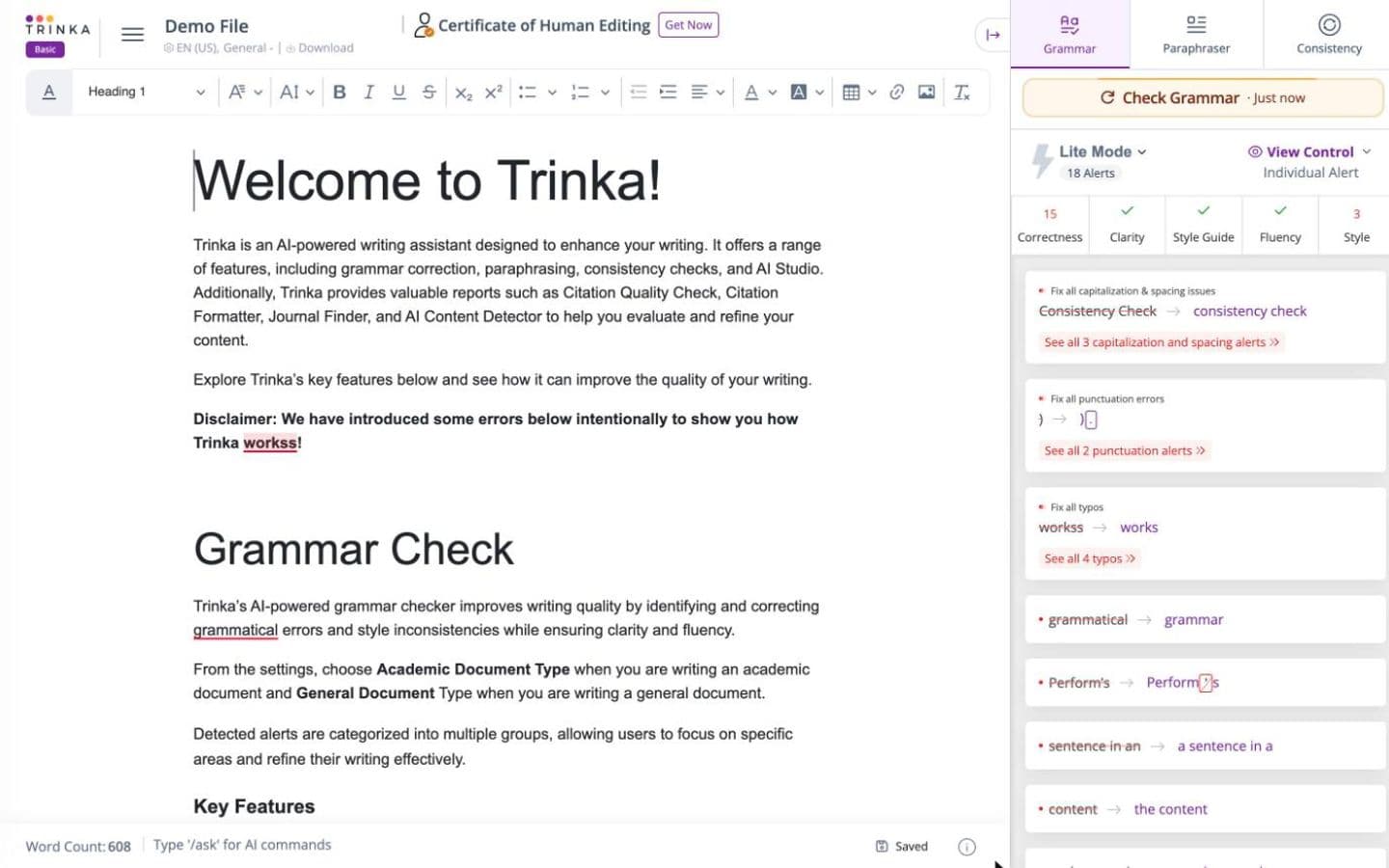
Trinka editor on its built-in demo file, signed in to a free account. Best for: Writers finishing a manuscript or thesis who need a journal style guide applied and their references checked.
4. Writefull
Writefull suits the Grammarly user who writes in LaTeX. It works inside Word and inside Overleaf, checks language directly in the LaTeX source, and its feedback comes from models trained on published papers. It says it never stores your text or uses it to train its AI, and one user's informal grammar test ranked it alongside Grammarly.
The trade-off is scope. It doesn't find, manage or format sources, and the free plan is a limited quota of each feature. Premium is US$21 a month or US$150 a year. Researchers on r/academia also report suggestions that treat mathematics as prose or twist the meaning of a sentence.
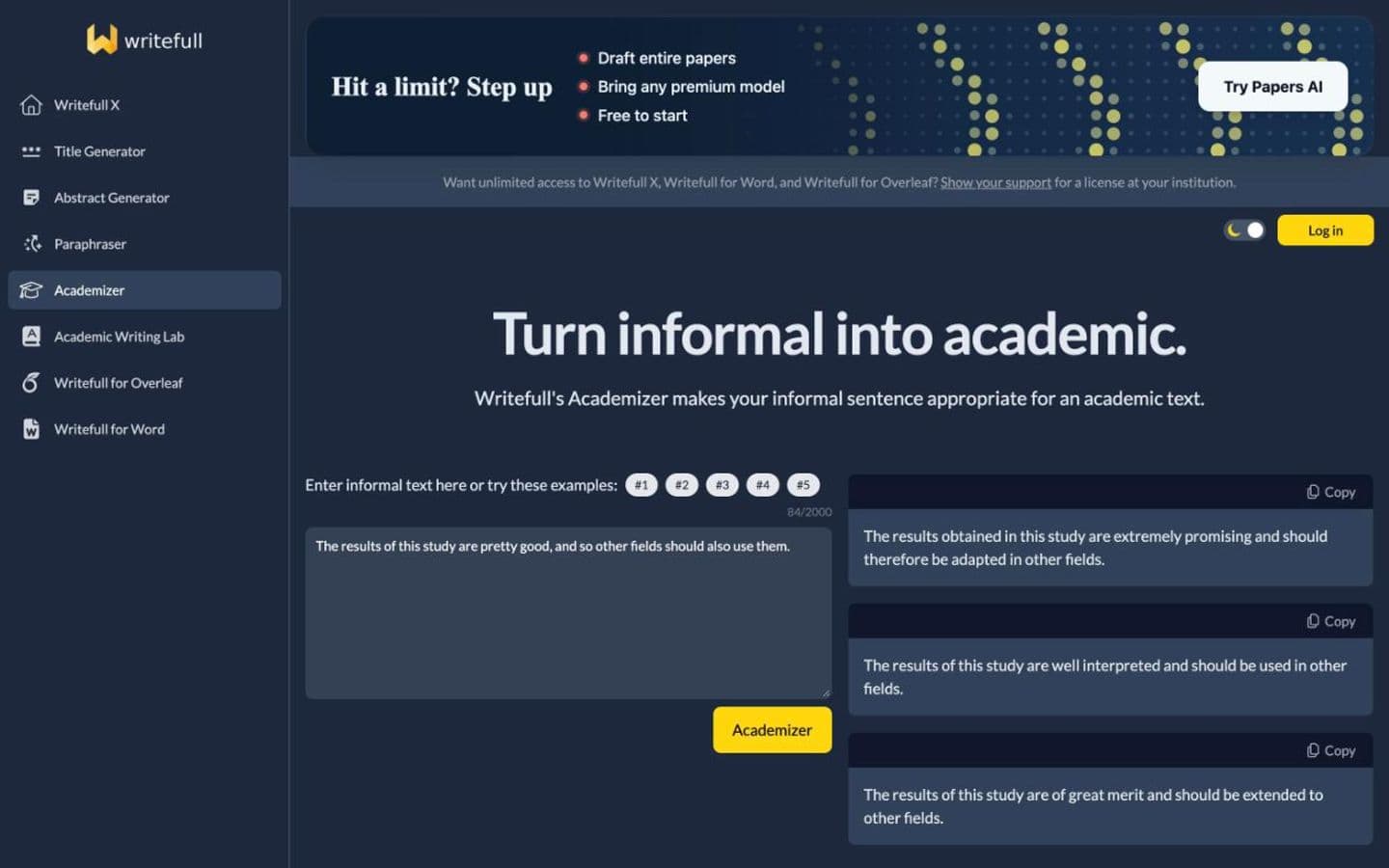
Writefull Academizer run on its own example sentence, signed out (the Word and Overleaf tools need an account). Best for: Researchers writing in Overleaf who want academic language edits on their own sentences.
5. Thesify
If AI Grader was the part of Grammarly you liked, Thesify is built around rubric feedback for long work. Its Reviewer judges a draft on thesis strength, evidence, clarity and fit with the assignment, accepts documents of up to 100,000 words, and returns a downloadable report.
Reviewer isn't free. A single review costs €14.95, or €24.95 a month buys three, and Reviewer has no free trial, so it suits a near-final draft better than daily use. A review by Manusights, which sells competing manuscript checks, called it a good fit for thesis feedback but noted it doesn't verify citations.
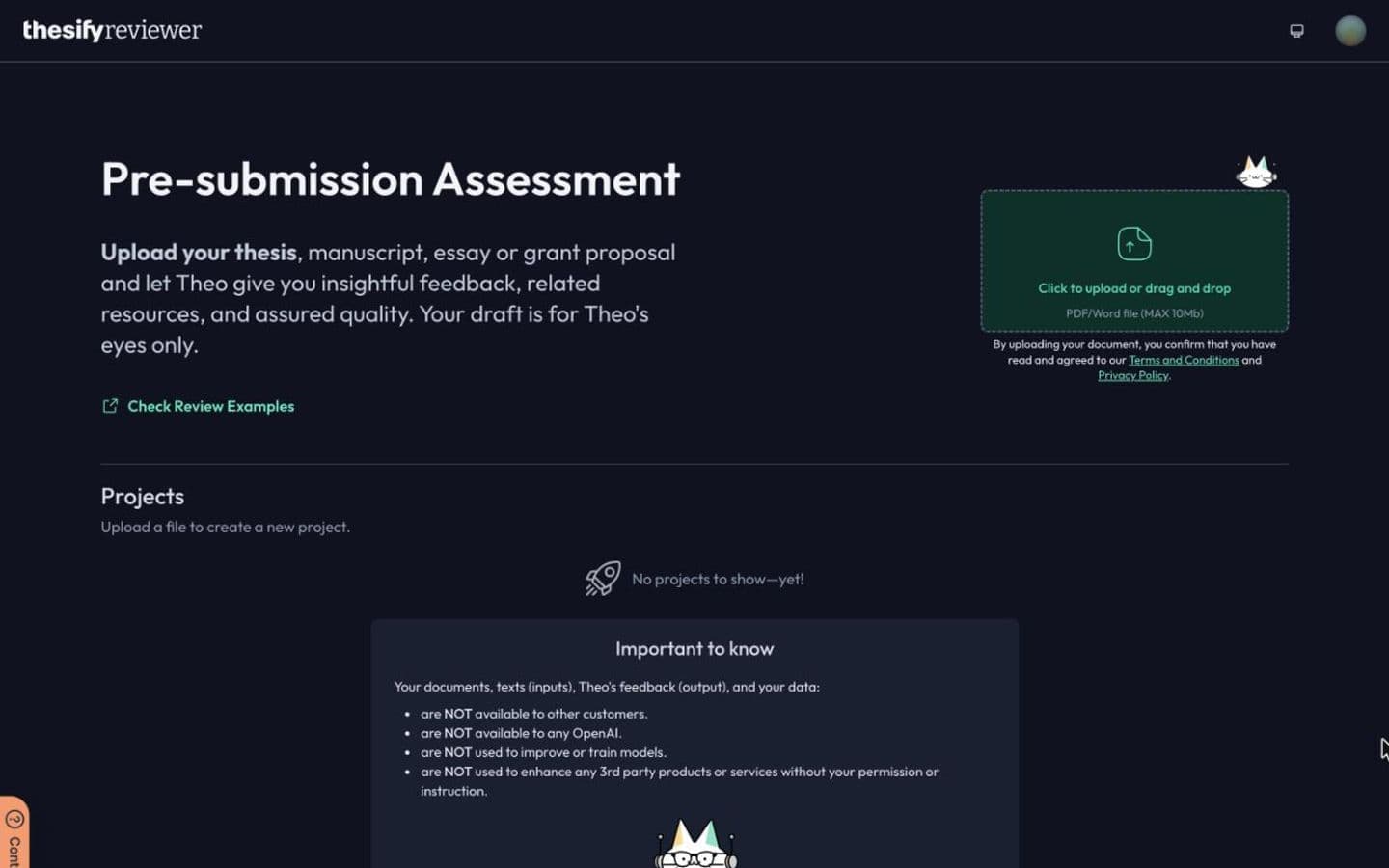
Thesify reviewer, signed in to a free account, before any document is uploaded. Best for: Graduate students who want rubric feedback on a thesis chapter before a supervisor sees it.
6. Jenni AI
Jenni AI is built around sources. You bring papers in from PDF uploads, Zotero or Mendeley, or its own search of 200M+ papers, and it ties each AI-suggested sentence to its place in the source PDF, with 10,000+ citation styles. Autocomplete can be limited to your own library.
The catch for a detector-wary student is that autocomplete writes sentences for you to accept, one after another. In GPTZero's review (GPTZero sells a detector) a 250-word introduction built mostly from accepted suggestions was flagged as AI-generated. The free plan allows 10 autocompletes a day and Plus is $12 a month; several Trustpilot reviewers report renewal charges without notice.
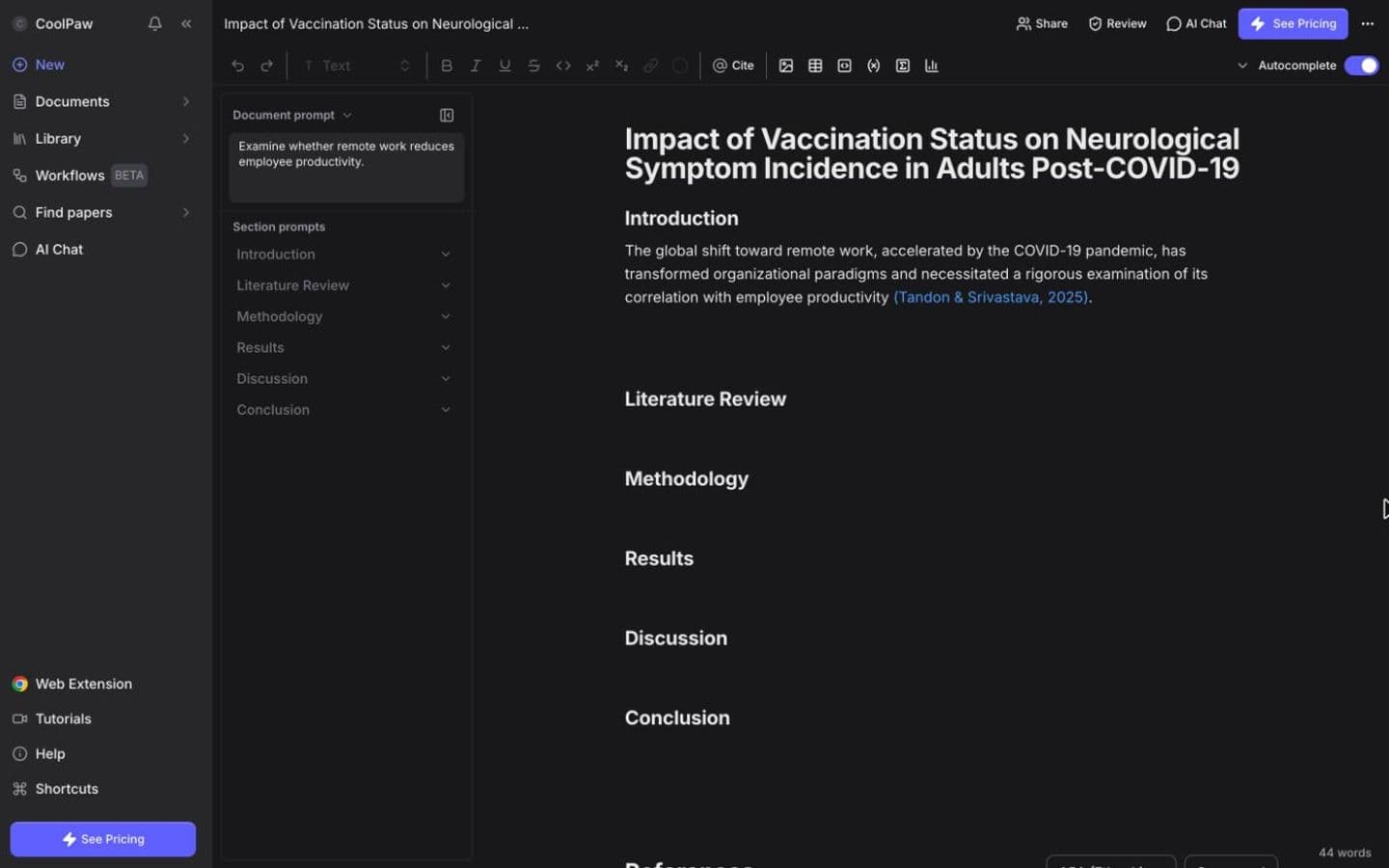
Jenni AI editor, signed in to a free account. Best for: Students who want sources at the centre of the editor and don't mind reworking AI-suggested sentences.
7. Paperguide
Paperguide belongs to the literature-review end of the work. It searches 200M+ papers across PubMed, arXiv, OpenAlex and Semantic Scholar, links every claim to the exact sentence in the source, and its reference manager imports from Zotero or Mendeley and switches between 1,000+ citation styles.
The free plan gives 2,000 AI credits a month and plagiarism checks on up to 4,000 words; Plus is $12 a month per seat, billed annually. Two caveats: its AI Writer will generate a cited draft from a research question, and its workflows are built for researchers and labs more than coursework essays.
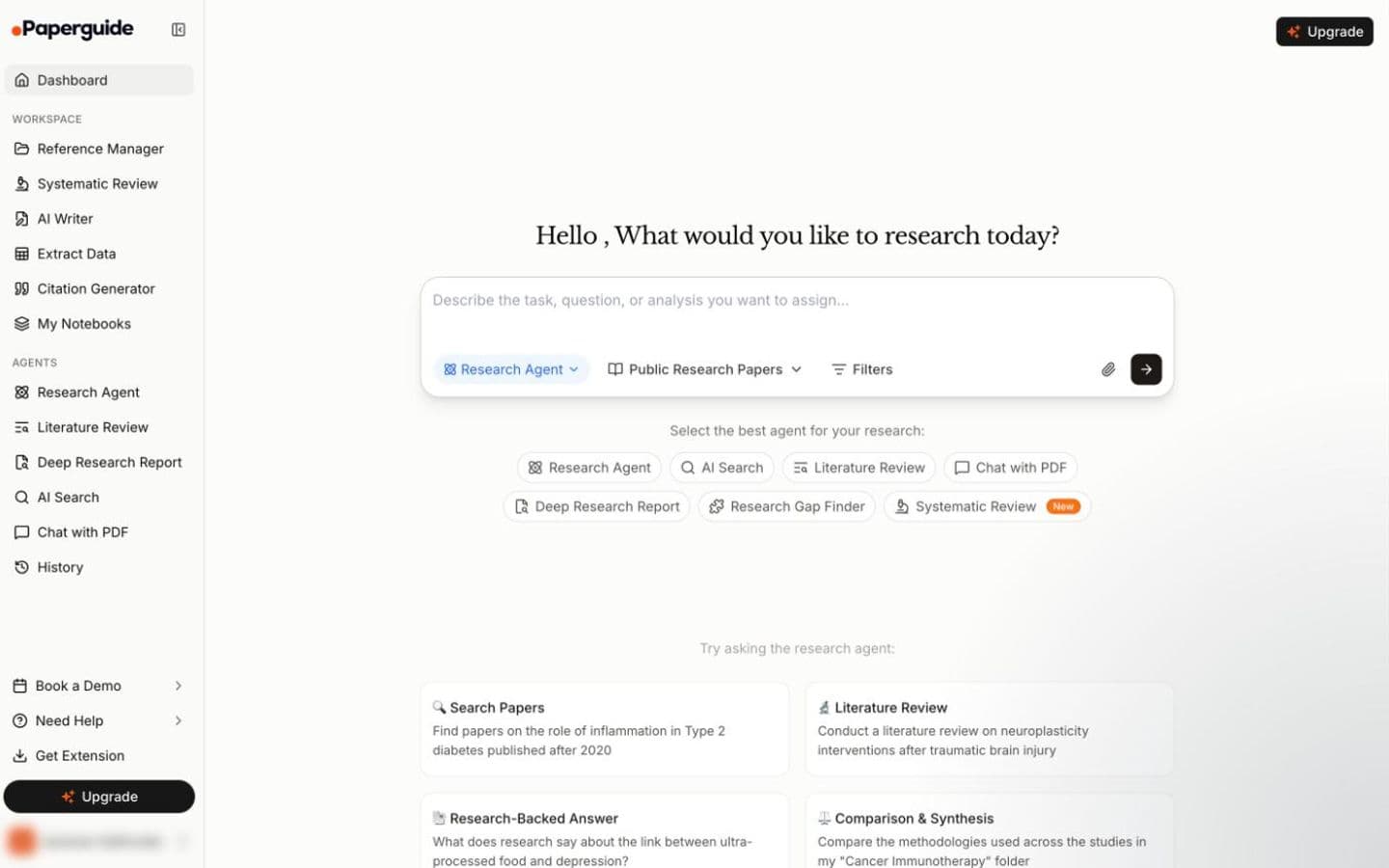
Paperguide dashboard, signed in to a free account (the account name is removed). Best for: Graduate students running a literature or systematic review.
At a glance
Every tool above, with Grammarly on the last row for reference. Writing assistants help you write; essay generators write the essay for you.
| Product | Type | Paid from | Free tier | Citations | Ghostwriting |
|---|---|---|---|---|---|
| EthiWrite | Writing assistant | $9 (billed every week) or $10/month ($120 billed annually) | Yes | Only from sources you added | Guides; you write |
| Paperpal | Writing assistant | See pricing page | Yes | Your sources, or papers it finds for you | Drafts text when asked |
| Trinka | Writing assistant | $48/year | Yes | Does not cite | Drafts text when asked |
| Writefull | Writing assistant | US$21/month | Yes | Does not cite | Drafts text when asked |
| Thesify | Writing assistant | €7.50/month | No | From its own paper database | Drafts text when asked |
| Jenni AI | Writing assistant | $12/month | Yes | Your sources, or papers it finds for you | Drafts text when asked |
| Paperguide | Writing assistant | $12/month | Yes | Your sources, or papers it finds for you | Drafts text when asked |
| Grammarly | Writing assistant | $12/month | Yes | Your sources, or papers it finds for you | Drafts text when asked |
The bottom line
Choose by what you were missing. For academic polish in the editor you already use, start with Paperpal; in Overleaf, Writefull. For a hard read of a long draft, Thesify. And if Grammarly's sources were the weak spot, move to a tool where every citation leads back to a paper you can open and read.
FAQ
- Is there a free Grammarly alternative for academic writing?
- Paperpal, Trinka, Writefull, Jenni AI and Paperguide all have free plans, and so does EthiWrite. Each is metered: Paperpal gives 200 grammar edits a month, Trinka 5,000 words of writing help, Paperguide 2,000 AI credits, Jenni 10 autocompletes a day, and Writefull a limited quota of each feature. Thesify has no free plan.
- Can Grammarly find sources for my essay?
- Partly. Citation Finder flags claims that need support, suggests web-based sources, and formats and inserts the citation. It doesn't say which databases it searches, so open each source and read it before you keep the citation.
- Will switching tools stop my work being flagged as AI?
- No tool can promise that, and Grammarly is open that its AI rewrite suggestions could get work flagged. What helps is accepting fewer rewrites and keeping a record of how you wrote. Grammarly's Authorship can be turned on in Microsoft Word, Google Docs and Canvas LMS submissions, so the record can follow you into those tools.
- Which Grammarly alternative works with LaTeX?
- Writefull checks language directly in LaTeX source inside Overleaf. Paperpal's browser extensions also support Overleaf, and Trinka works on LaTeX files.
- Is Grammarly Pro worth it for students?
- Pro adds 2,000 AI prompts a month plus plagiarism and AI-text detection, at $144 a year or $30 month to month. Trustpilot reviewers are split on billing: some describe renewal charges without warning and refused refunds, others got refunds quickly. If academic polish is what you'd be paying for, try an academic editor's free plan first.