Alternatives
Trinka alternatives for students and researchers in 2026
Trinka checks the English, the style guide and the reference list of a paper you've already written. What it isn't built for is the work before that: it doesn't find sources or structure an argument. So the right alternative depends on whether you want a different editor or help with the work Trinka leaves to you.
For another academic editor, Paperpal is the closest match and Writefull suits LaTeX. For the earlier work, EthiWrite (which we make) and Thesify review the argument, and Paperguide, Jenni AI and Yomu AI bring in papers for you.
Prices and features checked on October 17, 2026.
Where Trinka stops
The free Basic plan never expires, but the volume is low: 5,000 words of writing help a month in lite grammar mode, 5 AI writing requests and 4 credits. Plagiarism checks, the AI detector and the citation tools all spend credits, so four don't go far. Those free limits are also what Trustpilot reviewers complain about most.
Accuracy isn't perfect either. Originality.ai, which sells a grammar checker of its own, found that Trinka caught many basic and advanced errors but let through misspellings such as “atract” and some grammar mistakes. One test isn't a verdict, but it's a reason to keep proofreading yourself.
The bigger reason is scope. Trinka works on what you've already written, and its citation tools check and format references you already have rather than supplying new ones. It does offer “Write & Rewrite with AI”, capped by a monthly number of requests (25 on Premium), but if you're stuck before the draft exists, that won't get you far.
Within that scope it's good value. Premium is $48 a year billed yearly (monthly billing exists but isn't priced on the page), with style-guide corrections for APA, AMA, ACS, AGU and IEEE, and the Citation Checker flags retracted, hallucinated and predatory references against Crossref. Trustpilot reviewers credit it with improving the grammar and academic tone of manuscripts and theses, and a Confidential Data plan promises no data storage and no AI training on your text.
What to look for in a Trinka alternative
Help before the draft exists
If what you're missing is a source or a structure, judge a replacement on that, not on its grammar engine. Ask whether it can search papers, keep a library you reuse, and tell you where your argument is thin.
Where new references come from
Trinka checks references you supply. Tools that also find papers differ on where they look: Paperpal, Paperguide and Jenni AI each search their own paper index as well as citing what you upload. Whichever you use, open the paper before you cite it.
How the allowance is counted
Credit systems make a month's cost hard to predict. Trinka spends credits on plagiarism and citation tools, Paperguide meters its AI in credits, and Yomu AI's Pro plan caps AI actions at 1,000 a month. Work out which feature you'd use daily, then check how far the allowance stretches.
The best Trinka alternatives
1. EthiWrite
Full disclosure: this is our tool.
EthiWrite covers the part Trinka leaves to you: getting from sources to an argument. Your Library takes uploaded PDFs, papers from the open OpenAlex index, web pages and books, and citations can only come from it, so a claim nothing supports gets an empty result instead of an invented reference. Examiner Mode then maps the argument and flags unsupported claims, thin evidence and structural gaps.
The free plan needs no card, and uploading sources, searching papers, citing and export are never metered. Know its limit: paper search covers one index, OpenAlex, rather than a commercial database, while Paperguide (below) searches PubMed, arXiv and Semantic Scholar as well. Keep Trinka for the final language pass.
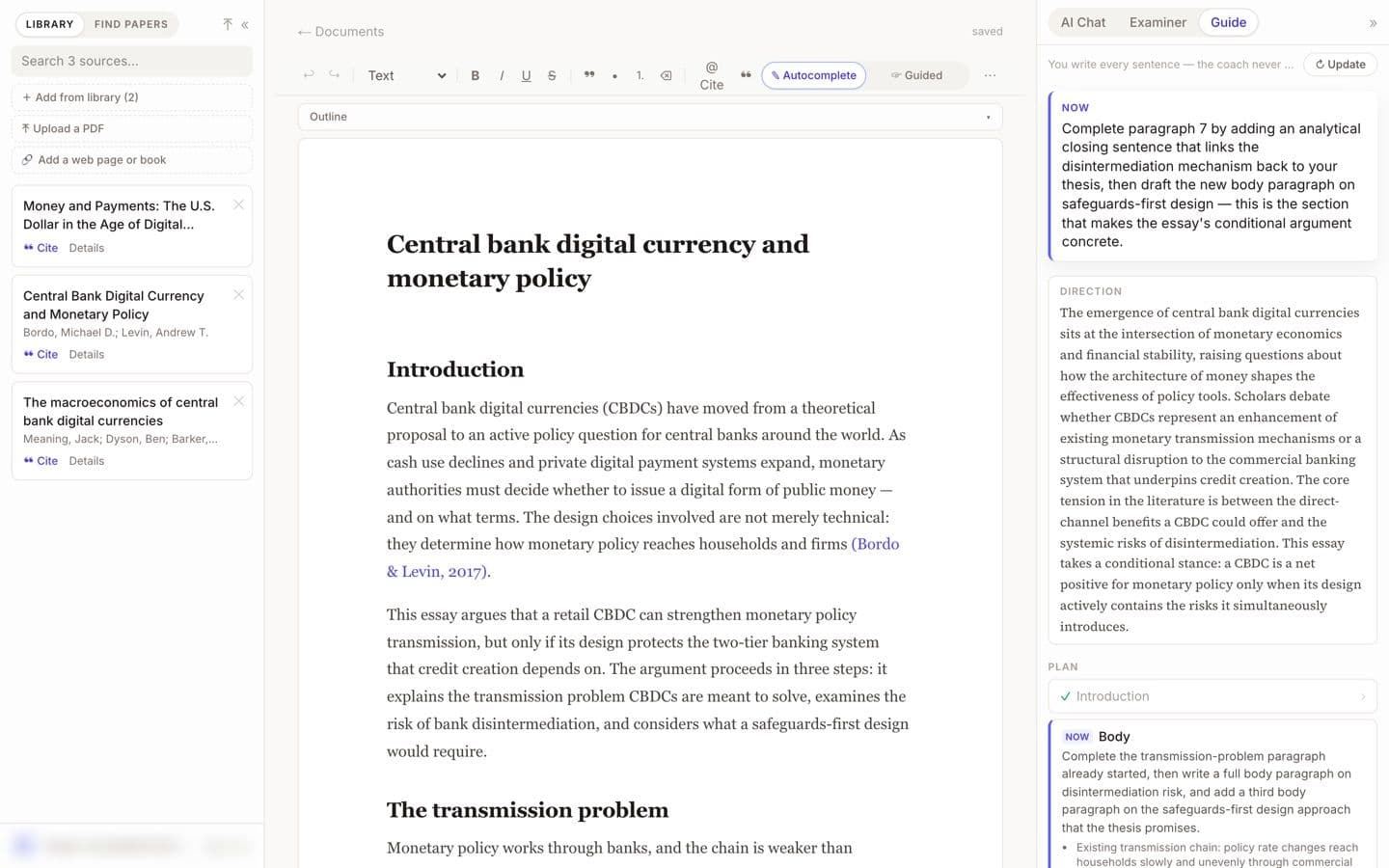
EthiWrite editor with the Guide panel open (demo account, email blurred). Best for: Students who need help finding, citing and arguing from sources before the language pass.
2. Paperpal
Paperpal is Trinka's nearest rival, with research built in. Next to grammar suggestions trained on scholarly edits and 30+ pre-submission checks, its Research and Cite searches 250M+ articles, extracts insights from PDFs and generates citations in 10,000+ styles, where Trinka only works on references you bring. It runs as a Word add-in and as Chrome and Edge extensions for Google Docs and Overleaf.
The free plan counts edits rather than words: 200 grammar edits a month plus five a day of the AI writing tools. Paid prices can't be compared in advance, because the pricing page shows none until it loads them for your region. And it will draft for you from your sources.
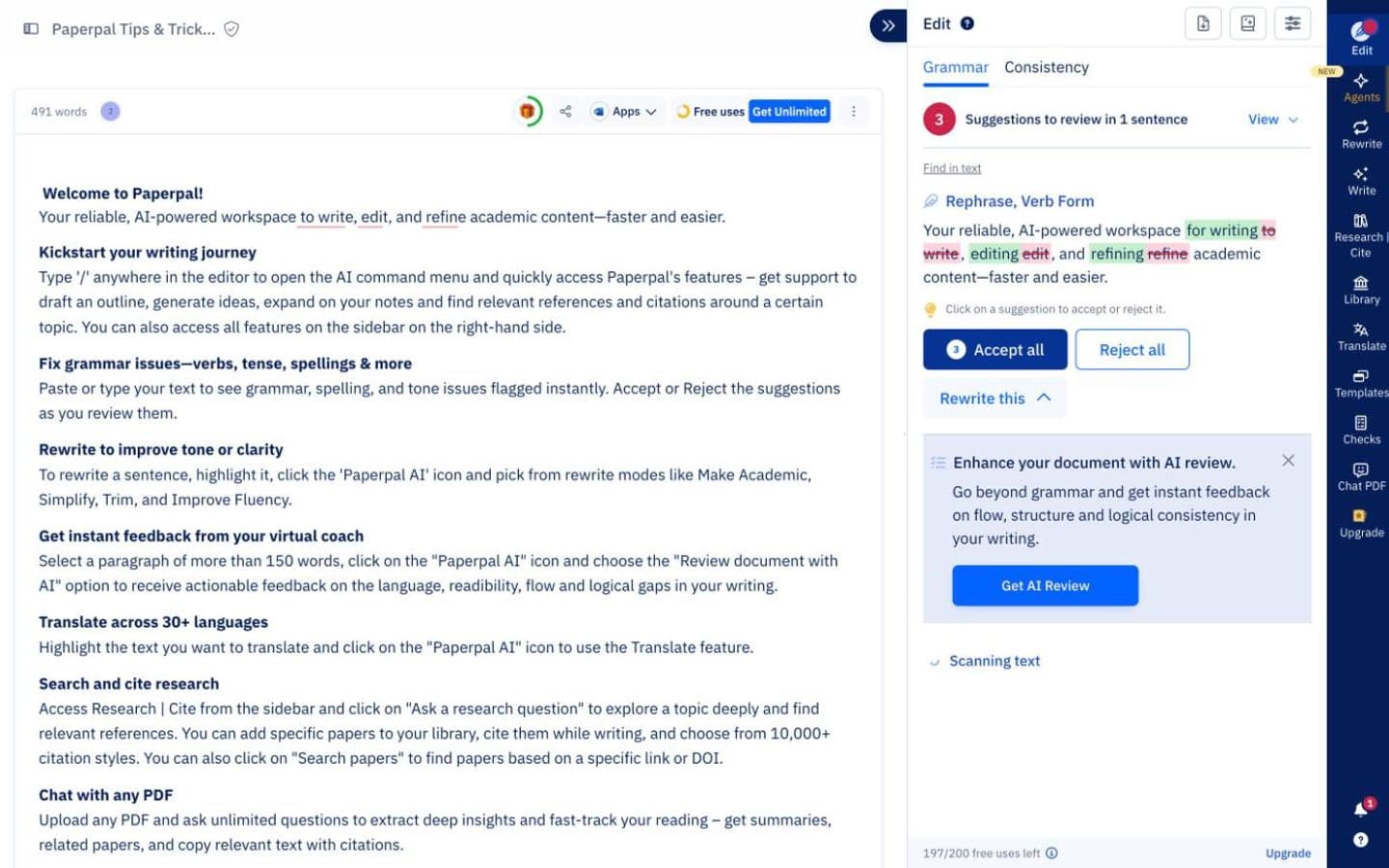
Paperpal editor on its built-in sample document, signed in to a free account. Best for: Researchers who want Trinka-style polish plus a paper search and a long list of citation styles.
3. Writefull
Writefull is the editor to pick if Overleaf is where you write. It checks language directly in the LaTeX source there, can generate LaTeX tables and equations, and also works in Word. Its feedback runs on models trained on published papers; it says it doesn't store your text or train its AI on it.
Like Trinka it doesn't find sources, and unlike Trinka it doesn't check or format references either; Writefull Cite, which flags sentences missing a citation, is sold to institutions only. Premium is US$21 a month or US$150 a year, so a year costs more than Trinka Premium's $48.
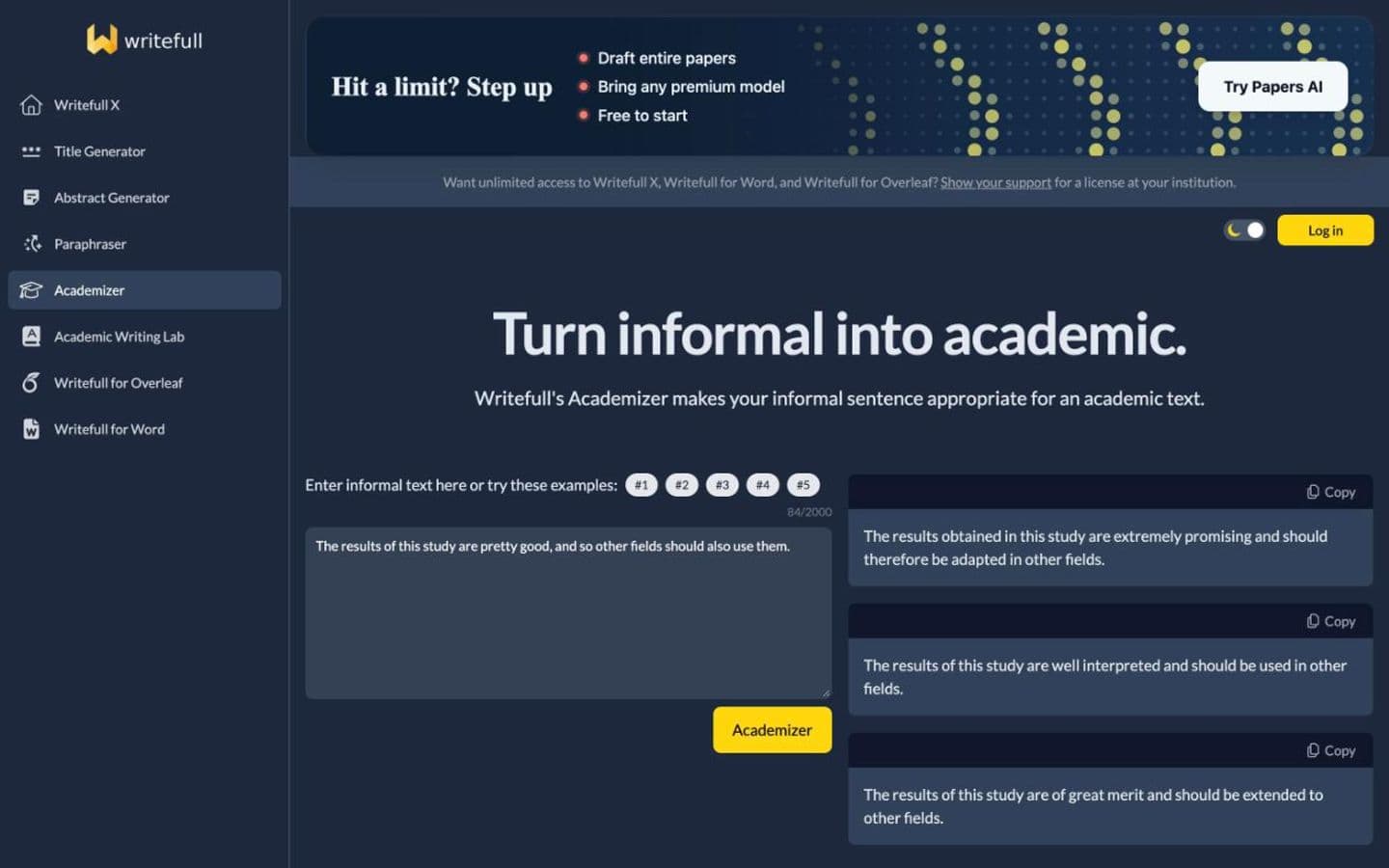
Writefull Academizer run on its own example sentence, signed out (the Word and Overleaf tools need an account). Best for: LaTeX writers who want academic language edits made directly in Overleaf.
4. Thesify
Trinka tells you whether a sentence is correct; Thesify tells you whether the chapter works. Its Reviewer evaluates thesis strength, evidence, clarity and alignment with the assignment, takes documents of up to 100,000 words, and returns a downloadable report. You can also highlight text to search 200+ million references and add citations to the draft.
It costs per review: €14.95 for one, €39.95 for three, €99.95 for ten, or €24.95 a month for three with unused reviews rolling over. Reviewer has no free trial. Commenters on Andy Stapleton's YouTube walkthrough (he's quoted as an endorser on Thesify's homepage) found the rubric feedback useful on early drafts.
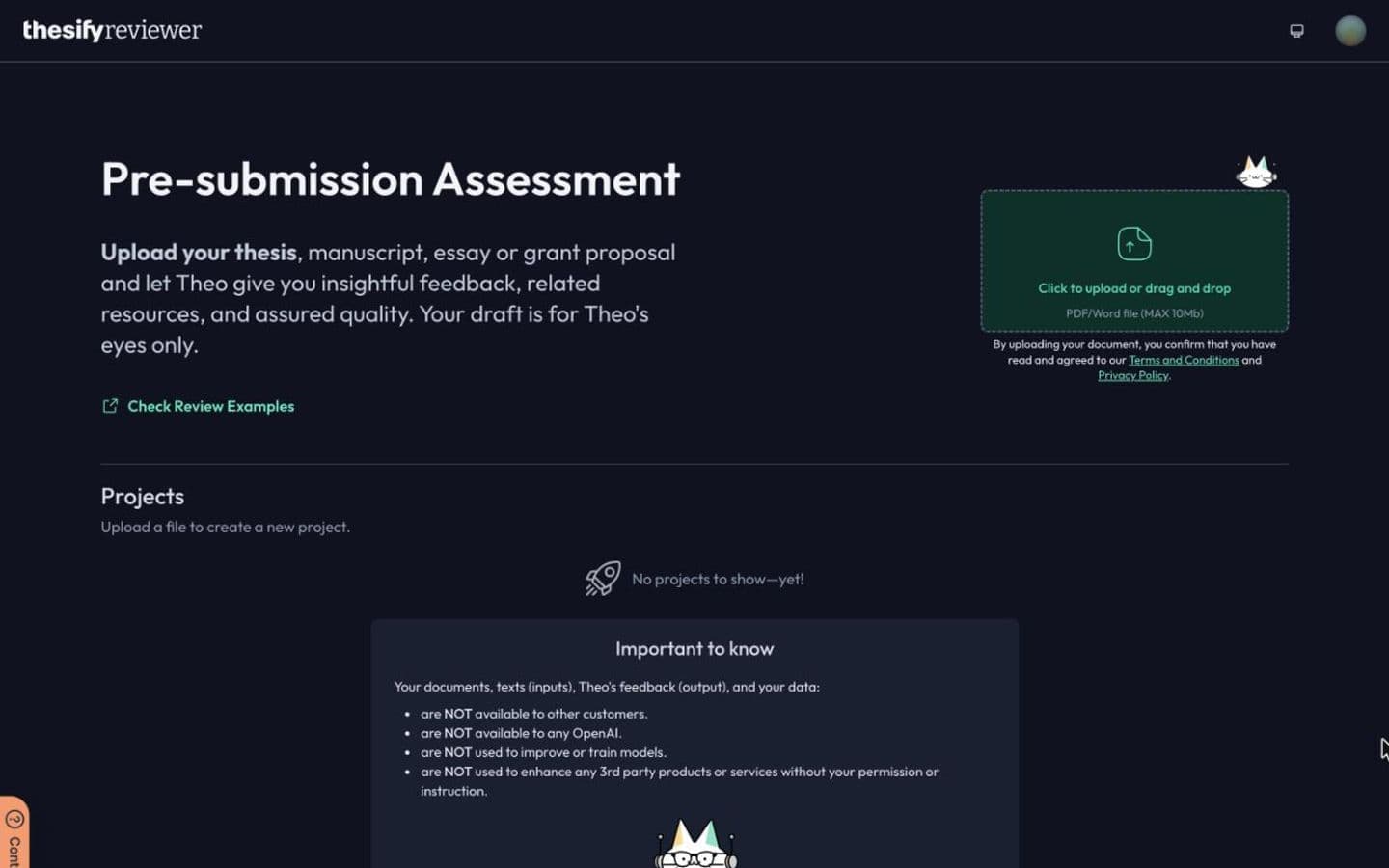
Thesify reviewer, signed in to a free account, before any document is uploaded. Best for: Graduate students who want rubric feedback on a chapter, with Trinka kept for the final language pass.
5. Paperguide
Paperguide fills Trinka's biggest gap, finding sources, at research scale. It searches 200M+ papers across PubMed, arXiv, OpenAlex and Semantic Scholar plus your own library, links every claim to the exact sentence it came from, and its reference manager imports from Zotero or Mendeley and switches between 1,000+ citation styles.
Free gives 2,000 AI credits a month and 4,000 words of plagiarism checks; Plus is $12 a month per seat, billed annually. Its workflows centre on literature and systematic reviews rather than coursework essays, and the AI Writer will generate a draft from a research question. On Trustpilot, a doctoral student reports frequent errors and crashes, and another reviewer says PDF uploads are slow.
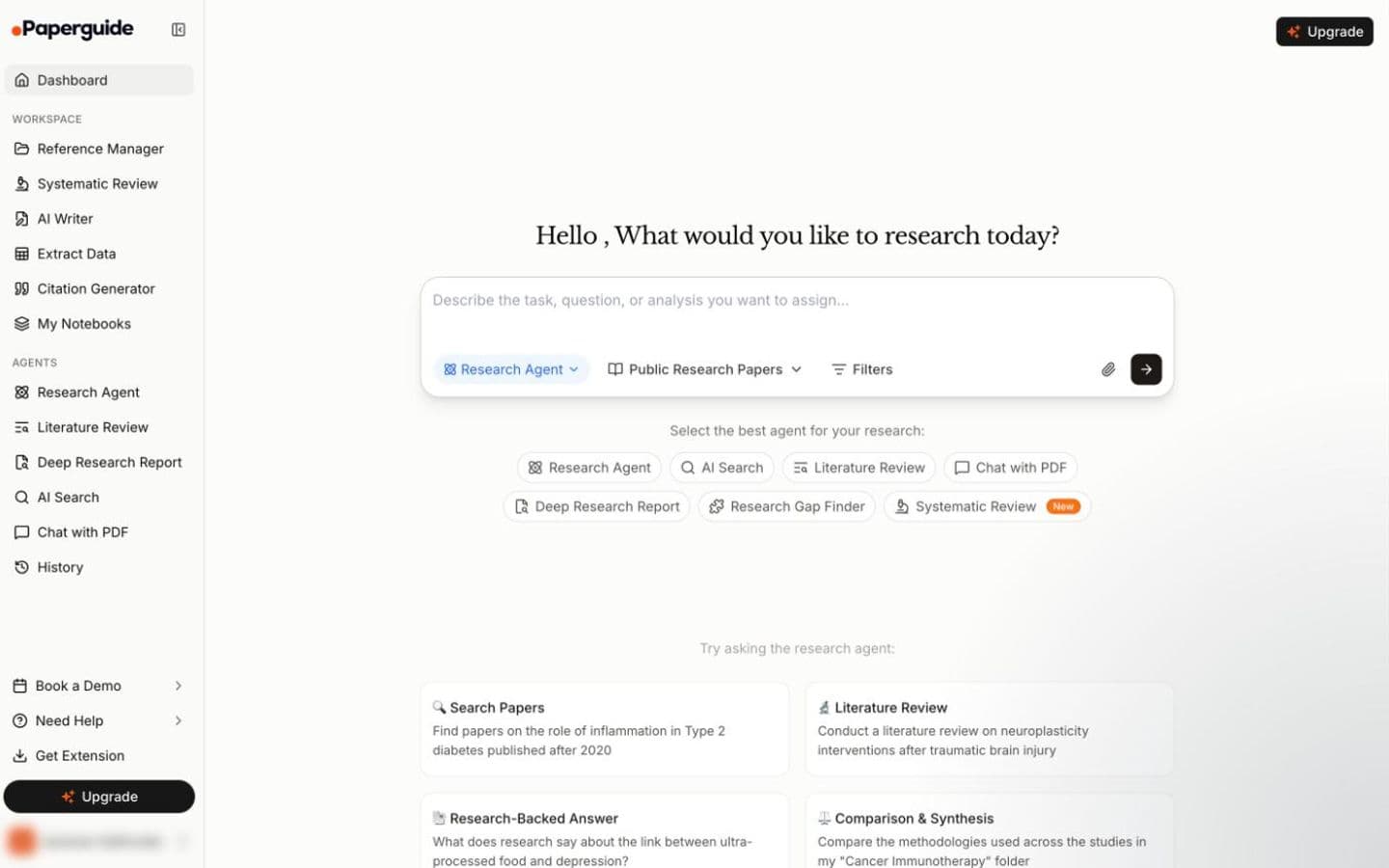
Paperguide dashboard, signed in to a free account (the account name is removed). Best for: Graduate students building a literature review who need to find and organise papers.
6. Grammarly
Grammarly is the generalist here, and its free docs editor includes tools aimed squarely at coursework. AI Grader estimates a grade from your rubric with personalized feedback, Reader Reactions shows where readers may get confused, and Authorship records how you wrote, with a report you choose whether to share.
Free use is metered, with AI Grader at three pieces of feedback a day, and Pro is $144 a year or $30 month to month, three times Trinka Premium's yearly price. Its Citation Finder suggests web-based sources in APA, MLA or Chicago only. Grammarly also warns that using its AI rewrite suggestions could get your work flagged for AI use.
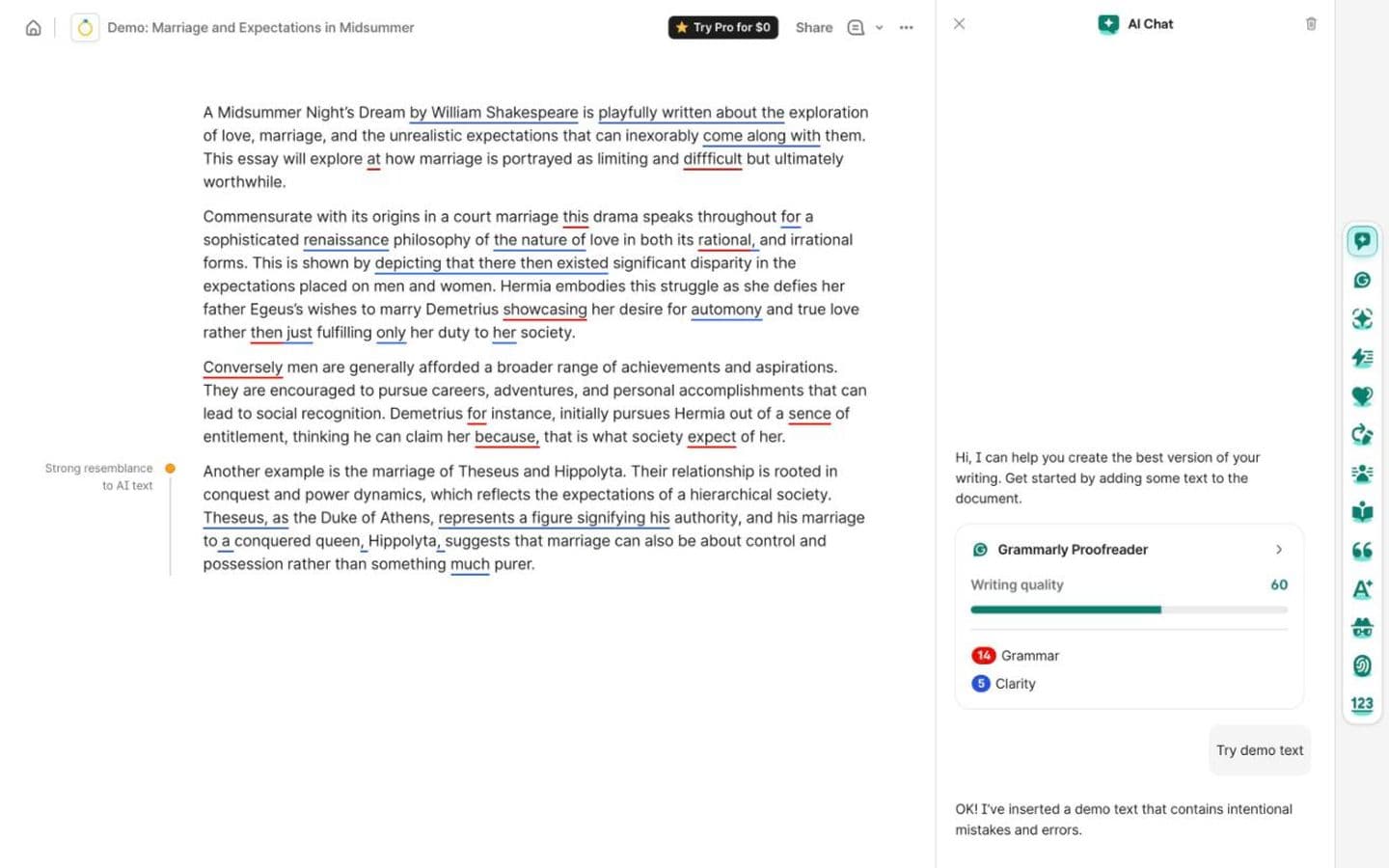
Grammarly doc with Grammarly's built-in demo essay, signed in to a free account. Best for: Students who want rubric feedback and a record of how they wrote, on a free plan.
7. Jenni AI
Jenni AI is a writing editor with sources built in. You bring papers from PDF uploads, Zotero or Mendeley, or its own search of 200M+ papers, and its AI chat reads that library and answers with citations. It formats in 10,000+ styles and links each AI-suggested sentence back to the source PDF.
Its autocomplete writes sentences for you to accept, one after another, so decide how much of that your course allows. The free plan is small (10 autocompletes a day, 5 chat messages, 3 Reviews), Plus is $12 a month and Pro $29. Billing is the most common complaint on Trustpilot.
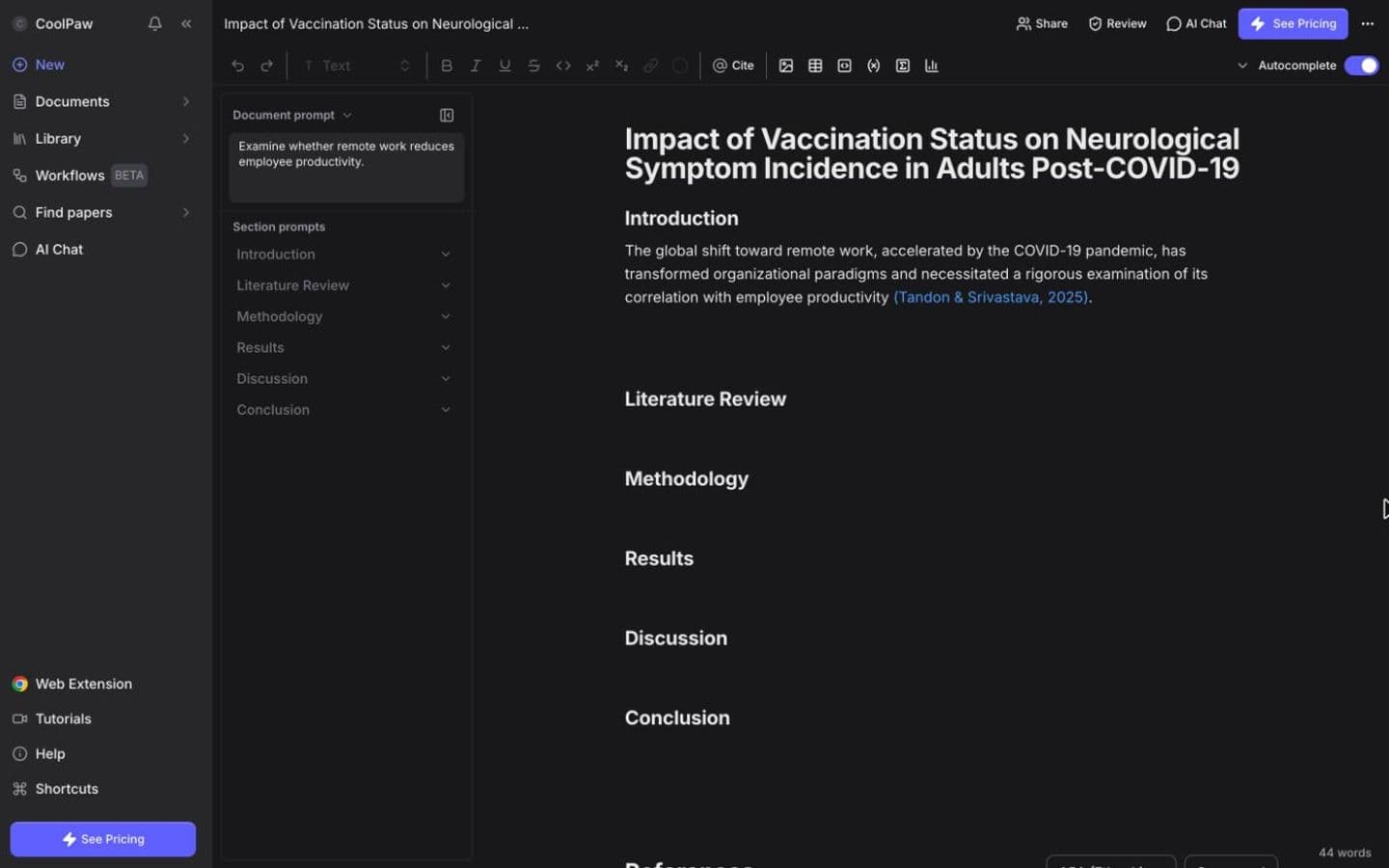
Jenni AI editor, signed in to a free account. Best for: Students who want a paper library and an AI co-writer in one editor.
8. Yomu AI
Yomu AI is an academic writing editor with a source library you reuse across documents, citation search powered by Sourcely in 700+ styles, chat with PDFs, and a Get Feedback review whose suggestions you can preview and apply. Paid plans let you choose models from several AI providers.
It writes for you by design: the new-document flow “writes a full, researched draft”. You won't find a free editor plan on its pricing page, though the FAQ says you can try it free first. Pro is $10 a month billed annually ($120 a year) or $21 month to month, capped at 1,000 AI actions; Ultra is unlimited.
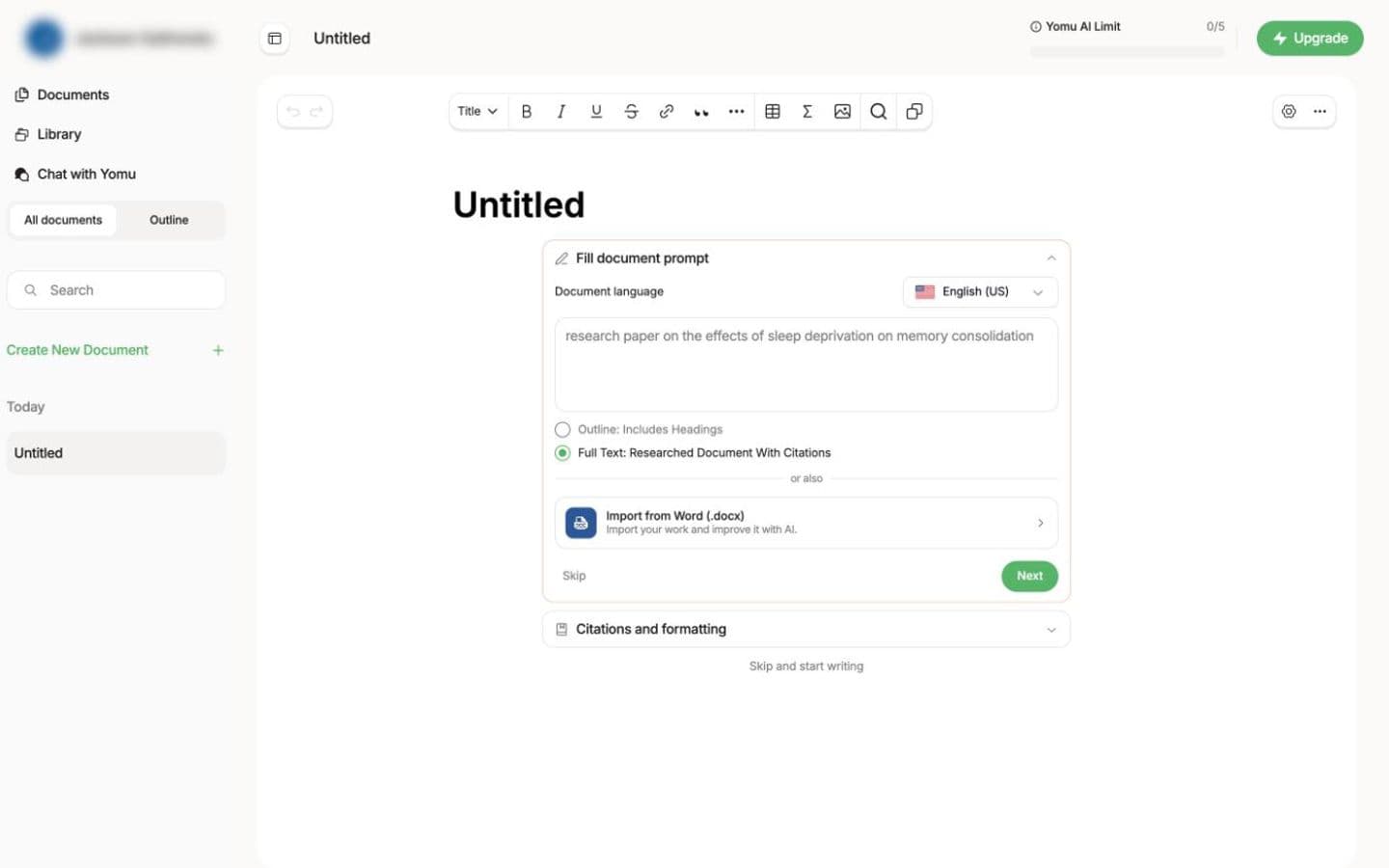
Yomu AI new-document screen, signed in to an unpaid account (its pricing FAQ says you can start for free to try it; the account name is blurred). Best for: Students who want drafting, citations and feedback in one editor and accept that it writes for them.
At a glance
Every tool above, with Trinka on the last row for reference. Writing assistants help you write; essay generators write the essay for you.
| Product | Type | Paid from | Free tier | Citations | Ghostwriting |
|---|---|---|---|---|---|
| EthiWrite | Writing assistant | $9 (billed every week) or $10/month ($120 billed annually) | Yes | Only from sources you added | Guides; you write |
| Paperpal | Writing assistant | See pricing page | Yes | Your sources, or papers it finds for you | Drafts text when asked |
| Writefull | Writing assistant | US$21/month | Yes | Does not cite | Drafts text when asked |
| Thesify | Writing assistant | €7.50/month | No | From its own paper database | Drafts text when asked |
| Paperguide | Writing assistant | $12/month | Yes | Your sources, or papers it finds for you | Drafts text when asked |
| Grammarly | Writing assistant | $12/month | Yes | Your sources, or papers it finds for you | Drafts text when asked |
| Jenni AI | Writing assistant | $12/month | Yes | Your sources, or papers it finds for you | Drafts text when asked |
| Yomu AI | Writing assistant | $10/month | No | Your sources, or papers it finds for you | Writes the essay |
| Trinka | Writing assistant | $48/year | Yes | Does not cite | Drafts text when asked |
The bottom line
If Trinka's checks are what you need, stay: $48 a year is a fair price for polishing a finished manuscript. If what's missing is the earlier work (finding papers, organising them, testing the argument), add a tool built for that stage and keep Trinka for the final pass: Paperguide for a literature review, Thesify for feedback on a thesis.
FAQ
- What do Trinka's paid plans add?
- Premium ($48 a year billed yearly) gives you full writing help, all grammar and paraphrase modes, style guides and 25 AI writing requests a month. Premium Plus ($125 a year) doubles the credits and adds 240 pages a year of standard plagiarism checks and 1,000 AI writing requests a month. Confidential Data ($300 a year) adds instant data deletion, no AI training and an offline grammar app.
- Can Trinka find sources for me?
- No. It doesn't supply sources; its Citation Checker and Citation Formatter work on references you already have. To find papers, Paperguide and Paperpal search their own indexes, and Thesify lets you highlight text in your draft to search for references.
- Is Trinka better than Grammarly for academic writing?
- It depends on the job. Trinka's paid plans correct to APA, AMA, ACS, AGU and IEEE style guides, and its Citation Checker tests your references against Crossref; Grammarly's Citation Finder formats new citations in APA, MLA or Chicago only. Grammarly's free docs editor offers a predicted grade and a writing record instead. Pick by which of those you'd actually use.
- Does Trinka work with LaTeX?
- Yes. It works on LaTeX files, as well as in Microsoft Word, the browser and a Windows app. Writefull runs inside Overleaf itself and checks the LaTeX source there.
- Which alternative helps with structure, not just language?
- Thesify's Reviewer judges thesis strength and evidence on long documents, and EthiWrite's Examiner Mode flags structural gaps and unsupported claims without rewriting anything. You can pair either with Trinka for the language.