Compare
Paperguide vs Writefull: which belongs in your research workflow?
Say you're writing up a literature review in Overleaf. Paperguide can do the reading side: search, screening, extraction, citations. Writefull can do the language side: checking your sentences inside the LaTeX source with models trained on published papers. They're built for different halves of the work.
So this is less a contest than a question of which gap you have. If you can't find or keep track of your sources, Paperguide. If your sources are sorted and your English is the worry, Writefull.
Prices and features checked on October 16, 2026.
At a glance
Writing assistants help you write; essay generators write the essay for you.
| Product | Type | Paid from | Free tier | Citations | Ghostwriting |
|---|---|---|---|---|---|
| Paperguide | Writing assistant | $12/month | Yes | Your sources, or papers it finds for you | Drafts text when asked |
| Writefull | Writing assistant | US$21/month | Yes | Does not cite | Drafts text when asked |
Citations: one manages them, one doesn't touch them
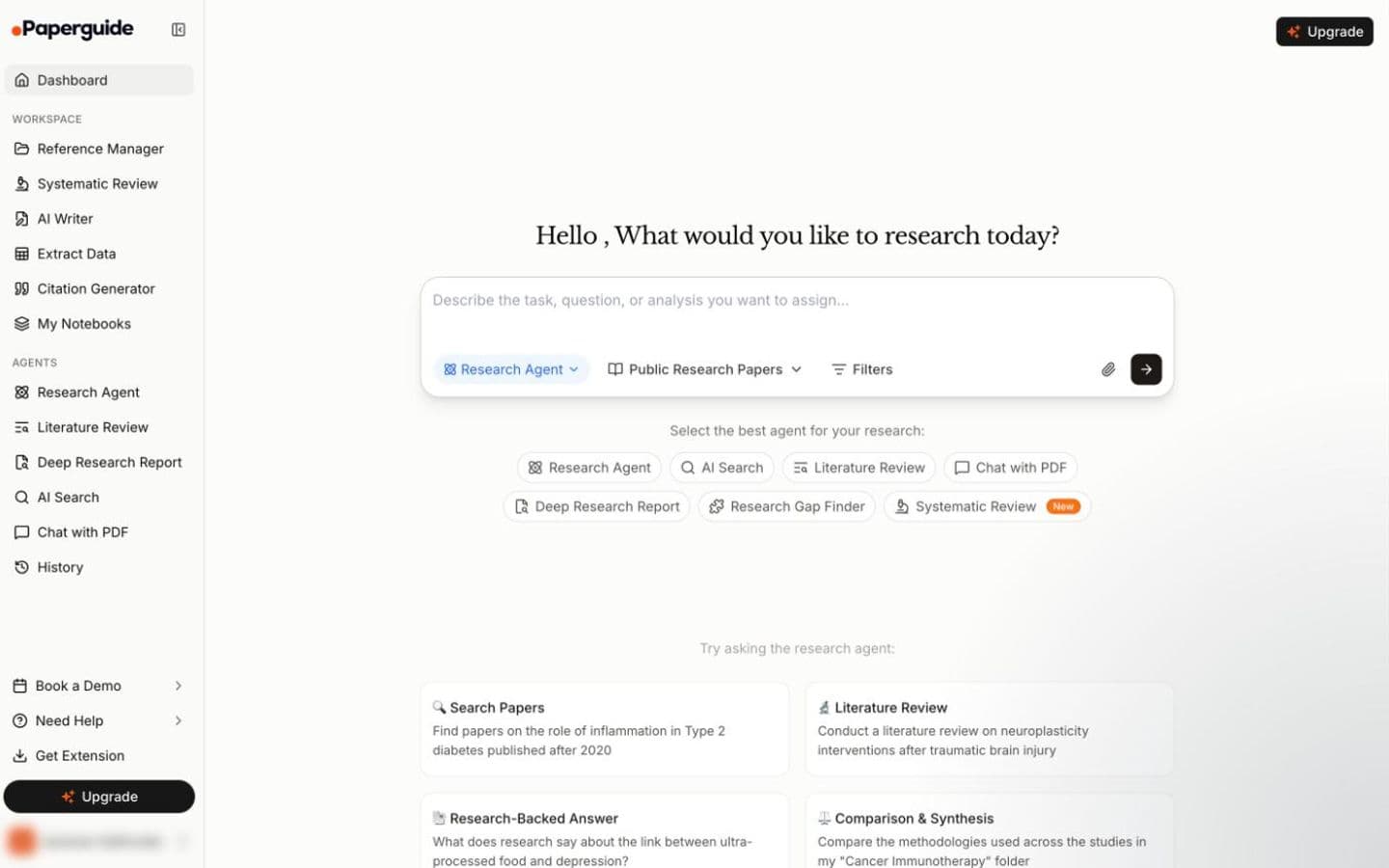
Paperguide is built around its reference manager. It imports from Zotero or Mendeley, switches between 1,000+ citation styles, and its search reaches 200M+ papers drawn from PubMed, arXiv, OpenAlex and Semantic Scholar. Claims link back to the specific sentence in the paper.
Writefull is a language tool and doesn't find, manage or format sources. Its one citation feature, Writefull Cite, flags sentences that need a citation but have none, and it's sold to institutions only. If your university has it, it's a handy check for claims that are missing a reference. If not, you'll need a reference manager anyway.
Who drafts what
Paperguide's AI Writer drafts from a research question, with citations attached, and it says AI-written passages never get invented references. You can also write it yourself with the agent alongside you.
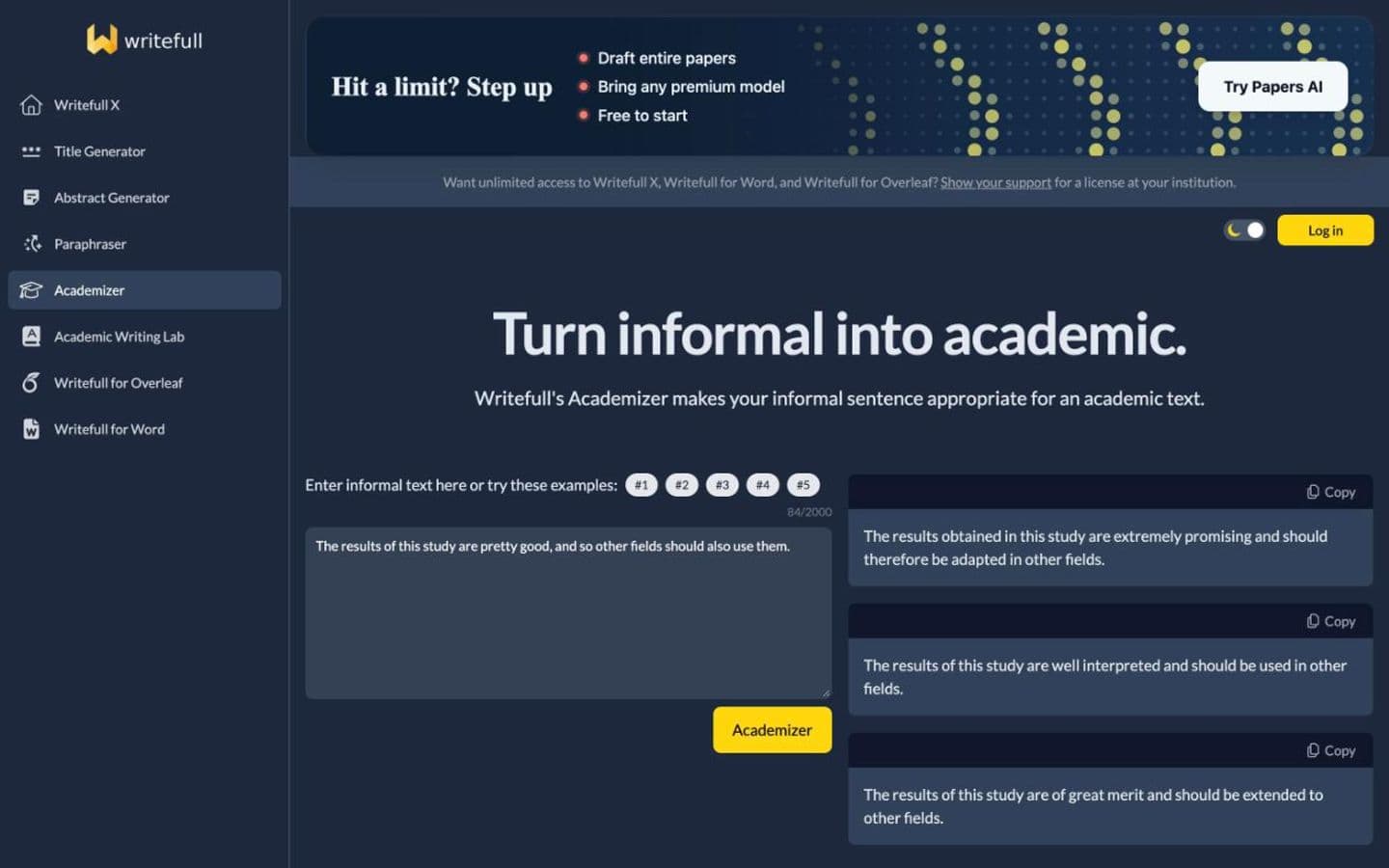
Writefull mostly edits your own sentences. Its Abstract Generator, Title Generator and Ask AI produce new text when asked, and its site now promotes a separate Papers AI product to “Draft the whole manuscript”. So both will produce text if you ask, but Writefull's core is still the language checker.
Feedback on the writing
Writefull's models learned from published papers and are tuned for academic writing. Inside Overleaf it reads the LaTeX source itself and will generate tables and equations for you. In one discussion, LaTeX users liked that it understands Overleaf source, while others found it correcting maths as prose, imposing a serial comma on British English, or twisting meaning.
Paperguide's feedback, such as it is, concerns your evidence. Dual independent screening for systematic reviews, a PRISMA diagram built from the review's own counts, and an extraction table where every value links back to its statement. Its free plan also includes plagiarism checks up to 4,000 words a month.
Reviewers praise Paperguide's literature search, extraction and Systematic Review features. The complaints are about stability: frequent errors and crashes for a doctoral student on an annual plan, and slow PDF uploads for another.
Privacy
Writefull says it never stores your text or uses it to train its AI, and asks consent before sending text to third-party AI services. If you're polishing unpublished results, that's worth weighing. Nothing on this page describes Paperguide's data policy, so read it before uploading anything sensitive.
Prices for one person and for a lab
For one person on annual billing, Paperguide Plus comes in $6 under Writefull Premium: $12 a month per seat, billed annually, is $144 a year, against US$150. Writefull also sells Premium month to month at US$21. Paperguide says annual billing comes 41% cheaper than monthly.
For a lab, the shapes differ. Writefull's Group plan is US$285 a year for two seats as shown, for up to 100 users, billed annually only. Paperguide prices per seat, billed annually: Pro at $29 a month and Evidence Teams, with dual-reviewer screening, at $89.
Both have free plans. Writefull's is a limited quota of each feature, and some users hit the daily quota quickly. Paperguide's gives 2,000 AI credits a month shared across the Research Agent, reports and AI Writer.
Which should you choose?
Choose Paperguide if the work is finding, screening and citing papers, especially for a systematic review, and you want claims tied to source sentences.
Choose Writefull if you've written the text and want academic language edits in Word or Overleaf from a tool that says it doesn't store your text. Try the free quota first.
A coursework essay is a different job from a paper, and it's the one EthiWrite, which we make, is built for. It gives feedback on your argument through Examiner Mode, which flags thin evidence and never rewrites your text. Every Quota is finite, though, and the free Plan puts a cap on the Sources your Library can hold.
FAQ
- Does Writefull work in Overleaf?
- Yes. It checks language directly in LaTeX source in Overleaf and can generate LaTeX tables and equations. It also works in Microsoft Word.
- Can Paperguide format my bibliography?
- Yes. The reference manager can switch a bibliography between 1,000+ citation styles, and it takes imports from Zotero or Mendeley. Writefull doesn't format sources at all.
- Is Paperguide good for coursework?
- Its workflows centre on literature and systematic reviews for researchers and labs, and some reviewers said its results were unhelpful for their assignments or unrelated to their research. It suits a dissertation literature review better than a short essay.
- Is Writefull accurate?
- Opinions split. One user's informal grammar test on r/Grammarly ranked it alongside Grammarly, while researchers in an r/academia thread found suggestions wrong or intrusive, including corrections that twisted their meaning.
- How big a review can Paperguide screen?
- Reviews can run to 1,000 papers on Plus and 5,000 on Pro, with the final screening call left to a human.
- Any billing problems to know about?
- Some Writefull users report being charged after cancelling and struggling to find the unsubscribe option. One Paperguide reviewer complained there's no way to remove a saved card short of deleting the account.