Alternatives
Ponder alternatives for when the credits or the canvas stop working
Ponder turns a literature search into a mind map, and every card traces back to the passage it came from. The sticking point is the meter. Everything runs on credits, the free plan gets 50 a day, and even a review sponsored by Ponder warned that they go faster than you'd expect.
For the same research-first work with more structure, Paperguide is the strongest swap: it adds systematic reviews and data extraction. If you came to Ponder to write rather than explore, Jenni AI or EthiWrite (our own tool) keep you on a page with suggestions you accept one at a time. Elephas is the odd one out, a Mac app for questioning a private stack of documents.
Prices and features checked on October 17, 2026.
Why Ponder users start shopping around
The credit tiers are where most of the arithmetic happens. Casual is $16 a month, or $14 billed yearly, for 1,100 credits plus the daily 50. Plus is $30, or $24 yearly, for 2,500, and Pro is $60, or $42 yearly, for 6,000. The free plan also limits advanced models and file uploads.
Outside opinion is hard to come by. Independent user reviews are scarce, and the most detailed one was sponsored by Ponder. That review still flagged fast credit use, especially on the free tier, and an AI that sometimes needs very explicit instructions.
Then there's how much Ponder will write. Ask, and its Draft stage produces literature reviews, papers and research reports from your project's sources, with the citations placed for you. That's more than you can hand in as your own work.
What you'd be giving up is real, though. Ponder searches 320M+ scholarly works alongside your PDFs, Word files, slides, audio and web links. A citation opens the exact paragraph it came from, citations that rest only on an abstract or a link get flagged, and retracted sources are checked again before export. Every AI edit is kept as a version you can roll back to.
What to look for in a Ponder alternative
Count what an evening of work costs
Each tool meters differently. Paperguide pools 2,000 free AI credits a month across its research agent, reports and AI Writer, while Jenni AI's free plan counts autocompletes per day and chat messages separately. Before switching, sketch a typical evening of work and see which allowance it fits.
Keep the path from claim to passage
This is Ponder's best habit, and the alternatives that match it are the ones worth shortlisting. Paperguide links each claim to the exact sentence in the paper. Jenni AI ties each suggested sentence to its spot in the source PDF.
Choose between a canvas and a page
Some minds work in branches, others in paragraphs. If the map is how you understand a field, losing it will hurt more than any price difference. If you only ever exported the map to start writing, a plain editor will feel lighter.
The best Ponder alternatives
1. EthiWrite
Full disclosure: this is our tool.
EthiWrite trades the canvas for a page. You write in a plain editor, and Autocomplete offers at most a sentence at a time, hard-capped at about thirty words; nothing enters the essay until you accept it. Citations come only from your Library (uploaded PDFs, OpenAlex papers, web pages and books), and each citation label is generated from the source record rather than composed by the model.
There's no Draft stage: it won't write paragraphs from a prompt. Examiner Mode reads your draft instead and flags unsupported claims and structural gaps. Like Ponder, it meters AI use. Every Quota is finite on every Plan, and the free Plan holds 10 Sources in your Library, though uploading, searching papers, citing and export are never metered.
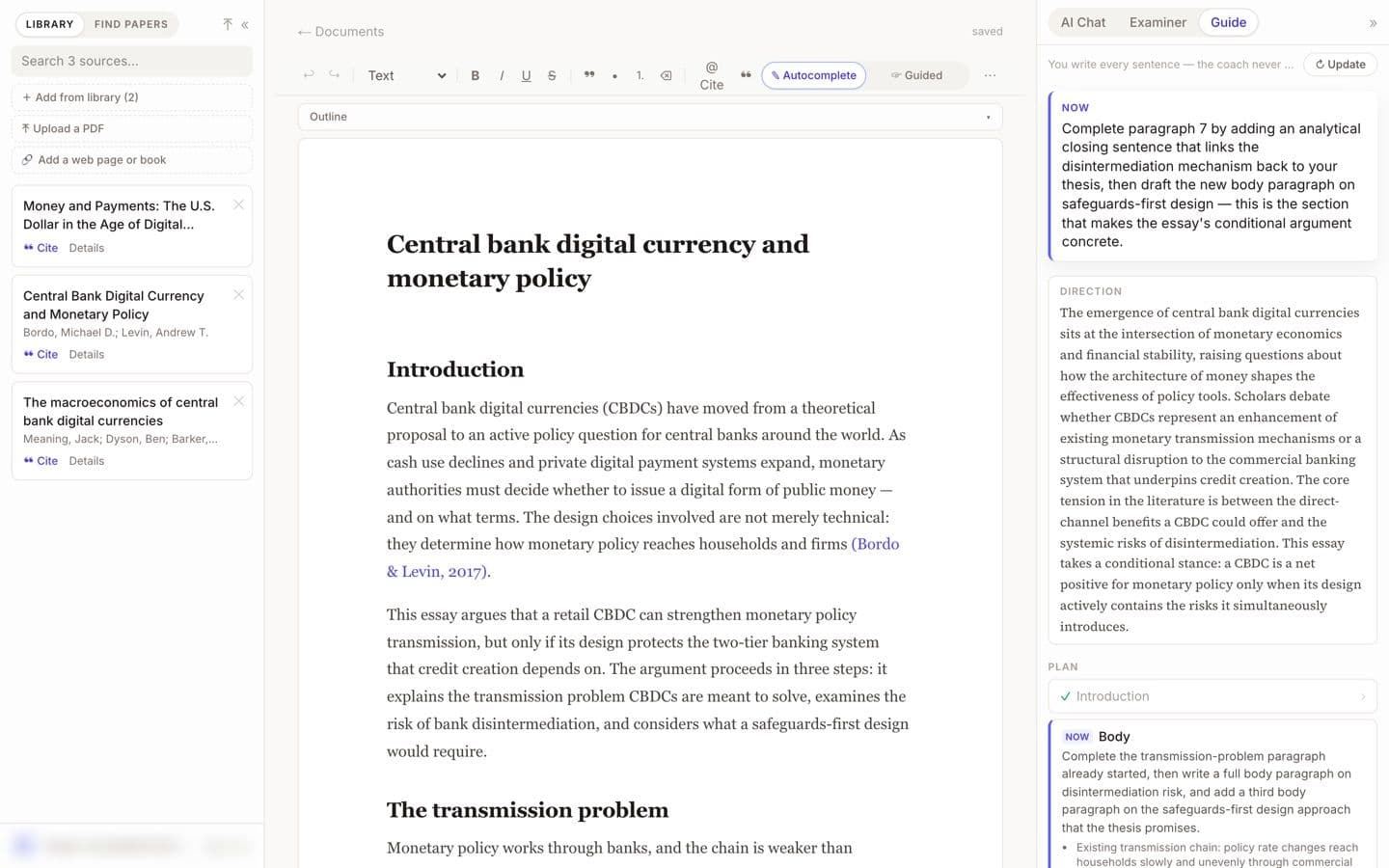
EthiWrite editor with the Guide panel open (demo account, email blurred). Best for: Students who want to write a linear essay themselves, with short suggestions and citations drawn from their own sources.
2. Paperguide
Paperguide keeps Ponder's traceability and adds process. Each claim links to the exact sentence in a paper from its 200M+ index (PubMed, arXiv, OpenAlex and Semantic Scholar) or your library. Systematic reviews get dual independent screening and a PRISMA diagram built from the review's own counts, and Extract Data fills a table where every value links back to its statement. Trustpilot reviewers single out the search, extraction and systematic-review features.
It meters in credits too: 2,000 a month free, 12,500 on Plus at $12 a month per seat and 50,000 on Pro at $29, both billed annually. Its AI Writer drafts from a research question if you ask. Reliability complaints include crashes reported by a doctoral student on an annual plan and slow PDF uploads.
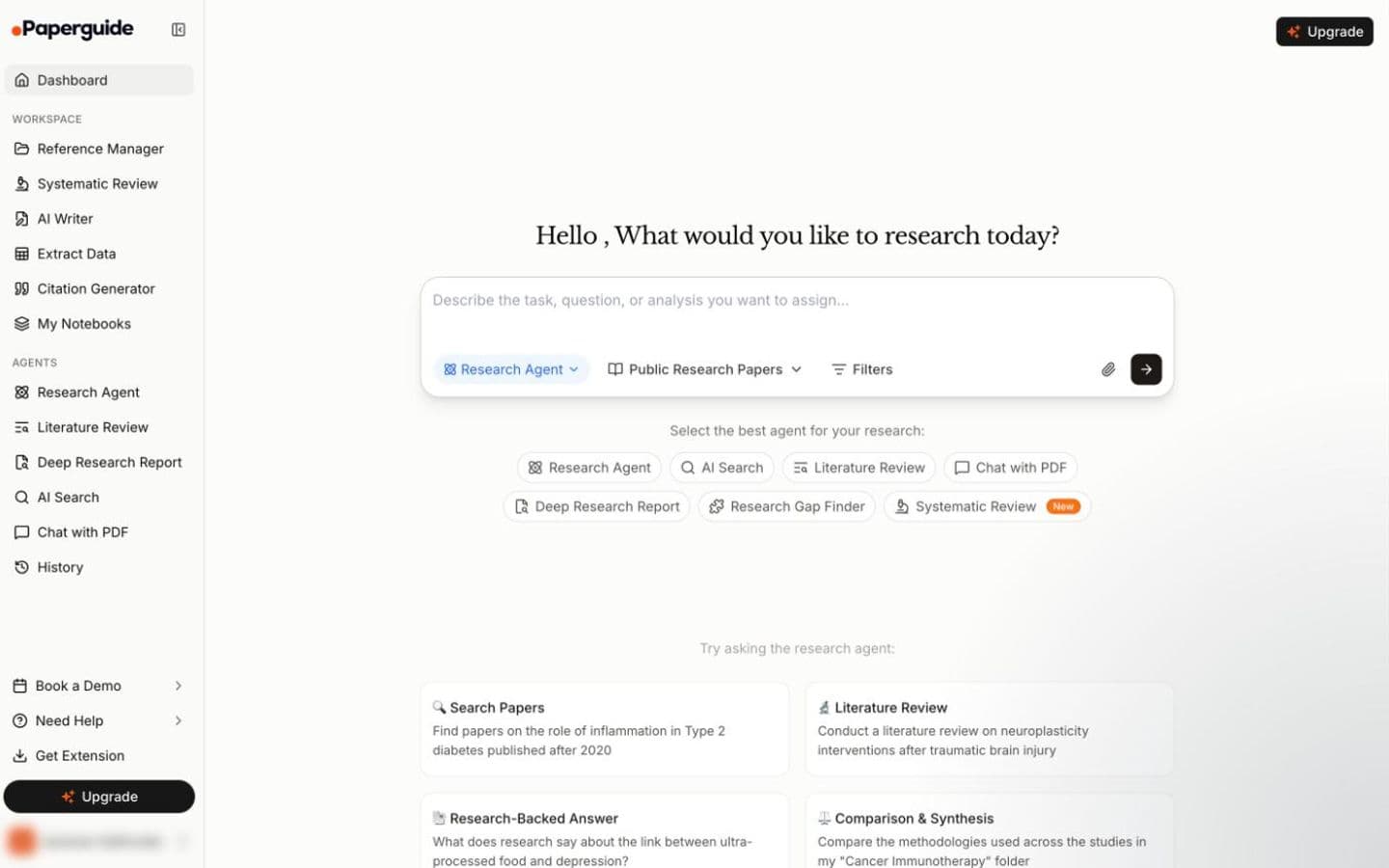
Paperguide dashboard, signed in to a free account (the account name is removed). Best for: Researchers who need screening, extraction and a PRISMA diagram, not just a map.
3. Jenni AI
Jenni AI is for the point where the map is finished and you need to write. Its autocomplete suggests sentences and can be held to your own library. Sources arrive from PDFs, Zotero, Mendeley or its search of 200M+ papers, each suggested sentence connects to its place in the source PDF, and citations format in 10,000+ styles.
Free gives 10 autocompletes a day, 5 chat messages and 3 Reviews; Plus is $12 a month and Pro $29. GPTZero, which sells an AI detector, reviewed it and found the autocomplete text read as AI-written and needed heavy rewriting. On Trustpilot, the most common complaint is renewals charged without notice.
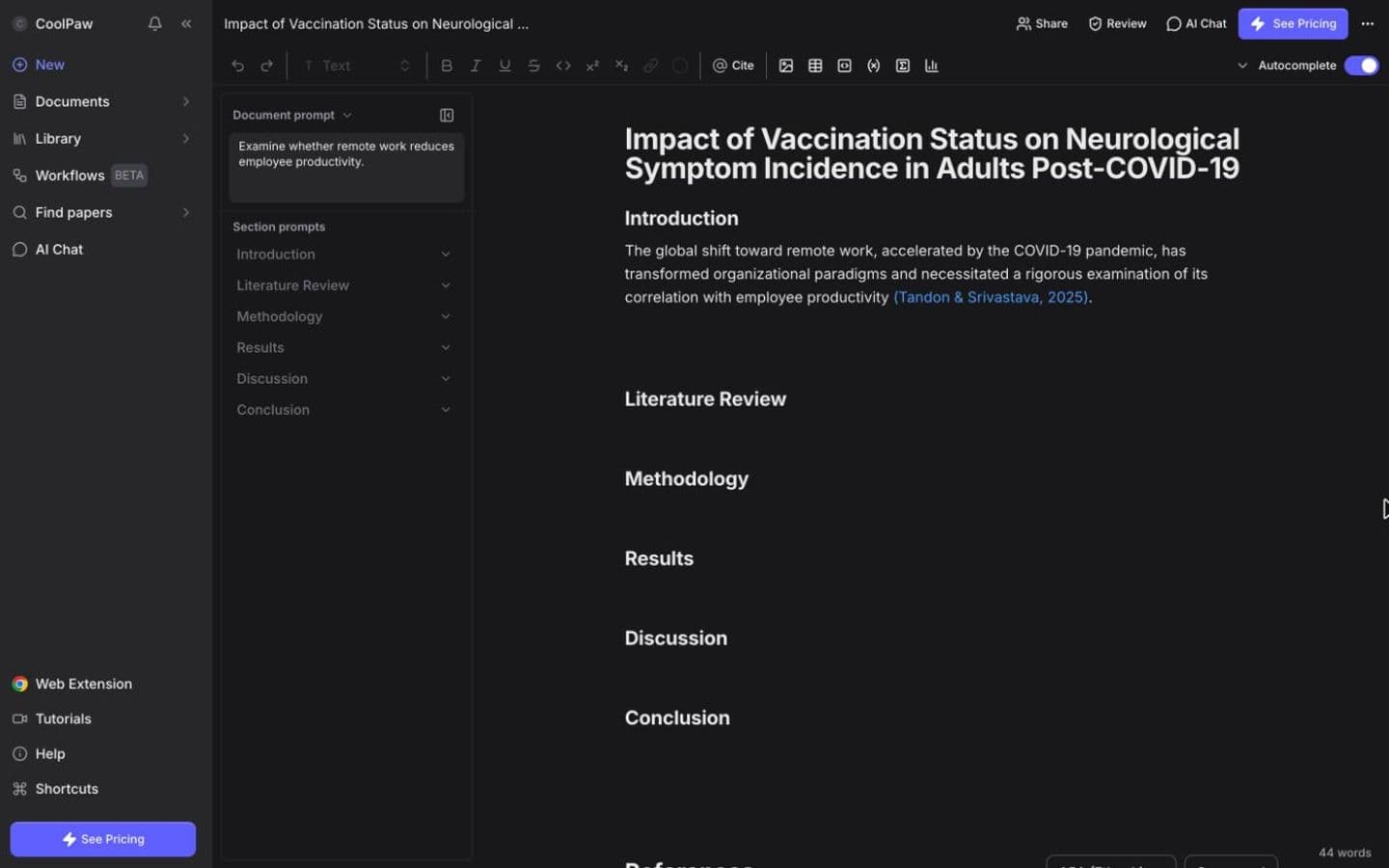
Jenni AI editor, signed in to a free account. Best for: Writers who want autocomplete and citation formatting more than a research canvas.
4. CitedEvidence
CitedEvidence is a credit-based suite as well, built from separate tools rather than one canvas: search over its own index (drawn from Google Scholar, PubMed, Semantic Scholar, Crossref, arXiv and more), PDF chat, a library, a citation generator, data analysis, and a systematic-review tool with screening and extraction. Explore mode opens the system before you make an account.
Read its pricing carefully. Basic is $10 a month and Premium $25, yet the page lists Basic at both 500 and 100 credits. Nobody has published a benchmark of its citation accuracy, and it generates thesis sections and long-form documents and sells AI “humanizer” credits. The one detailed third-party review is a desk review that found the credit pricing hard to predict.
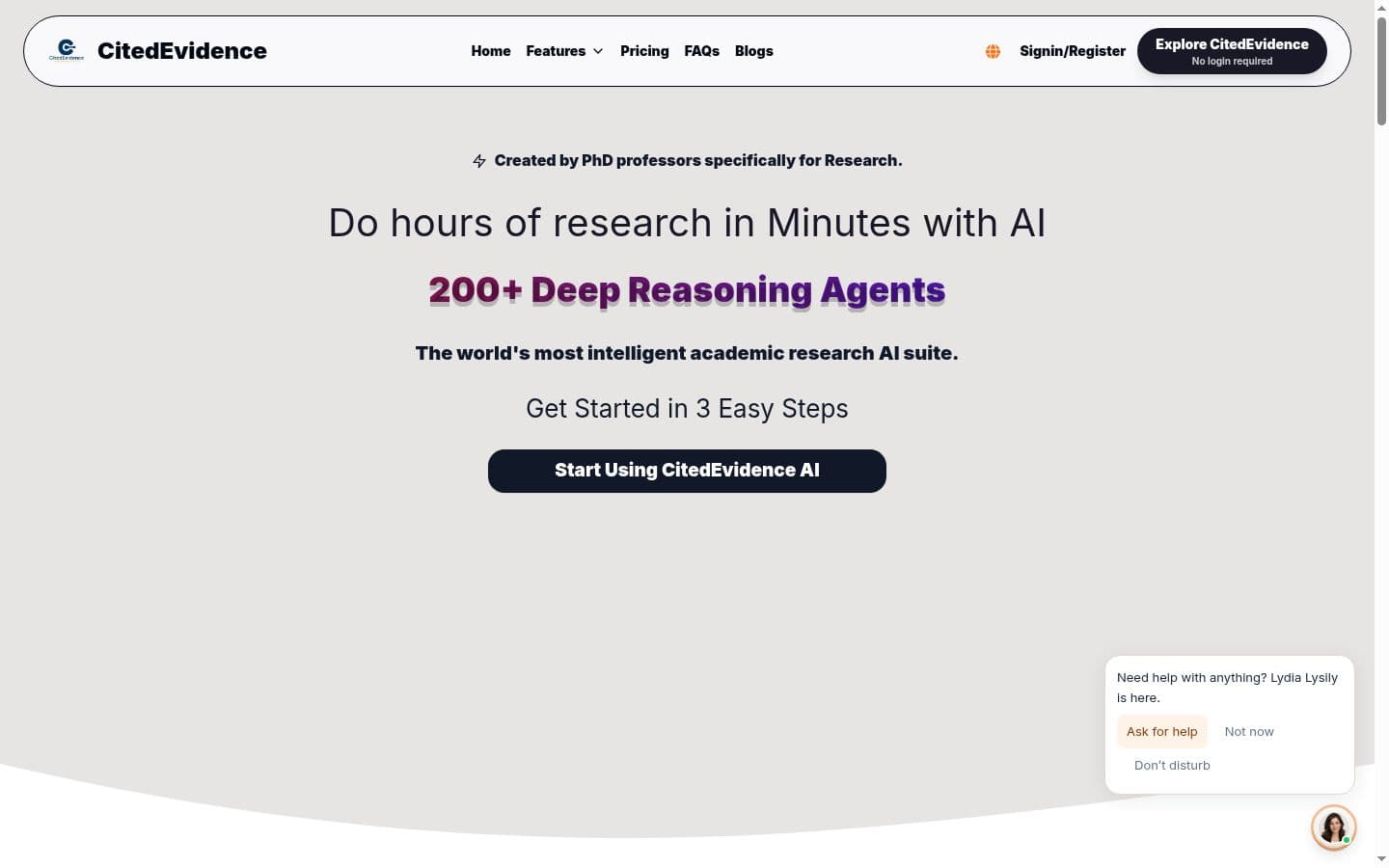
CitedEvidence public homepage, signed out. Best for: Researchers who want many research tools under one login and will verify its citations themselves.
5. Yomu AI
Yomu AI is a writing editor with research attached. You get a source library reused across documents, chat with PDFs, images and web search, Sourcely-powered citations in 700+ styles, and a pick of models from several AI providers on paid plans. Its Get Feedback reviews, added in September 2026, let you preview and apply changes to your draft.
Yomu will write for you too: its new-document flow produces a full, researched draft. Pro is $10 a month billed annually and capped at 1,000 AI actions, and Ultra, at $17 a month annually, has no cap. The editor has no listed free plan, and its only Trustpilot review complains of a renewal without notice.
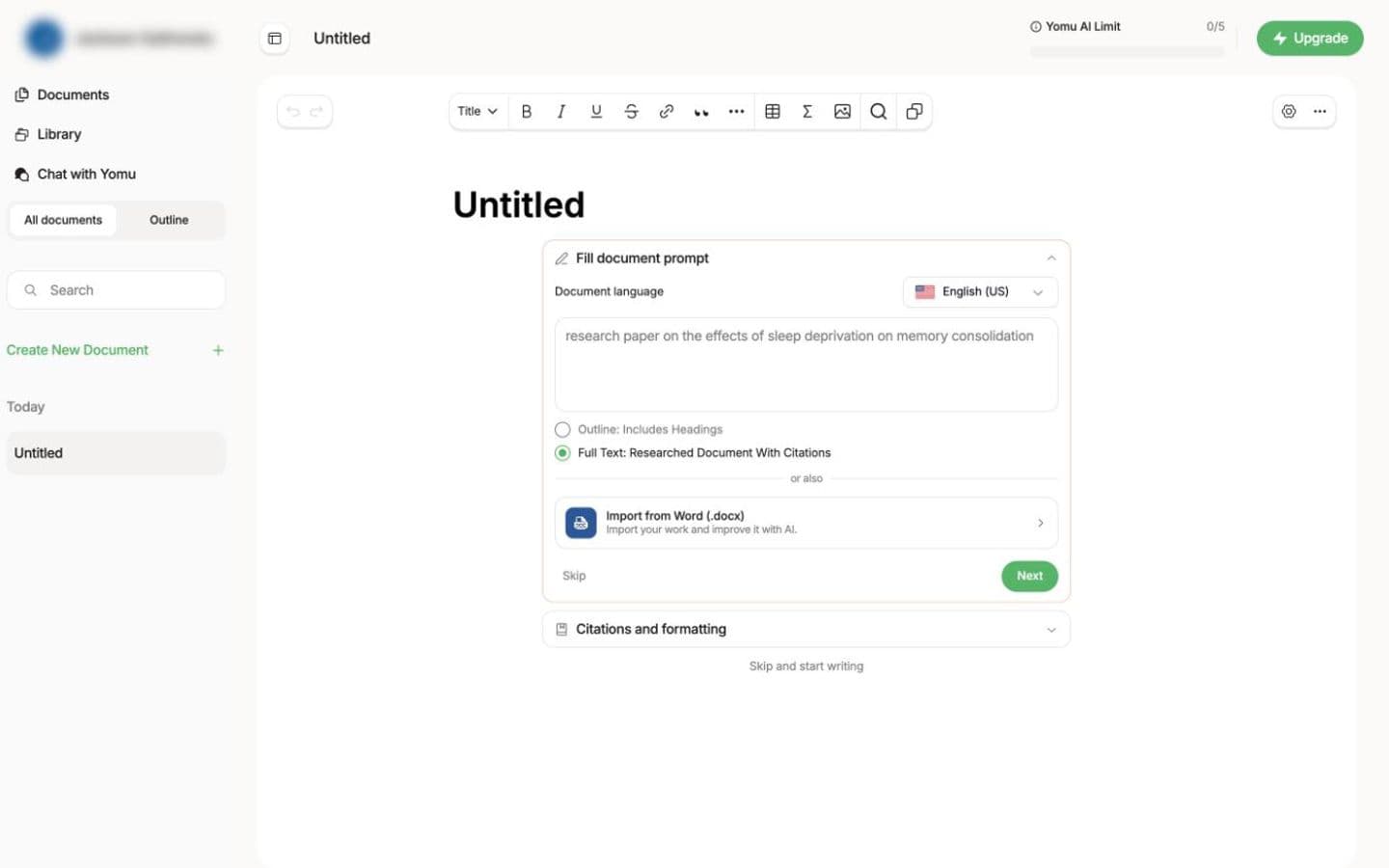
Yomu AI new-document screen, signed in to an unpaid account (its pricing FAQ says you can start for free to try it; the account name is blurred). Best for: Students who'd rather work in a document than on a canvas and don't mind an AI that drafts.
6. Elephas
Elephas keeps one part of Ponder, answers from your own files with the passage attached, and leaves the literature search behind: answers come from the documents you add, not the internet. It's a Mac app that reads PDFs, Word documents, spreadsheets, slide decks and scans, and each answer opens the quoted passage and page. Documents, index and chats stay on your computer, with answers from Elephas AI, your own API key or a model running on your Mac.
It needs an Apple Silicon Mac on macOS 14 or later. There's a 7-day trial rather than a free plan, and Personal costs $19 a month. It doesn't advertise an editor, citation styles or a bibliography.
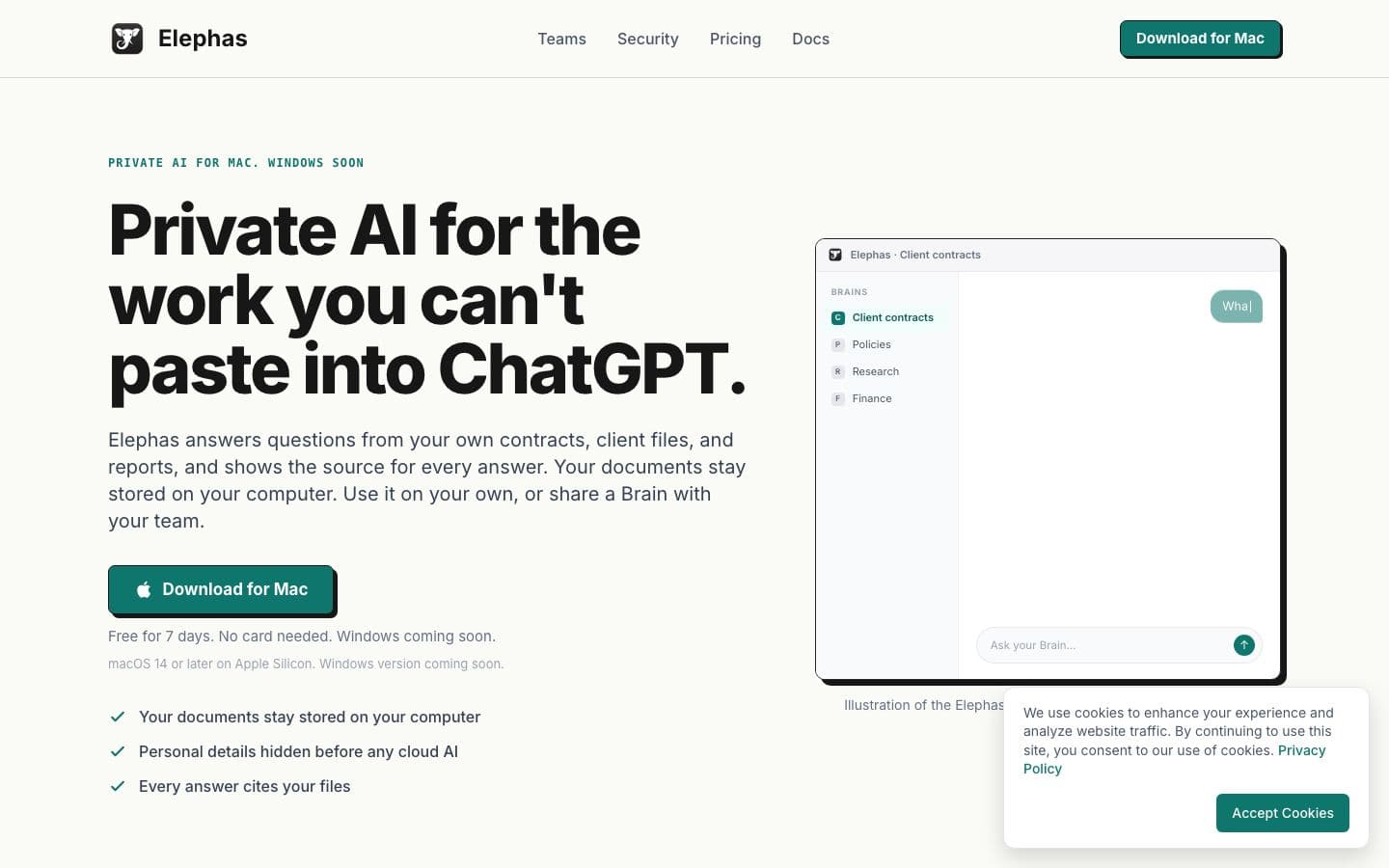
Elephas public homepage (it is a downloadable Mac app; the app itself was not captured). Best for: Mac users whose research lives in their own files and who want cited answers from them.
7. Thesify
Thesify is something to add once you've written a draft, rather than a replacement for Ponder's research stage. Reviewer reads documents of up to 100,000 words and gives feedback against rubrics for thesis strength, evidence, clarity and fit with the assignment, and returns a downloadable report. Highlighting a sentence searches 200+ million references so you can add a citation, and Coauthor marks which text the AI wrote and which a person did.
You buy reviews instead of credits: €14.95 for one, €99.95 for ten, or €24.95 a month for three, with unused reviews rolling over. There's no free plan, and Reviewer has no trial. Commenters under a YouTube walkthrough by Andy Stapleton, who is quoted as an endorser on Thesify's homepage, found the rubric feedback useful on early drafts.
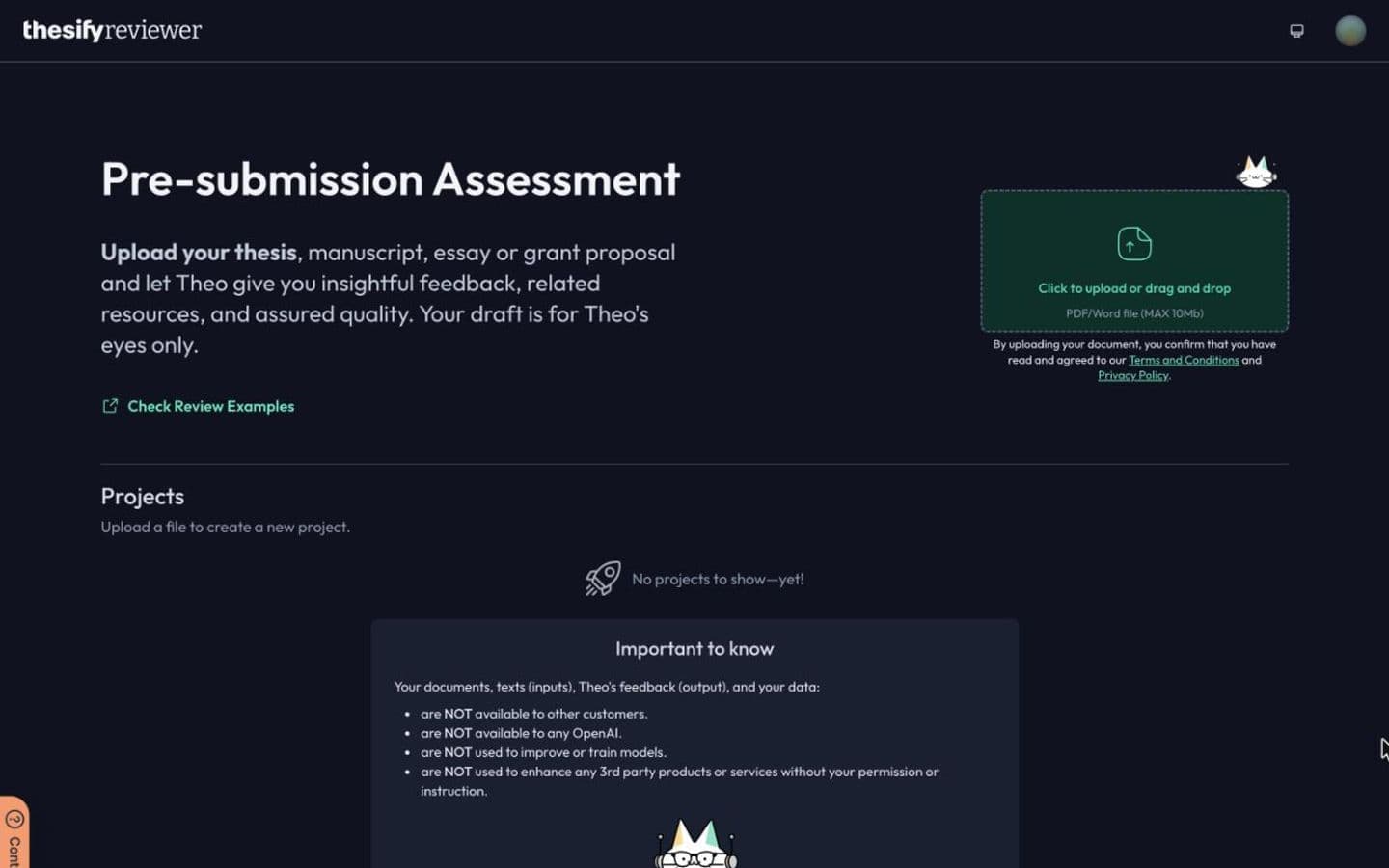
Thesify reviewer, signed in to a free account, before any document is uploaded. Best for: Graduate students who want a rubric critique of a thesis chapter they've written.
At a glance
Every tool above, with Ponder on the last row for reference. Writing assistants help you write; essay generators write the essay for you.
| Product | Type | Paid from | Free tier | Citations | Ghostwriting |
|---|---|---|---|---|---|
| EthiWrite | Writing assistant | $9 (billed every week) or $10/month ($120 billed annually) | Yes | Only from sources you added | Guides; you write |
| Paperguide | Writing assistant | $12/month | Yes | Your sources, or papers it finds for you | Drafts text when asked |
| Jenni AI | Writing assistant | $12/month | Yes | Your sources, or papers it finds for you | Drafts text when asked |
| CitedEvidence | Writing assistant | $10/month | No | From its own paper database | Writes the essay |
| Yomu AI | Writing assistant | $10/month | No | Your sources, or papers it finds for you | Writes the essay |
| Elephas | Writing assistant | $19/month | No | Only from sources you added | Guides; you write |
| Thesify | Writing assistant | €7.50/month | No | From its own paper database | Drafts text when asked |
| Ponder | Writing assistant | $14/month | Yes | Your sources, or papers it finds for you | Drafts text when asked |
The bottom line
Leave Ponder for Paperguide if you need a formal review process, or for Jenni AI if you're done exploring and want to write. Stay if the map is what makes a field make sense to you, and budget your credits. Wherever you end up, keep the click from a citation back to its passage.
FAQ
- How fast do Ponder's credits run out?
- The free plan refreshes 50 credits a day, and Casual adds 1,100 a month on top. A reviewer sponsored by Ponder said credits went faster than expected, especially on the free tier.
- Is there a Ponder alternative that doesn't use credits?
- A few price usage differently. Jenni AI's Pro plan, at $29 a month, has unlimited autocomplete, AI edits, chat and Reviews. Yomu AI's Ultra plan has unlimited AI actions. Thesify sells reviews one at a time or in packs.
- Does Ponder write papers for you?
- If you ask it to. The Draft stage writes literature reviews, papers and research reports from your project's sources and places the citations. Whether you can submit that text is a question for your course rules.
- Which alternative is best for a systematic review?
- Paperguide, which runs dual independent screening and builds a PRISMA diagram, while leaving the final screening call to a human. CitedEvidence also has screening and extraction, but no one has published a benchmark of its citation accuracy.
- Will my citations still be traceable if I switch?
- With the right tool, yes. Paperguide links claims to the exact sentence, Jenni AI connects suggestions to their place in the PDF, Elephas opens the quoted passage, and EthiWrite only cites sources in your Library. Whatever you use, open the passage before you trust the citation.