Compare
Paperpal vs Trinka: two academic editors, one real difference
These two are close cousins. Both check grammar and academic style, both run plagiarism and AI-detection checks, and both work in Microsoft Word and with LaTeX (Paperpal through Overleaf). If all you want is cleaner English in a finished thesis, either will do the job.
The real difference is sources. Paperpal will search 250M+ research articles and cite them for you. Trinka won't find sources at all, but it will check the ones you already have against Crossref. So: Paperpal if you still need references, Trinka if you need yours audited.
Prices and features checked on October 17, 2026.
At a glance
Writing assistants help you write; essay generators write the essay for you.
| Product | Type | Paid from | Free tier | Citations | Ghostwriting |
|---|---|---|---|---|---|
| Paperpal | Writing assistant | See pricing page | Yes | Your sources, or papers it finds for you | Drafts text when asked |
| Trinka | Writing assistant | $48/year | Yes | Does not cite | Drafts text when asked |
Language checks, side by side
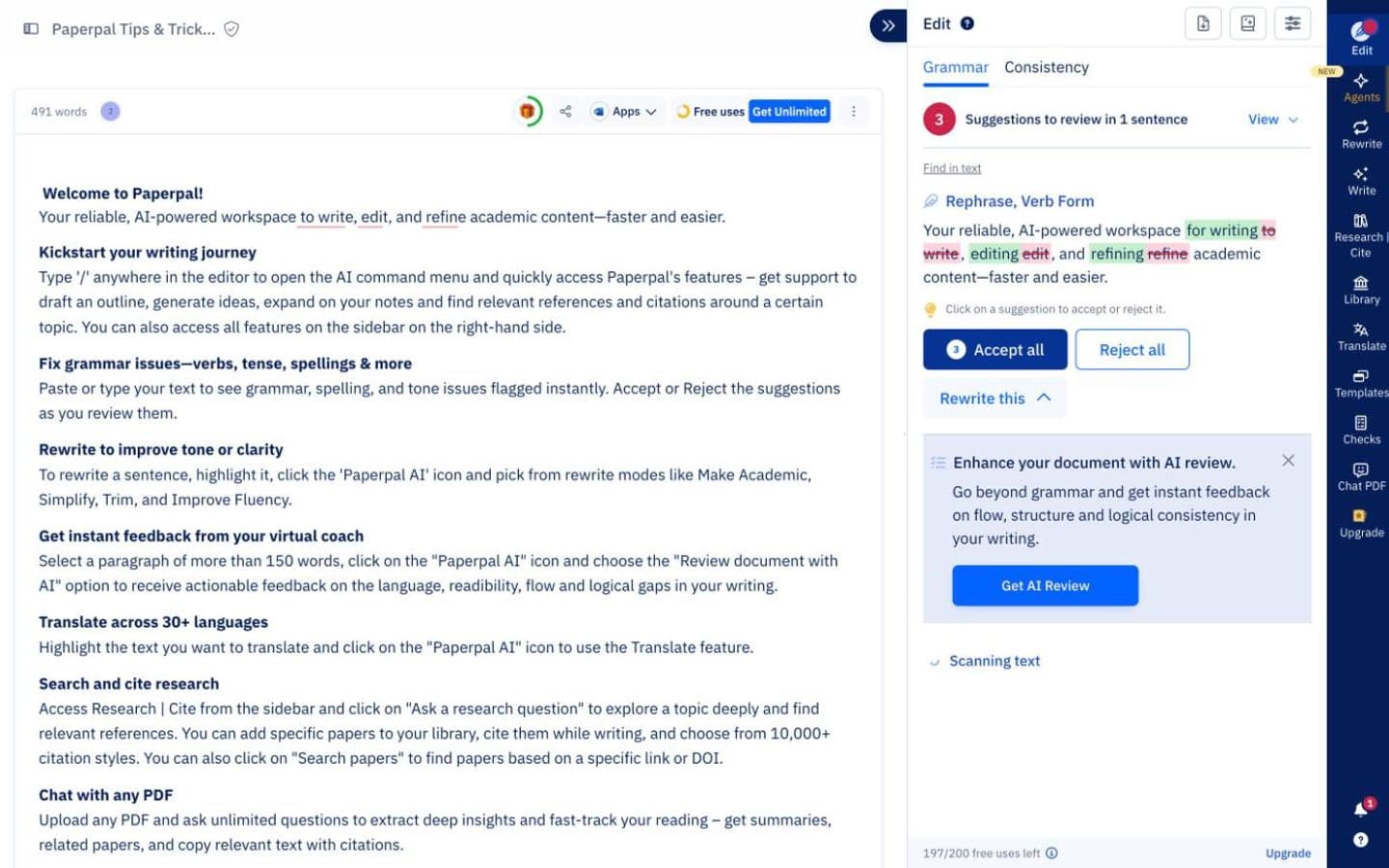
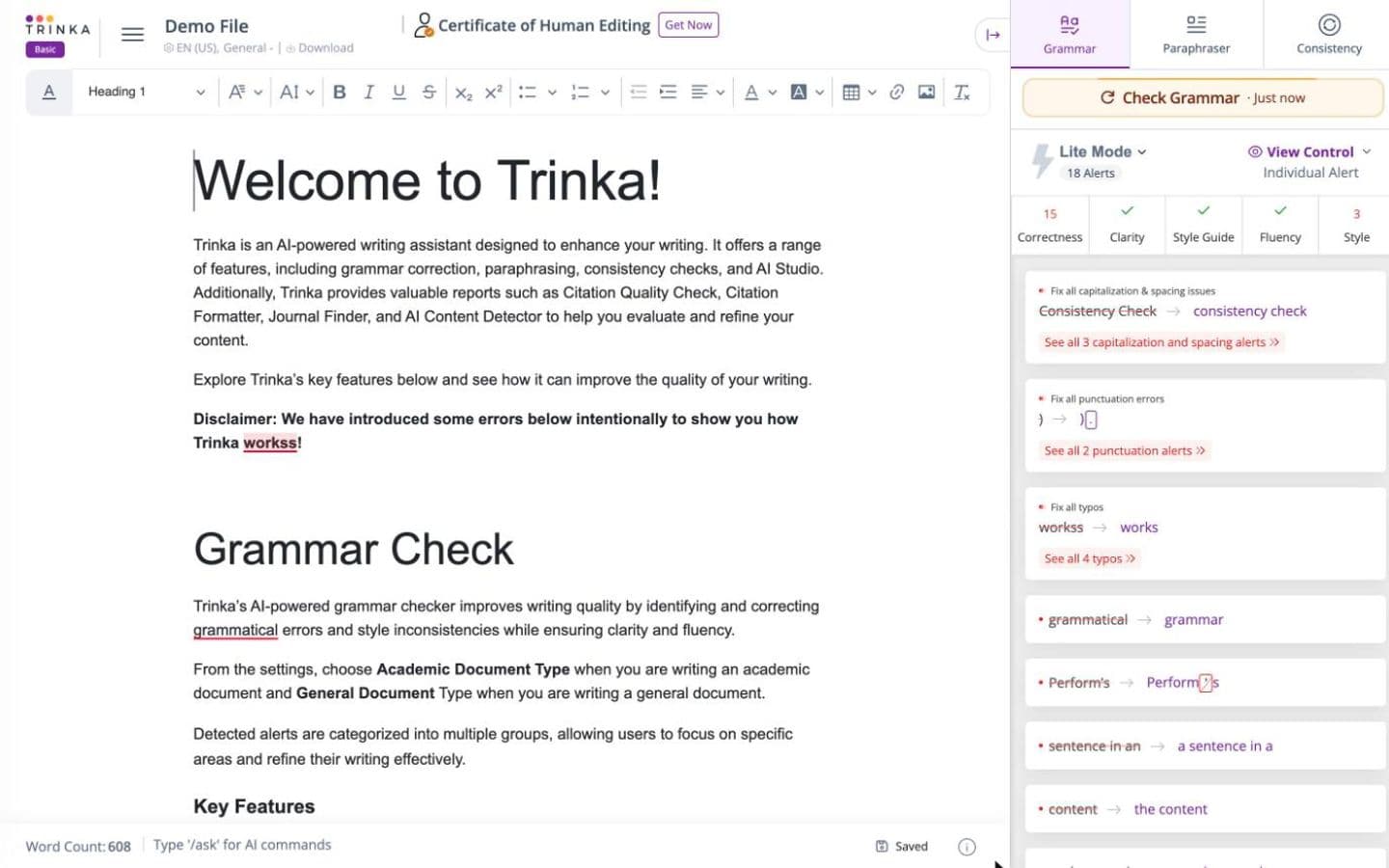
Paperpal's edits to grammar and tone are trained on scholarly editing, with 30+ pre-submission checks layered on top for journal language and formatting standards. Trinka checks grammar, punctuation and academic style, and on paid plans adds style-guide corrections for APA, AMA, ACS, AGU and IEEE.
Neither gets a clean bill. Originality.ai, which sells a grammar checker, tested Trinka and found it caught many basic and advanced errors but missed misspellings such as “bussiness” and “atract”. Commenters on r/research were sceptical of AI editing like Paperpal's, warning it can blur what you meant. Trustpilot reviewers credit Trinka with better grammar and academic tone in manuscripts and theses; Paperpal's Trustpilot reviews are mostly invited ones, and they praise the AI-detection checks.
Finding references versus auditing them
Paperpal's Research and Cite extracts insights from PDFs and generates citations in 10,000+ styles. You can also cite from references and PDFs you upload.
Trinka's Citation Checker runs your existing references against Crossref and marks any that are retracted, hallucinated or predatory, and its Citation Formatter formats them. Those tools spend credits, and the free plan gets 4 a month. If you've ever pasted a reference from an AI chat without checking it, this is the feature to run.
Where each one writes for you
Both stretch past editing. Paperpal's homepage offers to “Draft with suggestions grounded in your sources”, and its paraphraser restructures your sentences. Trinka offers “Write & Rewrite with AI”, rationed per plan: 5 requests free, 25 a month on Premium and 1,000 a month on Premium Plus. For both, the core job is correcting text you wrote.
Where you can use them, and privacy
Paperpal has a Word add-in and Chrome and Edge extensions that support Google Docs and Overleaf. Trinka works in Word, in the browser, as a Windows app and on LaTeX files.
Trinka also sells a Confidential Data plan at $300 a year that promises it won't store your data or train AI on your text, and adds an offline grammar app. For unpublished data, that's a reason to look at Trinka. Nothing on this page describes a comparable plan from Paperpal.
Prices and free plans
Trinka prints its prices: Premium is $48 a year (40% off a listed $80) and Premium Plus $125, and Premium is $20 billed monthly. Paperpal offers Prime and Pro on monthly or annual terms, with prices that appear only after the page loads your region's figures. Until you check, you can't say which is cheaper.
Trinka's Premium Plus is the plan to look at for a long thesis: double credits, file translation, 240 pages a year of standard plagiarism checks and 1,000 AI writing requests a month. Paperpal's Pro, at the top of its range, has unlimited grammar edits and AI detection and 30k words a month of plagiarism and reference checks.
The free plans measure different things. Trinka's never expires and covers 5,000 words of writing help a month in lite grammar mode, 5 AI writing requests and 4 credits; its most common complaint is those limits. Paperpal counts edits and uses instead: 200 grammar edits a month, five uses a day each of its AI writing tools and research Q&A, plus lite plagiarism and journal-fit reports. Paperpal's paid Prime tier jumps to 20k grammar edits a month.
Which should you choose?
Choose Paperpal if you want language polish and a source search in one tool, inside Word, Google Docs or Overleaf. Start on its free plan, then check your regional price.
Choose Trinka if your references are already in place and you want them validated against Crossref, along with grammar and style-guide corrections, at a published yearly price.
The argument underneath the English is a separate problem. EthiWrite (we make it) has an Examiner Mode that maps your argument and flags unsupported claims without rewriting a word. It formats only APA, MLA and Chicago, while Paperpal generates citations in 10,000+ styles.
FAQ
- Can Trinka find sources for me?
- No. Trinka doesn't supply sources; its citation tools work on references you already have. Paperpal's Research and Cite searches 250M+ research articles.
- Does Paperpal or Trinka work with LaTeX?
- Both. Paperpal supports Overleaf through its Chrome and Edge extensions, and Trinka works on LaTeX files.
- Which has the better free plan?
- They're measured differently, so it depends on what you need. Trinka gives 5,000 words of writing help a month; Paperpal gives 200 grammar edits a month plus daily uses of its AI tools and research Q&A.
- Which suits a journal manuscript?
- Both are aimed at it. Paperpal runs 30+ pre-submission checks against journals' language and formatting standards; Trinka's paid plans correct to five style guides: APA, AMA, ACS, AGU and IEEE. Pick by which checks your target journal cares about.
- Do both check plagiarism?
- Yes. Paperpal compares your text against 99B+ sources, with plagiarism and reference checks counted in words on Prime. Trinka runs plagiarism checks on credits, and Premium Plus includes 240 pages a year of standard checks.