Alternatives
Aithor alternatives for students who want to write the essay themselves
Aithor takes a topic, hands you an outline to edit, then writes the draft. It advertises “Full papers up to 15 000 words”, with references pulled from its own database of academic sources. If you need an essay you can put your name to, that's the wrong job for it.
The replacements below split up what Aithor bundles: finding papers, citing them, and getting a draft checked. Jenni AI is the closest match for research and citations, Paperguide suits a literature review, Grammarly and Thesify give feedback on a draft, and Trinka checks a reference list you already have. EthiWrite is on the list too (we make it). Each review says how far the tool will write for you.
Prices and features checked on October 17, 2026.
Why students move off Aithor
Aithor is open about what it's for. The generator's own line is “AI drafts, you refine for submission”. Its marketing calls the essays “Untraceable by AI detectors” and “99% undetectable”, and an “AI disguise” feature blends the AI text with your writing style. The FAQ says using AI for essays “is not cheating as long as you use it ethically and responsibly”. Your school gets the final word on that, not Aithor, and a disguise doesn't change whose work the essay is.
The references are what people like. Trustpilot reviewers praise the reference lists, and Aithor says its AI “does not invent sources”. A review on Tools for Humans, an AI tools directory, still found citations that can be inaccurate and need checking one by one, and drafts that need heavy editing. Other reviewers say the source pool ran thin on specific topics.
Then there's money. Signed-out visitors see no prices, and the site's cookie list includes regional price A/B-test cohorts, so what you pay may vary. A directory listing last reviewed in March 2026 put full access at $24.99 a month, $16.99 a month on a three-month plan, or $8.33 a month billed annually. Several Trustpilot reviewers say they couldn't cancel, or were charged after cancelling.
The parts around the generator are genuinely handy: an outline you can regenerate, a reference finder with full-text PDFs, references in six styles including Harvard and Vancouver, and a grammar checker and citation generator on the side. The Tools for Humans reviewer credited the fast outlines and auto-formatted citations too. If those are what you'd miss, look for them in the tools below.
What to look for in a Aithor alternative
References you can open
A reference list is only as good as the paper behind each entry. Prefer a tool that shows you the passage or the PDF a citation came from, so checking it takes seconds instead of a trip to the library.
A ceiling on how much it writes
Tools range from one suggested sentence at a time to a full draft on request. Work out what your course allows, then pick a tool whose ceiling sits below that line rather than one you have to hold back.
An exit you can find
Aithor's cancellation complaints are a reason to check the way out before you pay: whether there's a monthly option or a trial, and what the terms say about refunds.
The best Aithor alternatives
1. EthiWrite
Full disclosure: this is our tool.
EthiWrite is built for the student who has to write the paper. Guided mode writes nothing, and Autocomplete offers one sentence at a time, capped at about thirty words, that stays grey until you accept it. Citation labels come from the source record, and only for sources in your Library, which takes uploaded PDFs, papers from OpenAlex, web pages and books.
Once the draft is done, Examiner Mode reads it and points to unsupported claims, thin evidence and structural gaps, with no ability to rewrite a word. There's a free plan. The limit: paper search covers one index, OpenAlex, rather than a commercial database, so for a narrow topic you may end up uploading PDFs yourself.
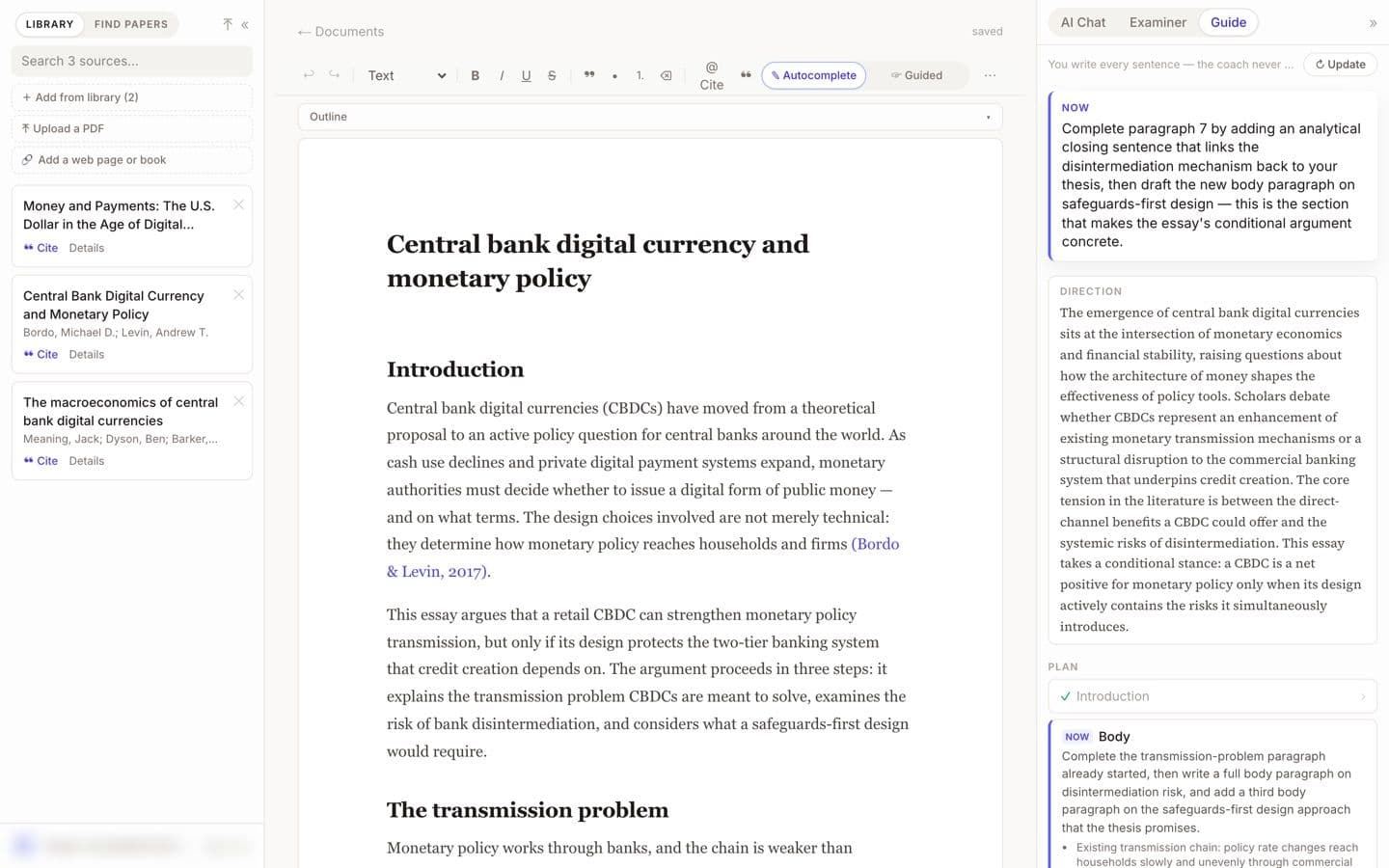
EthiWrite editor with the Guide panel open (demo account, email blurred). Best for: Students who want to research and write the essay themselves, with references they can trace.
2. Jenni AI
Jenni AI covers the research half of what Aithor does. Sources come in from PDF uploads, Zotero or Mendeley, or its own search of 200M+ papers, and AI-suggested sentences link to their place in the source PDF. It formats in 10,000+ styles, and its AI chat answers questions about your library with citations. Trustpilot reviewers praise the citation and bibliography tools.
It still writes, a sentence at a time: in GPTZero's review (GPTZero sells a detector), a 250-word introduction came together mostly from accepted suggestions, and a detector flagged all of it. You can limit autocomplete to your own library. Free gives 10 autocompletes a day, Plus is $12 a month and Pro $29, and several Trustpilot reviewers report renewal charges without notice.
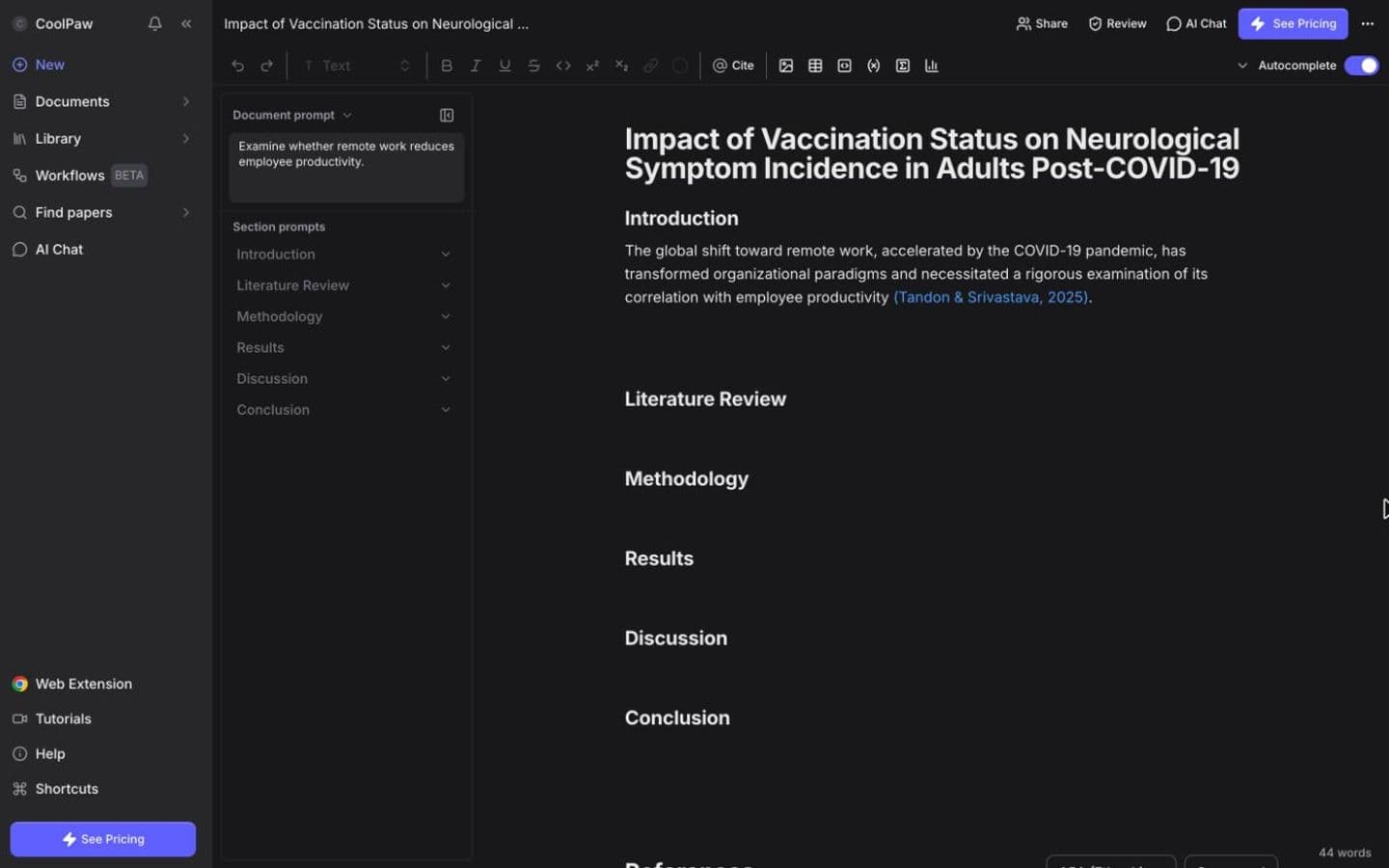
Jenni AI editor, signed in to a free account. Best for: Students who want a big paper search and citation formatting, and will keep autocomplete on a short leash.
3. Paperguide
If the assignment is a literature review, look at Paperguide. It searches 200M+ papers across PubMed, arXiv, OpenAlex and Semantic Scholar, plus your own library, and every claim links to the exact sentence it came from. Next to a reference list that needs checking one by one, that's a real difference. The reference manager imports from Zotero or Mendeley and switches between 1,000+ styles.
The free plan has 2,000 AI credits a month, and Plus is $12 a month per seat, billed annually. Its AI Writer will generate a citation-grounded draft from a research question, so it can write for you as well. Some Trustpilot reviewers found its results unhelpful for their university assignments.
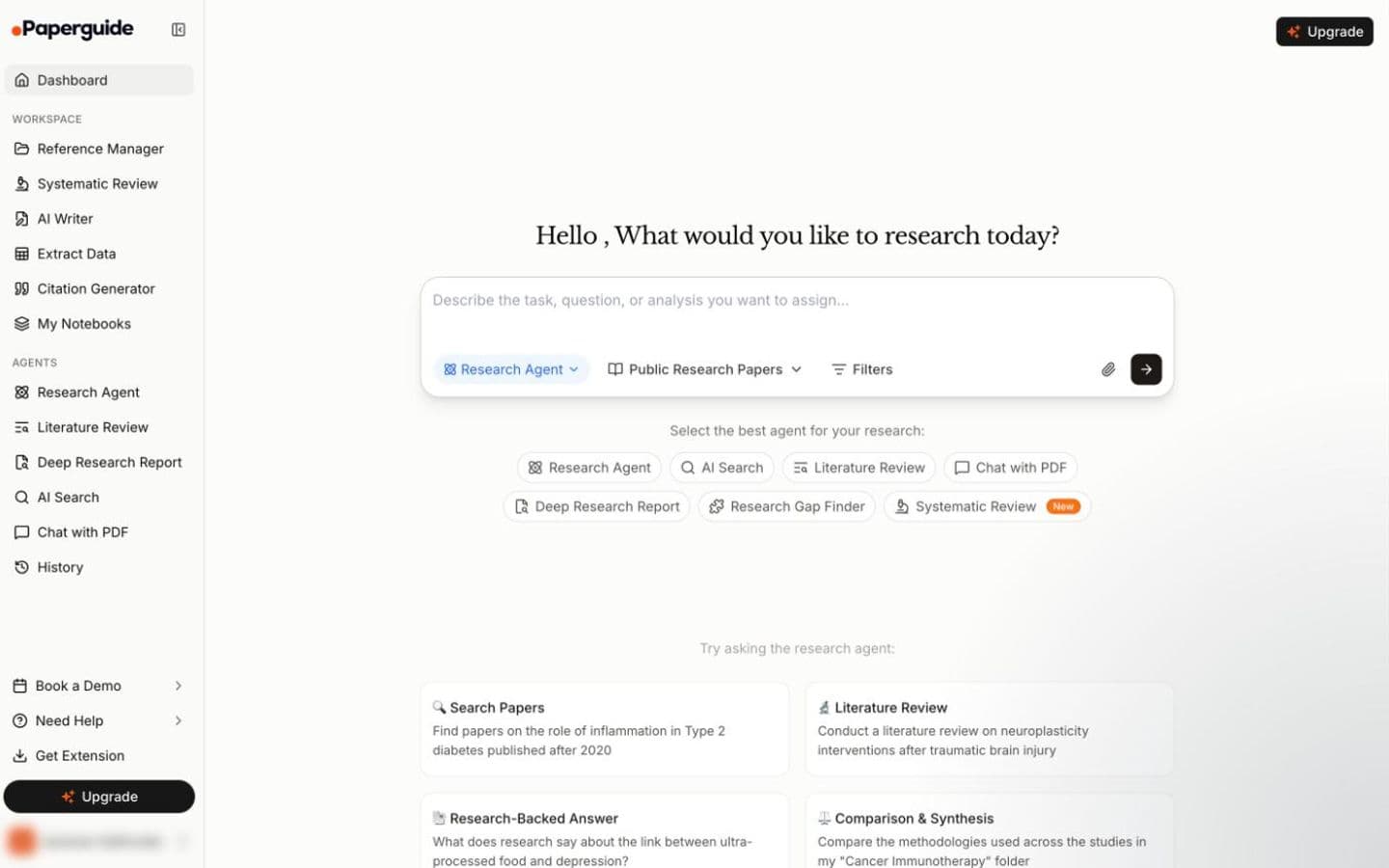
Paperguide dashboard, signed in to a free account (the account name is removed). Best for: Graduate students working on a literature or systematic review.
4. Grammarly
Grammarly answers the opposite worry. Authorship records how you wrote a draft (typed, pasted or AI-assisted), with a replay and a report you choose whether to share, and it's on the free plan. Where Aithor sells a disguise, this gives you evidence. AI Grader estimates your grade from your rubric and gives personalized feedback, though Grammarly says the estimate “should not be taken as your actual grade”.
Citation Finder suggests web-based sources and formats them in APA, MLA or Chicago only, without naming the databases it searches. Free use is metered, mostly by the day; Pro is $144 a year or $30 month to month. Its agents can draft text straight into the editor, and Grammarly itself warns that its AI rewrite suggestions could get work flagged.
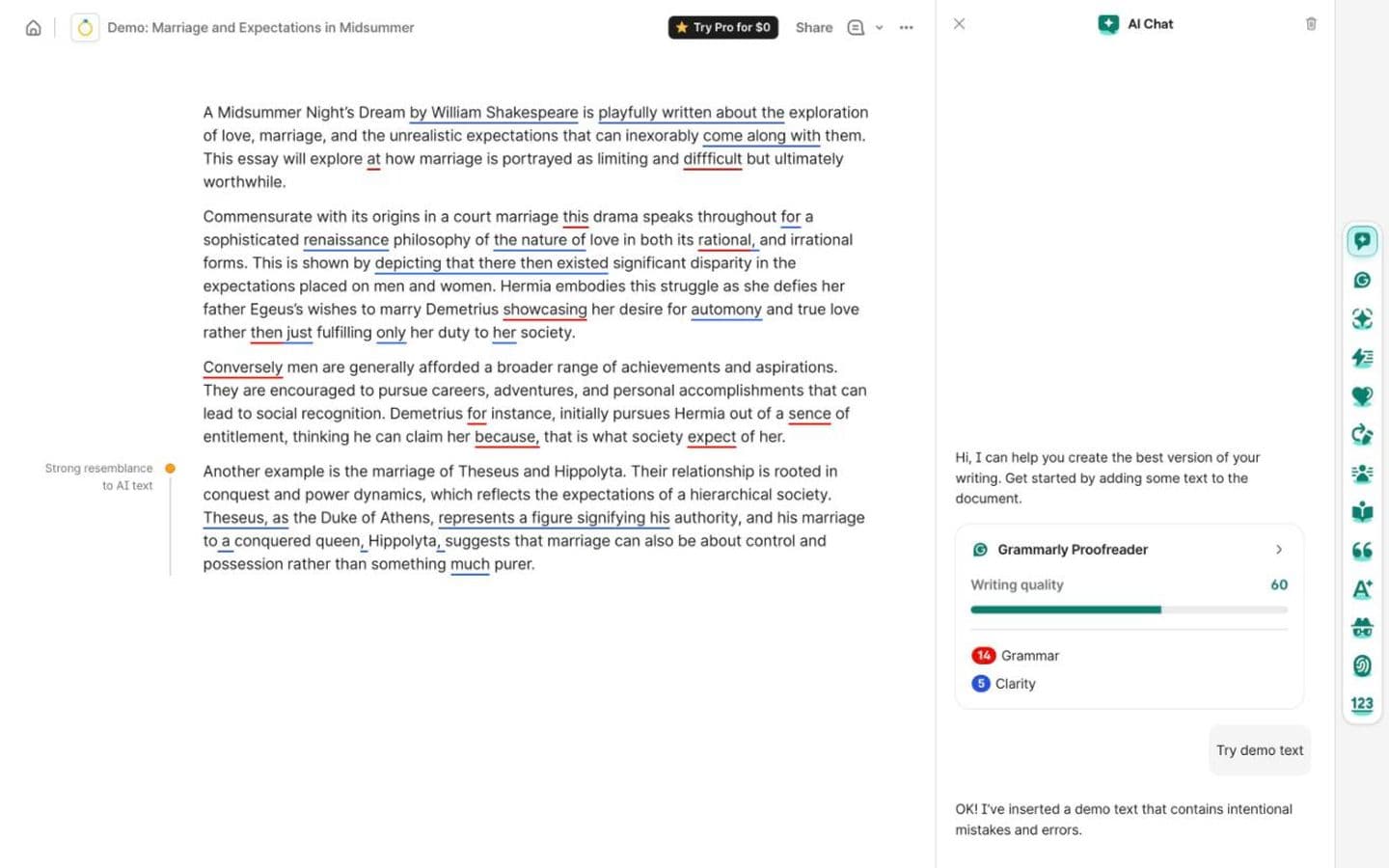
Grammarly doc with Grammarly's built-in demo essay, signed in to a free account. Best for: Students who want a record of how they wrote, and a grade estimate before they submit.
5. Thesify
Thesify's FAQ says it won't write your paper; its Reviewer reads one instead. You get structured feedback on argument, clarity and methodology, judged against rubrics for thesis strength, evidence and fit with the assignment, on documents of up to 100,000 words, as a downloadable report. Commenters under a YouTube walkthrough found the feedback useful on early drafts.
You pay per review: €14.95 for one, €39.95 for three, or €24.95 a month for three. There's no free plan and no Reviewer trial. The newer Coauthor workspace has agents that “search, read, and draft”, so the no-writing line belongs to Reviewer, not the whole product.
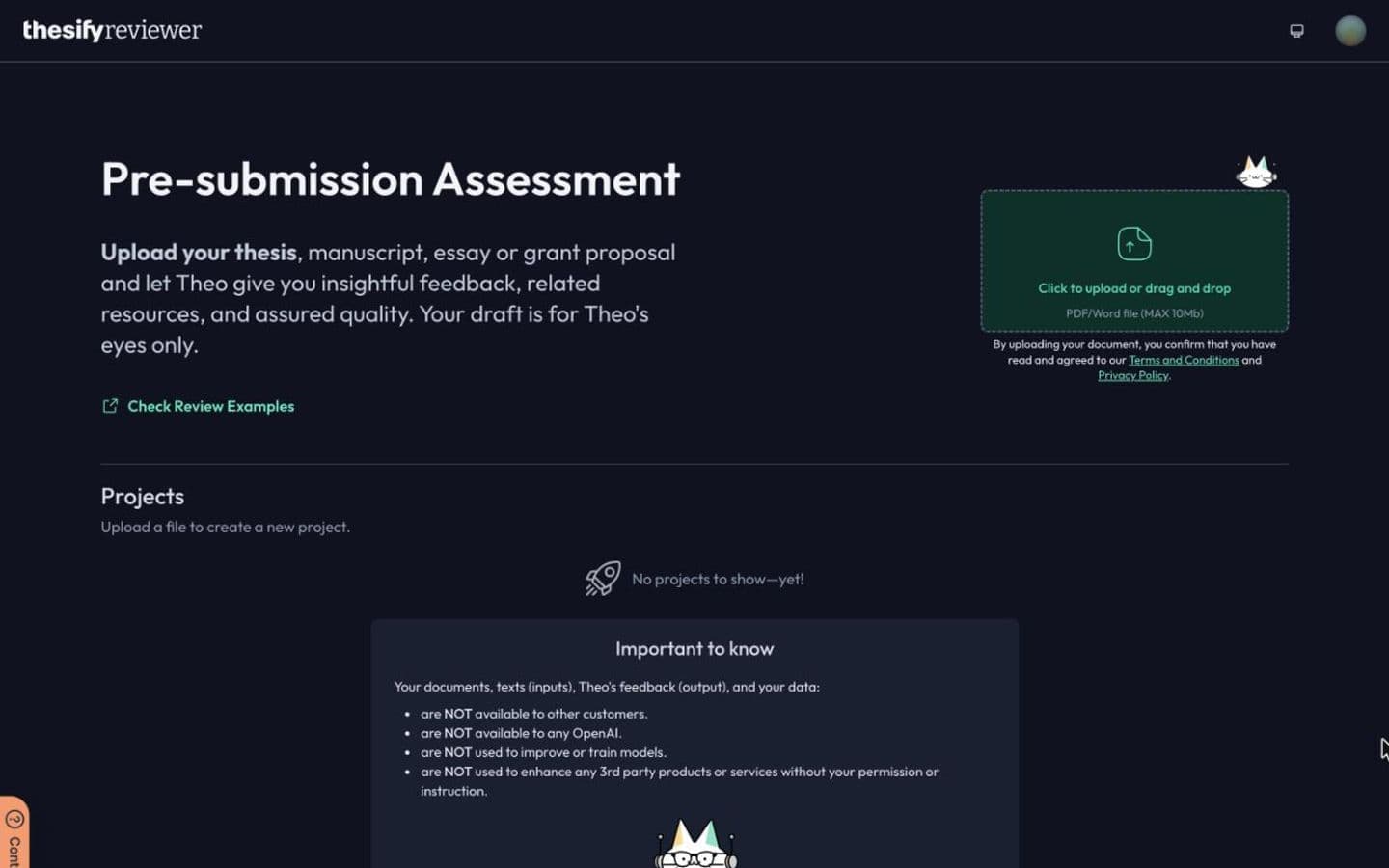
Thesify reviewer, signed in to a free account, before any document is uploaded. Best for: Students with a long draft who want rubric feedback before a supervisor reads it.
6. Trinka
If you're keeping a reference list from an earlier draft, run it through Trinka. Its Citation Checker validates references against Crossref and flags retracted, hallucinated and predatory sources. Beyond that, it checks grammar, punctuation and academic style, and works in Word, the browser, a Windows app and on LaTeX files.
It works on text you've written and won't find sources or structure an argument. The free Basic plan gives 5,000 words of writing help, 5 AI writing requests and 4 credits a month, and the citation tools spend credits. Premium is $48 a year, billed yearly; a monthly option exists, but its price isn't shown in the page text.
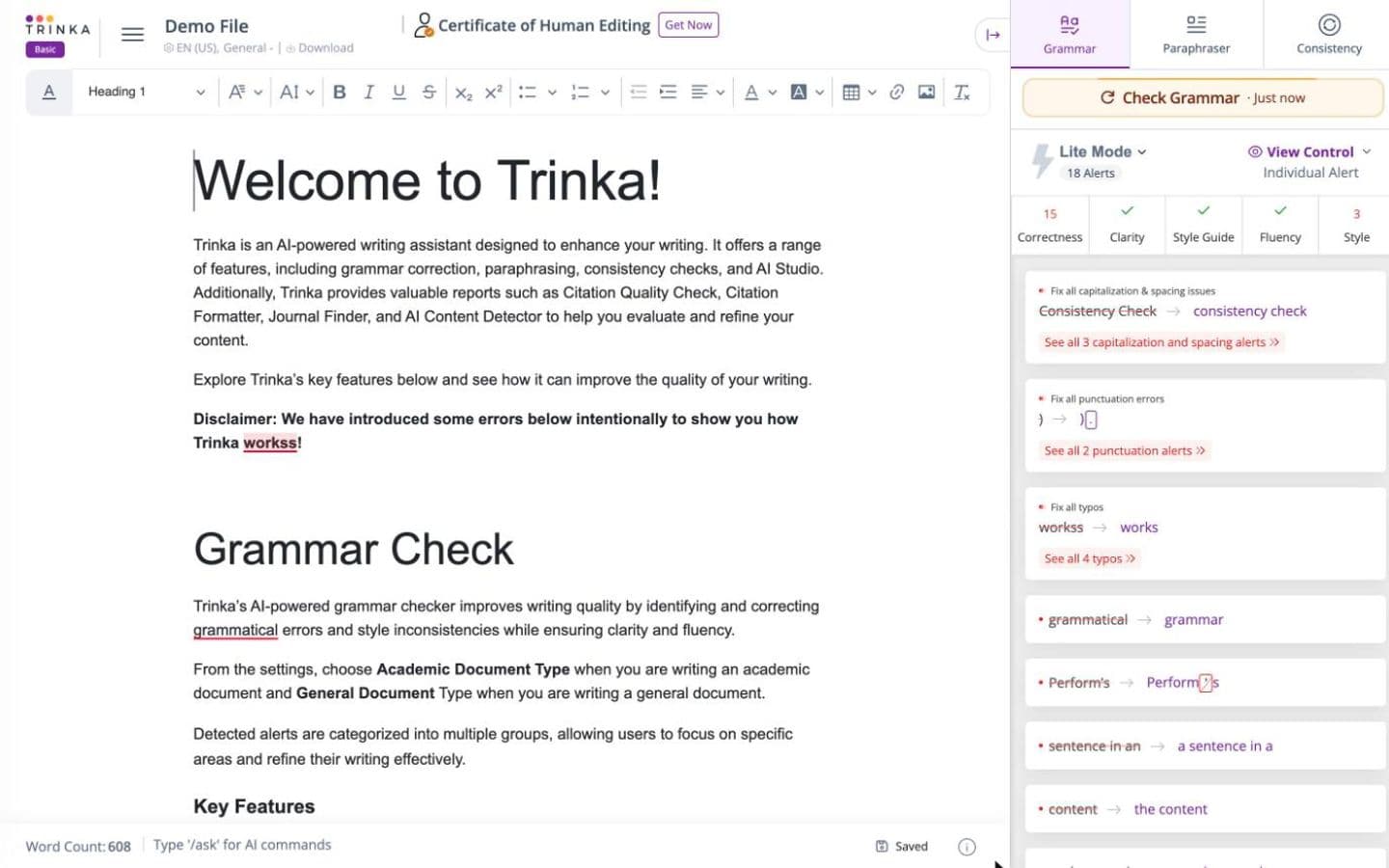
Trinka editor on its built-in demo file, signed in to a free account. Best for: Checking a reference list you already have, and polishing academic English.
7. EssayGenius
EssayGenius is shaped most like Aithor: an essay workspace with sources built in. Source results come from academic databases such as OpenAlex and Crossref, with DOIs and links to the papers, and the outline, sources, notes, citations and version history sit beside the essay. Every draft is auto-saved with timestamps, and a Process Report shows how the essay developed.
It does draft: one full essay on the free plan and unlimited on Pro, even though the vendor says “We do not write your paper”. A roundup on Best Writing rates it “Use with caution” for institutional acceptance. The free plan includes unlimited essays, a source library and citations, with 25 AI messages a month; Pro is $15 a month or $108 for a year.
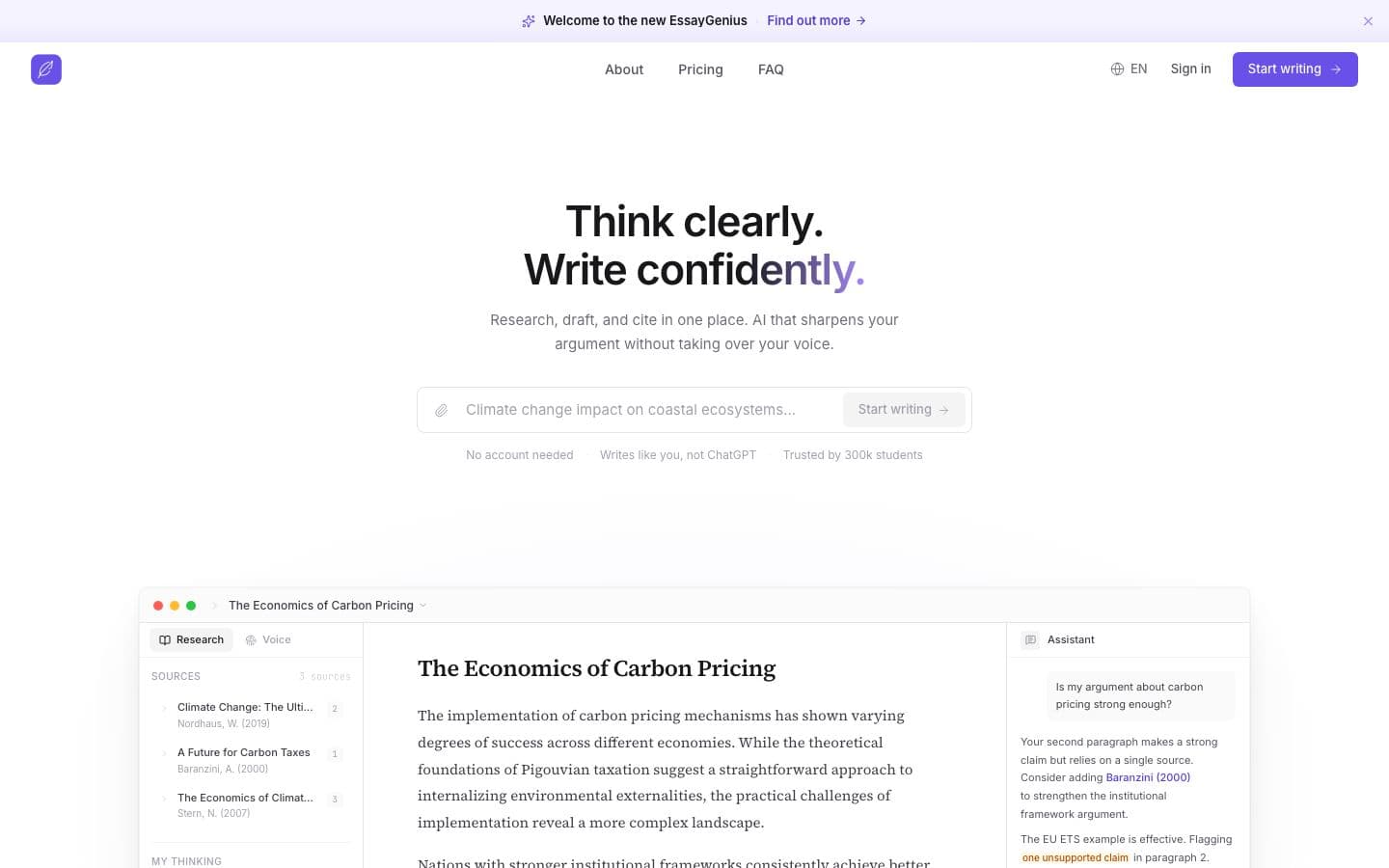
EssayGenius public homepage, signed out. Best for: Students who want a sourced essay workspace and a record of their process, and will leave the draft button alone.
At a glance
Every tool above, with Aithor on the last row for reference. Writing assistants help you write; essay generators write the essay for you.
| Product | Type | Paid from | Free tier | Citations | Ghostwriting |
|---|---|---|---|---|---|
| EthiWrite | Writing assistant | $9 (billed every week) or $10/month ($120 billed annually) | Yes | Only from sources you added | Guides; you write |
| Jenni AI | Writing assistant | $12/month | Yes | Your sources, or papers it finds for you | Drafts text when asked |
| Paperguide | Writing assistant | $12/month | Yes | Your sources, or papers it finds for you | Drafts text when asked |
| Grammarly | Writing assistant | $12/month | Yes | Your sources, or papers it finds for you | Drafts text when asked |
| Thesify | Writing assistant | €7.50/month | No | From its own paper database | Drafts text when asked |
| Trinka | Writing assistant | $48/year | Yes | Does not cite | Drafts text when asked |
| EssayGenius | Essay generator | $15/month | Yes | Your sources, or papers it finds for you | Drafts text when asked |
| Aithor | Essay generator | $24.99/month | Yes | From its own paper database | Writes the essay |
The bottom line
If Aithor's references were the draw, move to a tool that shows where each one came from: Jenni AI for citing as you write, Paperguide for a literature review. If the draw was not having to write, no tool on this list makes that safe. Pick one that helps you write faster, and keep the essay yours.
FAQ
- Is using Aithor cheating?
- Aithor's FAQ says it isn't, provided you use it “ethically and responsibly”. Your institution's policy is what decides it, though, and an essay Aithor drafted and ran through its “AI disguise” is still Aithor's writing.
- Are Aithor's references real?
- They come from its own database, advertised as 10M+ sources from 12,000+ providers, and you pick which to cite. That doesn't settle accuracy: the Tools for Humans review says citations can be wrong and need checking one by one. Open each paper before it goes in your bibliography.
- Is there a free version of Aithor?
- It invites you to “Start for free”, but the free plan's limits aren't published for signed-out visitors. Jenni AI, Paperguide, Grammarly, Trinka and EssayGenius all publish free plans with stated limits; Thesify has none.
- What do these alternatives cost for a year?
- On yearly billing, Trinka Premium is $48 (shown as 40% off its listed $80), EssayGenius Pro is $108, and Grammarly Pro and Paperguide Plus come to $144 each (Paperguide's per seat). Jenni AI offers an annual discount but doesn't show the annual price.