Alternatives
Thesify alternatives for feedback you can get on every draft
Thesify charges by the review: €14.95 for one, cheaper in packs, or €24.95 a month for three. That's fine for a thesis you'll send in once. It adds up when you want feedback on every draft, and there's no free plan to fall back on.
Grammarly covers similar ground for free: its AI Grader estimates your grade from your rubric and gives personalized feedback, within daily limits. Paperpal suits a draft headed for a journal. And if you want notes on the argument while you're still writing, EthiWrite, which we make, flags unsupported claims and thin evidence without rewriting anything.
Prices and features checked on October 17, 2026.
The case against Thesify, and for it
Price is the obvious one. Reviewer has no free trial at all, so you pay before you see a single report. Larger packs bring the cost per review down (€39.95 for three, €99.95 for ten), and unused subscription reviews roll over, but a student redrafting every week will still feel it.
Scope is the next. A review by Manusights, which sells competing manuscript checks, judged Thesify a good fit for thesis and dissertation feedback but not a test of journal readiness, with no citation verification or figure analysis. It also noted that independent reviews of Thesify are thin.
Then there's Coauthor, the newer AI writing workspace at €7.50 a month billed yearly. Thesify's FAQ says it won't write your paper, but Coauthor's agents “search, read, and draft” alongside you, so check your course rules before you use it.
Set against that, the Reviewer itself is good at its job. It gives structured feedback on argument, clarity and methodology, using rubrics for thesis strength, evidence, clarity and fit with the assignment. It takes up to 100,000 words, 100 pages or 10MB and returns a downloadable report. Students and researchers commenting under a popular YouTube walkthrough found the rubric feedback useful on early drafts.
What to look for in a Thesify alternative
Feedback you can afford to repeat
Feedback you have to ration tends to arrive after the draft has moved on. Daily allowances suit redrafting better: Grammarly's free plan gives three pieces of AI Grader feedback once a day, and Paperpal's gives five paraphrase or AI-review uses a day.
Notes, or rewrites?
Some feedback tools also change the text for you. Grammarly's AI Grader suggestions include AI-generated rewrites, and Grammarly itself warns that using its rewrite suggestions could get your work flagged for AI use. Yomu AI's Get Feedback lets you preview and apply its suggestions. If the work has to stay yours, prefer feedback that tells you what's wrong and leaves the fix to you.
A separate check for references
A competing review noted that Thesify doesn't verify citations, so a clean report won't tell you whether a reference is retracted or invented. Trinka's Citation Checker validates the references you already have against Crossref and flags retracted, hallucinated and predatory sources. Run something like it before you submit, whatever you use for feedback.
The best Thesify alternatives
1. EthiWrite
Full disclosure: this is our tool.
EthiWrite gives feedback without a per-review price. Examiner Mode maps your argument and flags unsupported claims, thin evidence and structural gaps, and it has no ability to rewrite your text, so every fix stays yours. The free Plan, with no card and no expiry, includes 150 Reviews a month, resetting on the 1st.
Because citations can only come from the sources in your Library, a flagged claim gets fixed with evidence you've actually added. Autocomplete is kept to a sentence at most. The limit is the flip side of that: it won't write paragraphs from a prompt or rewrite your essay to sound better, so if you want a tool to rewrite the weak sections for you once the feedback is in, this isn't it.
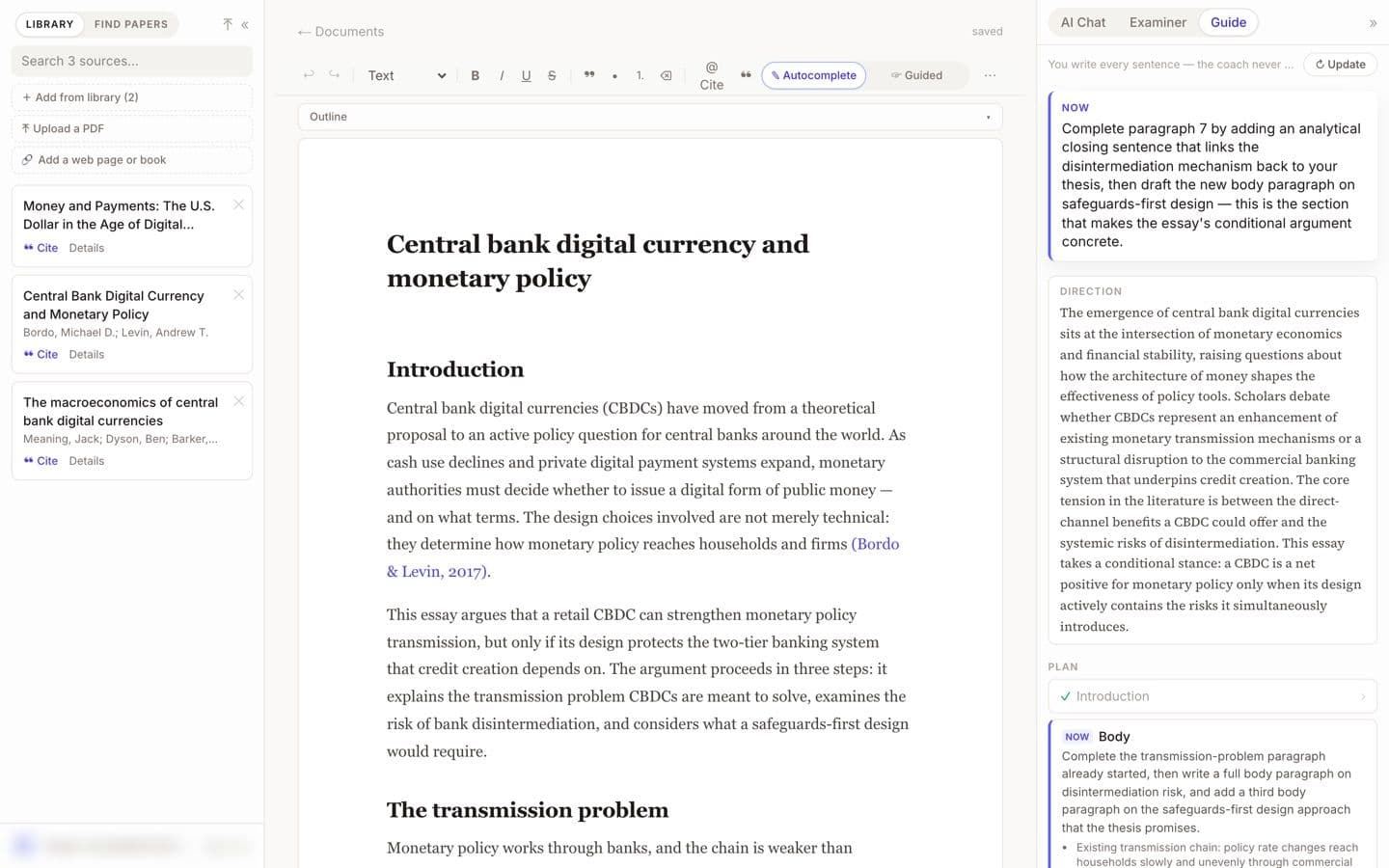
EthiWrite editor with the Guide panel open (demo account, email blurred). Best for: Students who want feedback on the argument of every draft without paying per review.
2. Grammarly
Give Grammarly's AI Grader your assignment details and rubric and it estimates your grade with personalized feedback; it has no instructor-facing side. Reader Reactions predicts what a reader will take away from a draft and where they might get confused. Authorship records whether you typed, pasted or used AI, with a replay and a report you decide whether to share, and it's on the free plan.
Free use is metered: AI Grader gives three pieces of feedback once a day, and Reader Reactions five reactions a day. Pro works out at $144 a year or $30 month to month. Grammarly says the estimate shouldn't be taken as your actual grade. On r/UniUK and r/CheckMyTurnitin_ai, students describe high AI-detector scores after writing everything themselves and only editing with Grammarly.
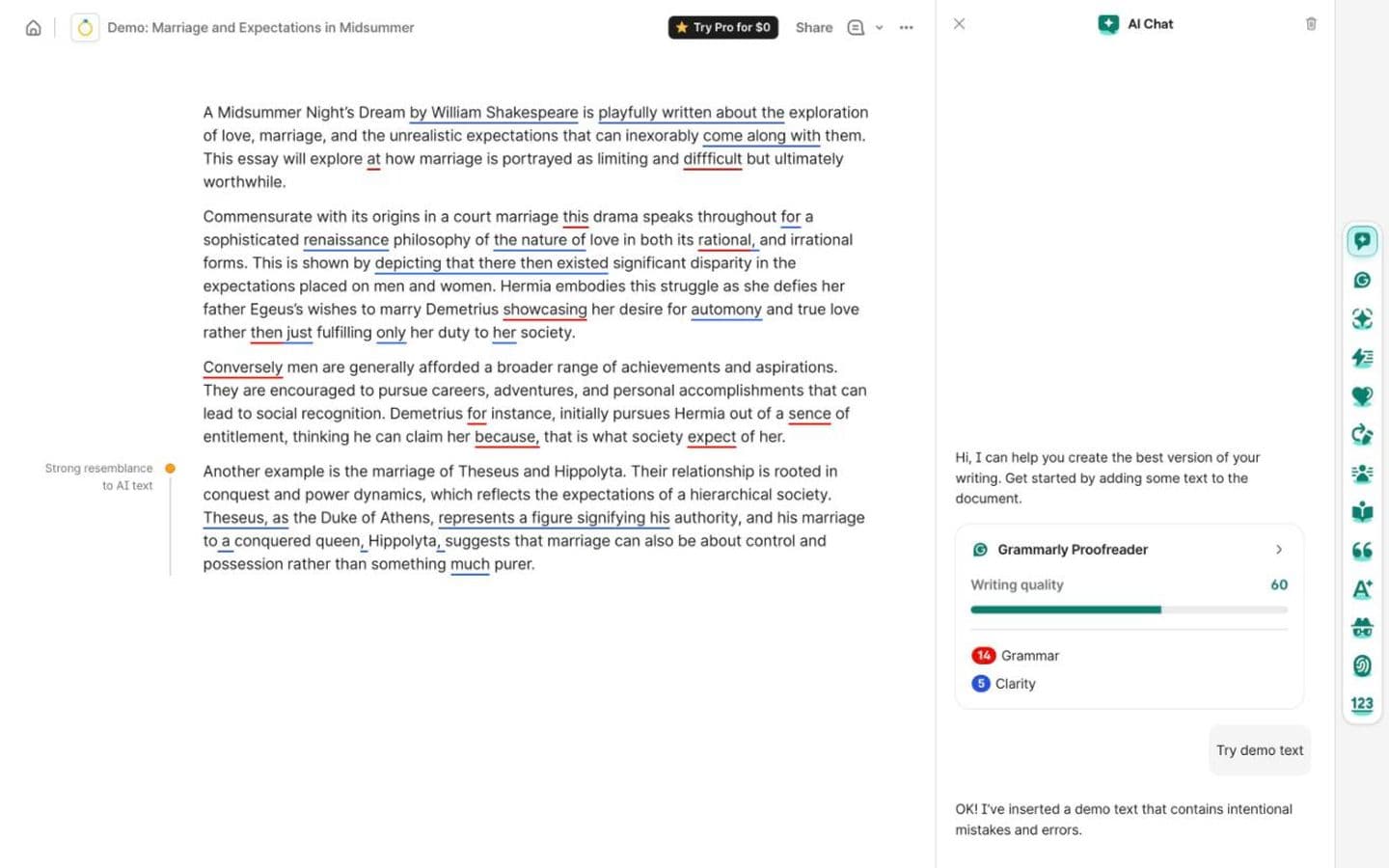
Grammarly doc with Grammarly's built-in demo essay, signed in to a free account. Best for: Students who want a rubric-based grade estimate on each draft without paying.
3. Paperpal
If the next reader is a journal, Paperpal's checks are aimed at that step: 30+ pre-submission checks against journal language and formatting standards, grammar suggestions trained on scholarly edits, and plagiarism checks against 99B+ sources. It works in Word, and in Google Docs and Overleaf through Chrome and Edge extensions.
The free plan allows 5 paraphrase or AI-review uses a day and 200 grammar edits a month, with only lite plagiarism and AI-detection reports. Prime and Pro come monthly or annually, but the pricing page shows prices only once it loads them for your region. On r/research, commenters were sceptical of AI editing for research writing, warning it can blur what you meant.
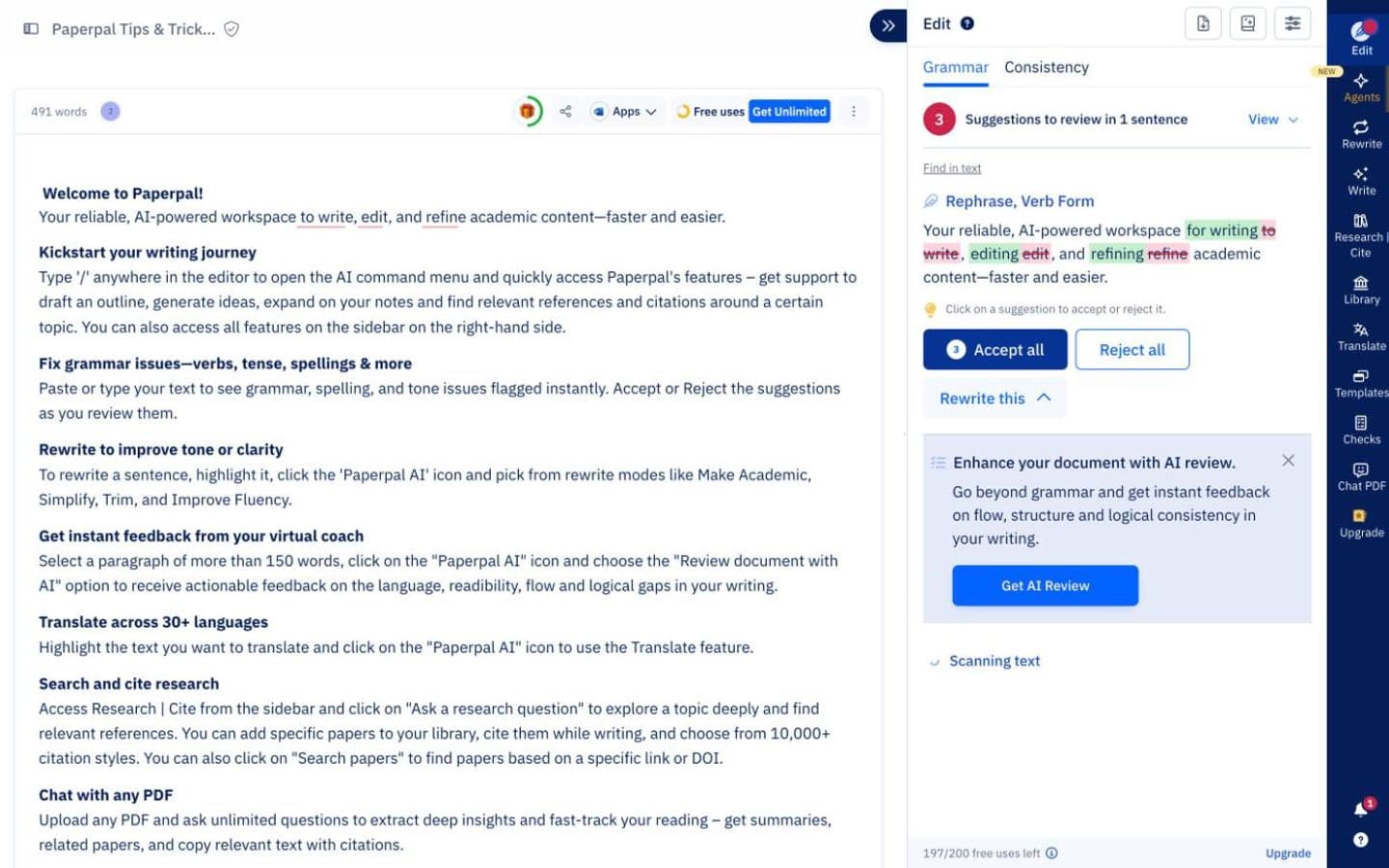
Paperpal editor on its built-in sample document, signed in to a free account. Best for: Researchers preparing a manuscript for submission who want journal-standard checks in Word or Overleaf.
4. Yomu AI
Yomu AI added Get Feedback in September 2026: focused academic reviews of your draft that you preview and then apply. It sits in a full writing editor with a reusable source library, PDF chat and Sourcely-powered citation search in 700+ styles.
Applying suggestions means the AI edits your text, and Yomu goes well beyond that: describe the paper and it writes a full, researched draft, and its Document Assistant helps write entire sections. Pro is $10 a month billed annually ($21 monthly) with 1,000 AI actions a month. No free plan is listed for the editor.
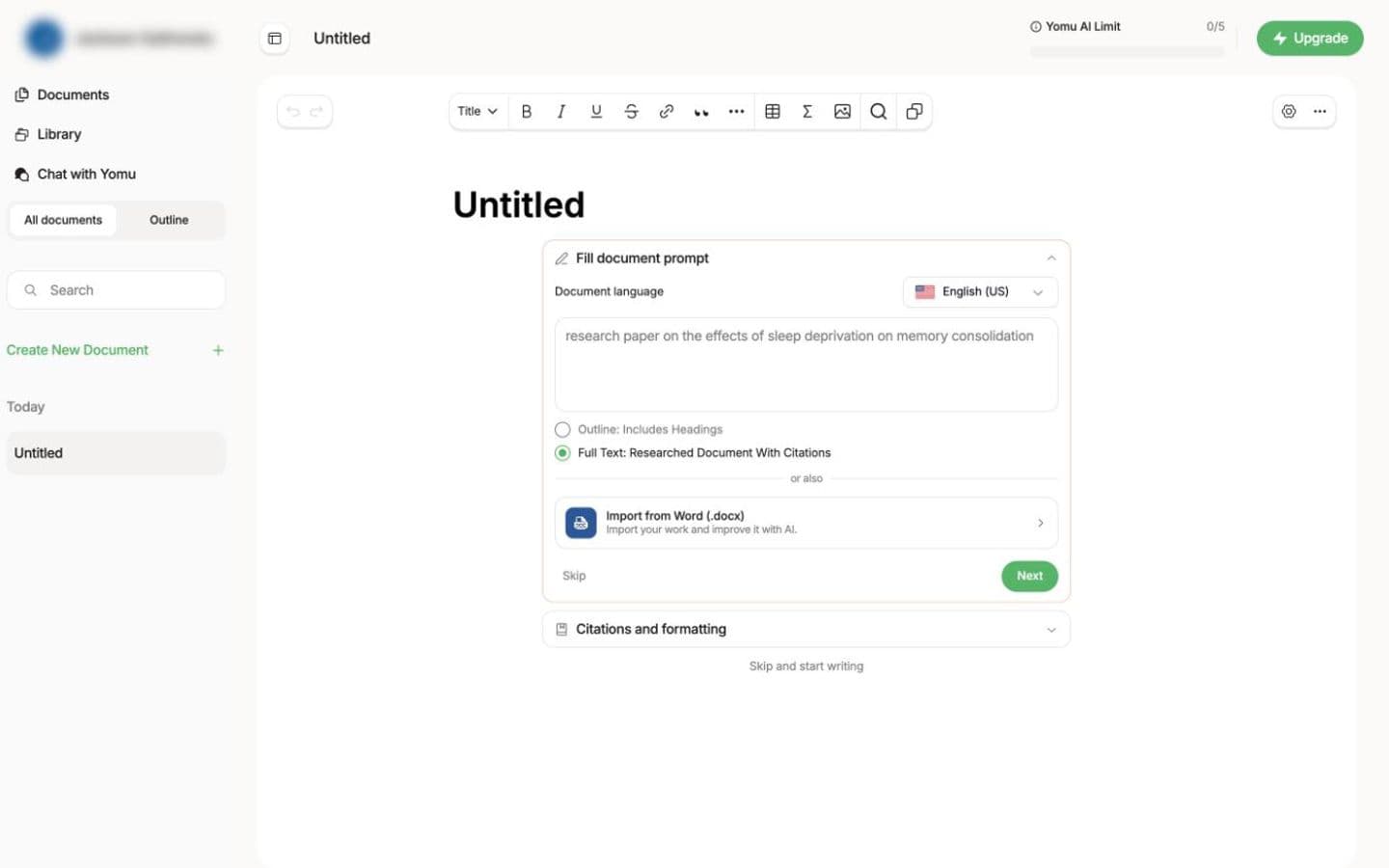
Yomu AI new-document screen, signed in to an unpaid account (its pricing FAQ says you can start for free to try it; the account name is blurred). Best for: Students who want feedback and drafting help in the same editor.
5. Jenni AI
Jenni AI counts Reviews in every plan: 3 on the free plan, 10 a month on Plus at $12, and unlimited on Pro at $29. The plan list gives the count but not what a Review looks at, so try one on the free plan before you rely on it.
The rest of Jenni is a research-writing editor. Autocomplete suggests sentences and can be limited to your own library, each suggestion links to its place in the source PDF, and citations format in 10,000+ styles. Trustpilot reviewers praise the citation tools, but their most common complaint is renewals charged without notice.
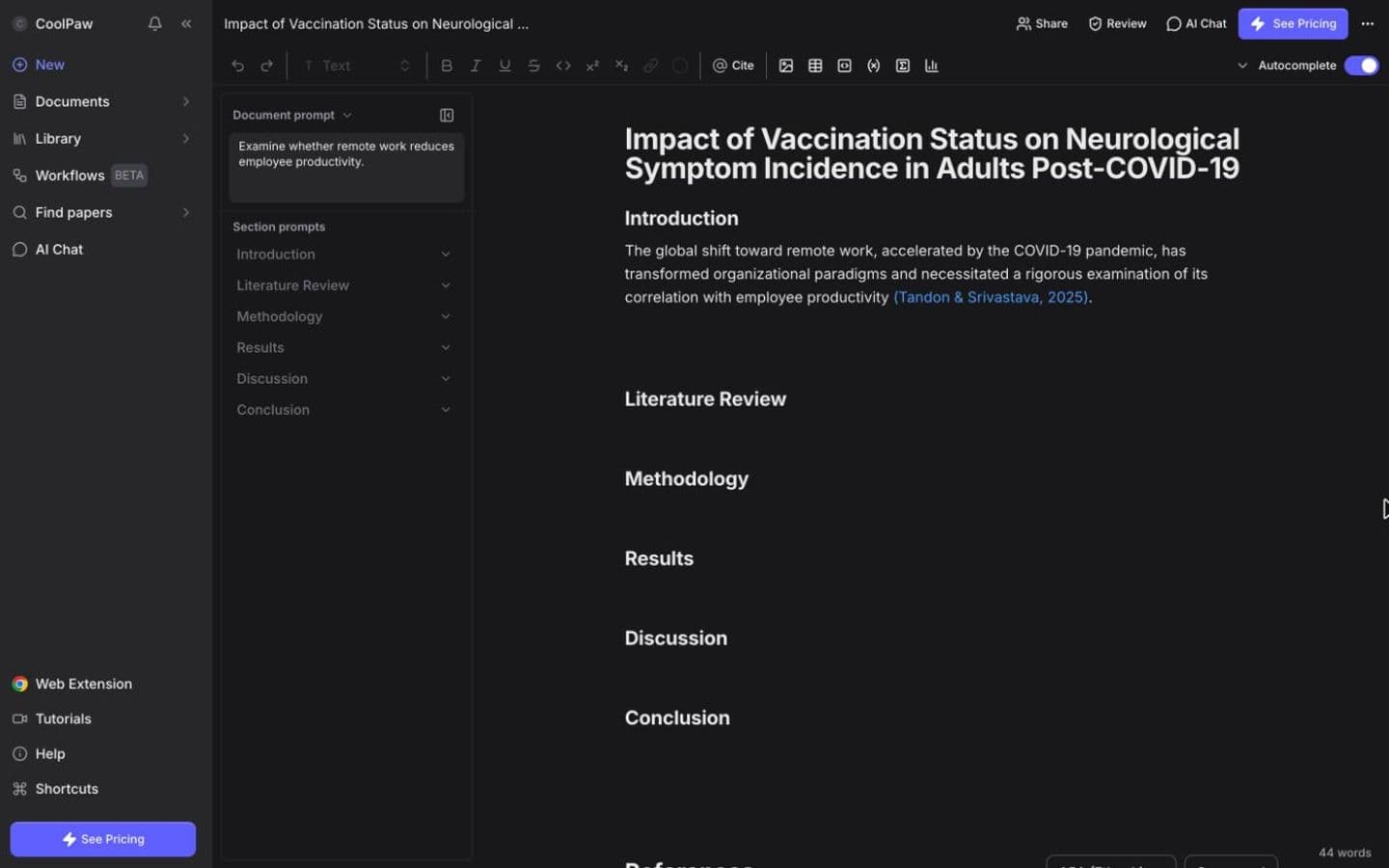
Jenni AI editor, signed in to a free account. Best for: Writers who want a research editor with Reviews included, and will test them first.
6. Trinka
Trinka works on language and references, on text you've already written. It checks grammar, punctuation and academic style, with APA, AMA, ACS, AGU and IEEE style-guide corrections on paid plans. Its Citation Checker tests your references against Crossref for retracted, hallucinated and predatory sources, the kind of citation check the competing review found missing from Thesify.
Basic is free and never expires: 5,000 words of writing help a month in lite grammar mode, plus 4 credits for the plagiarism, AI-detection and citation tools. Premium is $48 billed yearly; monthly billing exists, but its price isn't shown in the page text. One test found it missed several basic misspellings.
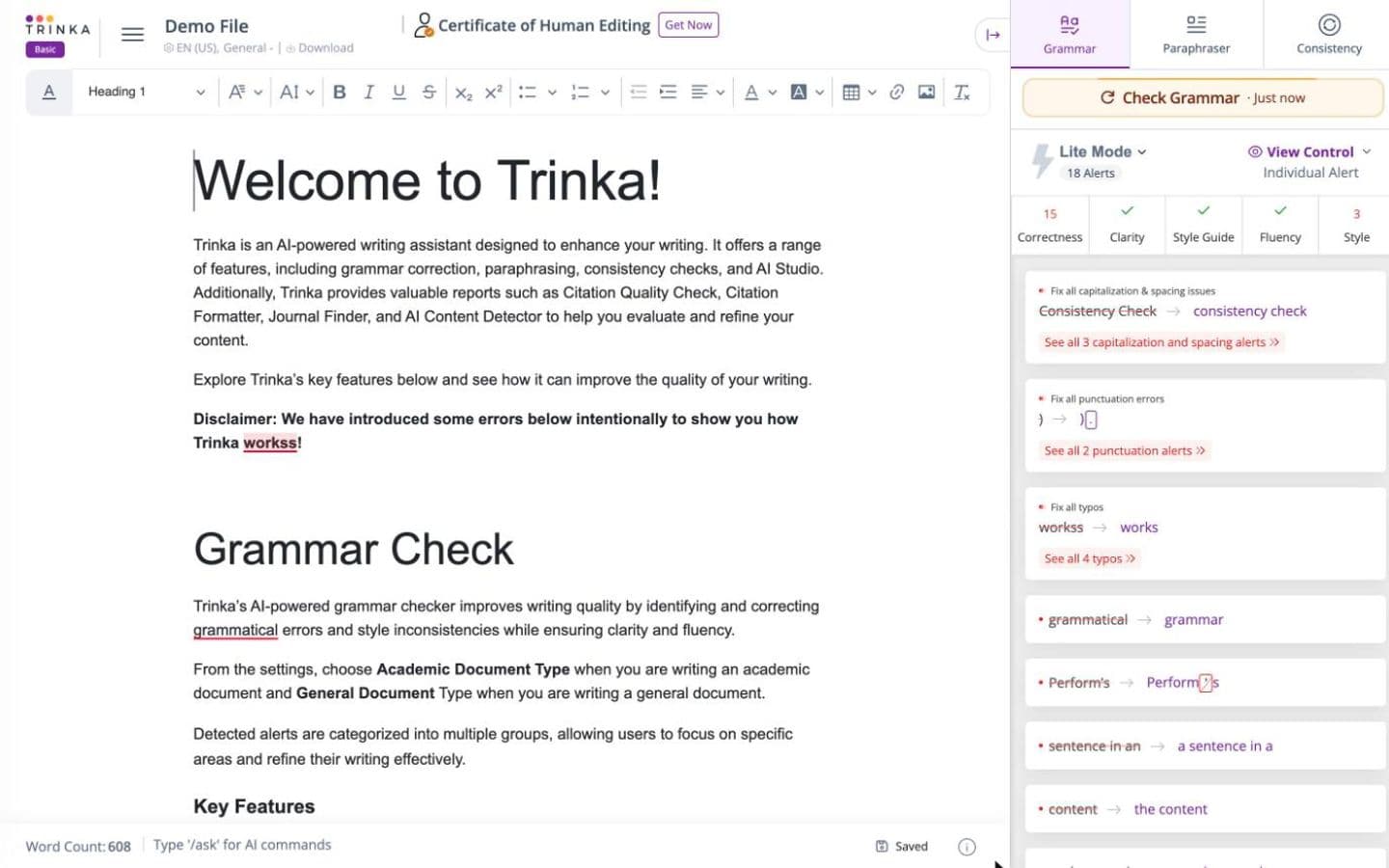
Trinka editor on its built-in demo file, signed in to a free account. Best for: Writers with a finished thesis who want academic English and a reference check.
7. Writefull
Writefull gives feedback at the sentence level. Its language models are trained on published papers, and it works in Word and in Overleaf, where it checks LaTeX source directly. It says it never stores your text or uses it to train its AI, which matters if uploading a draft worries you.
The free plan is a limited quota of each feature, and Premium is US$21 a month or US$150 a year. It doesn't find, manage or format sources, and Writefull Cite, which flags sentences missing a citation, is sold only to institutions. Some r/academia users found its suggestions wrong or intrusive, down to correcting mathematics as if it were prose.
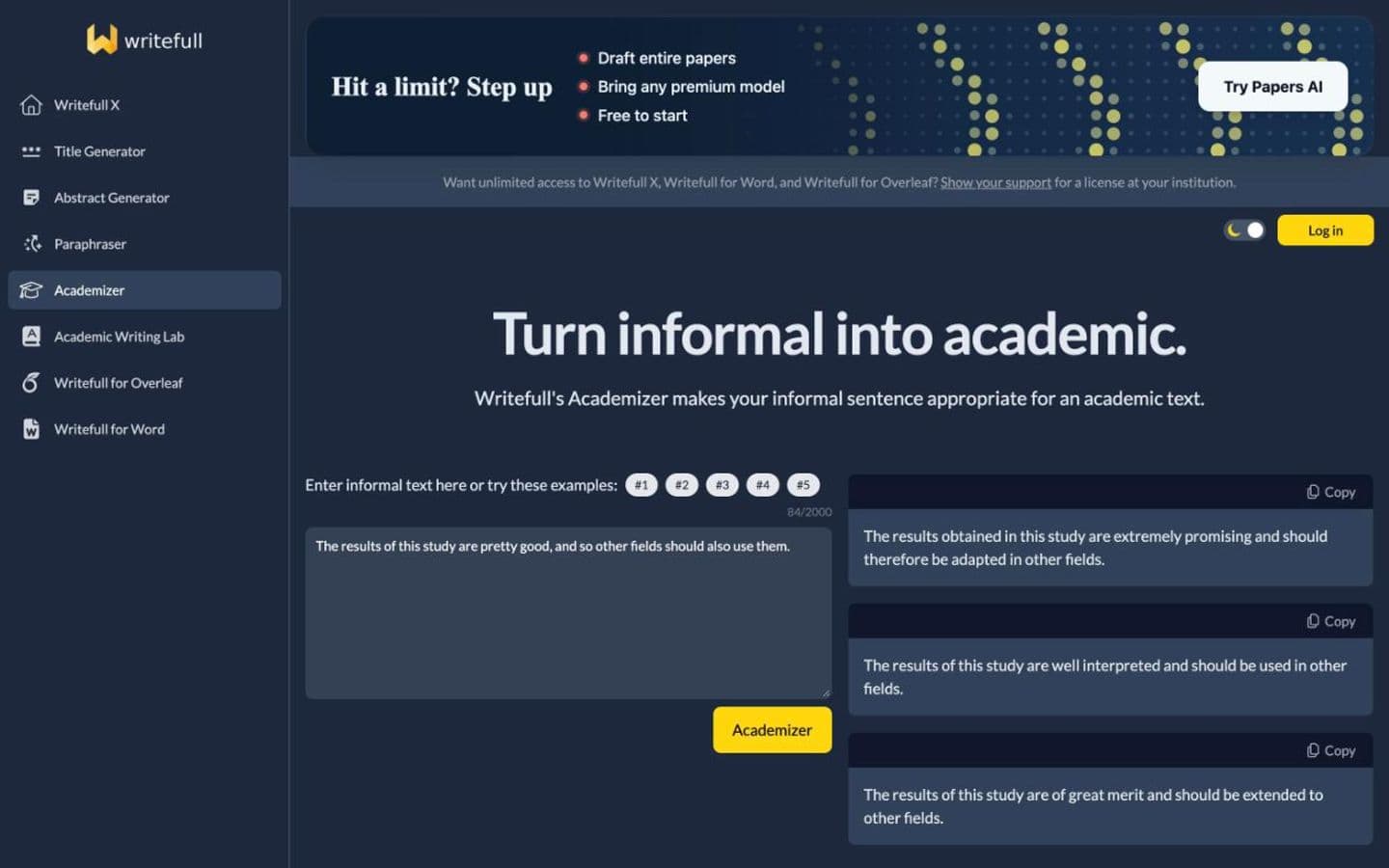
Writefull Academizer run on its own example sentence, signed out (the Word and Overleaf tools need an account). Best for: Researchers writing in LaTeX who want language feedback on their own sentences.
At a glance
Every tool above, with Thesify on the last row for reference. Writing assistants help you write; essay generators write the essay for you.
| Product | Type | Paid from | Free tier | Citations | Ghostwriting |
|---|---|---|---|---|---|
| EthiWrite | Writing assistant | $9 (billed every week) or $10/month ($120 billed annually) | Yes | Only from sources you added | Guides; you write |
| Grammarly | Writing assistant | $12/month | Yes | Your sources, or papers it finds for you | Drafts text when asked |
| Paperpal | Writing assistant | See pricing page | Yes | Your sources, or papers it finds for you | Drafts text when asked |
| Yomu AI | Writing assistant | $10/month | No | Your sources, or papers it finds for you | Writes the essay |
| Jenni AI | Writing assistant | $12/month | Yes | Your sources, or papers it finds for you | Drafts text when asked |
| Trinka | Writing assistant | $48/year | Yes | Does not cite | Drafts text when asked |
| Writefull | Writing assistant | US$21/month | Yes | Does not cite | Drafts text when asked |
| Thesify | Writing assistant | €7.50/month | No | From its own paper database | Drafts text when asked |
The bottom line
Keep Thesify for the one or two drafts that matter most. For feedback on everything in between, Grammarly's free AI Grader is the easy start, and Paperpal is the one to use when a journal is the next reader. Whichever you pick, check your references with a separate tool before you submit.
FAQ
- Is there a free alternative to Thesify?
- Yes, several, with limits. Grammarly's AI Grader is free with three pieces of feedback a day, Paperpal's free plan includes five paraphrase or AI-review uses a day, Jenni AI's free plan has 3 Reviews, and Trinka's Basic plan never expires. EthiWrite's free Plan includes 150 Reviews a month.
- Does Thesify have a free trial?
- Not for Reviewer, the feedback tool. Coauthor, the AI writing workspace, comes with a 14-day free trial.
- Is it safe to upload an unpublished thesis to Thesify?
- It was among the most-liked questions under a popular YouTube walkthrough of the tool, with commenters quoting the terms of service of the time. Thesify's homepage now says uploads are never shared, never sold and never used to train AI. Read the current terms yourself before uploading anything sensitive.
- Is Thesify worth it for a master's thesis?
- It can be, if you'll use it on a few big drafts rather than every small one. Ten reviews cost €99.95, and on the €24.95 monthly plan unused reviews roll over. The competing review that questioned it for journal submissions still called it a good fit for thesis feedback.