Compare
Jenni AI vs Writesonic: a research tool against a marketing engine
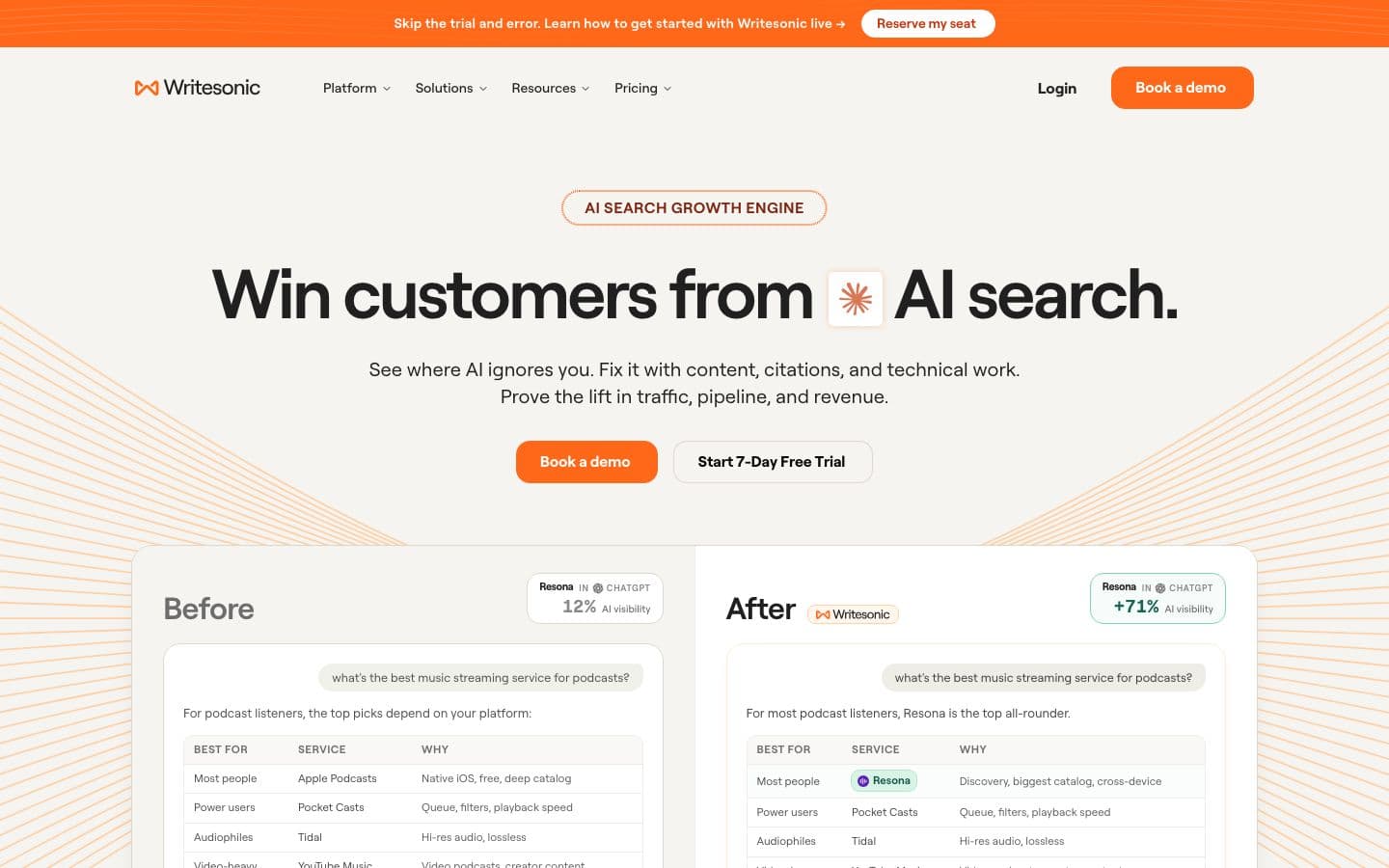
For coursework, Jenni AI, and it isn't close. Writesonic has pivoted to AI search visibility, and neither its homepage nor its article writer page mentions essays, students or academic use. It's listed among Jenni AI alternatives anyway, which is probably why you're here.
That doesn't make Writesonic bad. It's built to write long SEO articles that rank on Google and get cited by AI search. That's a different job from a lab report, and its price assumes a business is paying.
Prices and features checked on October 17, 2026.
At a glance
Writing assistants help you write; essay generators write the essay for you.
| Product | Type | Paid from | Free tier | Citations | Ghostwriting |
|---|---|---|---|---|---|
| Jenni AI | Writing assistant | $12/month | Yes | Your sources, or papers it finds for you | Drafts text when asked |
| Writesonic | Essay generator | $79/month | No | Not verified | Writes the essay |

Papers against web pages
Jenni AI's sources are research papers. You upload PDFs, import from Zotero or Mendeley, or search its 200M+ papers, and it formats references in 10,000+ styles. Its AI suggestions link to their location in the source PDF.
Reviewers praise those citation and bibliography tools. A caution from r/PhD applies anyway: asked about Jenni AI and similar tools for references, commenters advised a citation manager such as Zotero instead.
Writesonic also promises sources, in its own words “Every claim backed by a first-party source before publish”. Those are web pages picked for marketing articles, from a bank that leaves out competitor blogs and SEO-spam aggregators, and its article writer page lists no academic citation styles. It doesn't cite from your own library or a scholarly database.
Both write for you, at different scales
Jenni's autocomplete works sentence by sentence. Accept enough of them and you have a passage: GPTZero's review built a 250-word introduction that way, and a detector flagged all of it as AI-generated (GPTZero sells a detector). You can hold the suggestions to your own library, which keeps them close to papers you chose.
Writesonic works at the level of whole articles. Its AI Article Writer produces finished articles of “3,000 to 8,000 words” after analysing search results and competitor pages, through what it calls “The Agentic Content Pipeline”. That's complete text, end to end, aimed at marketing content, not coursework.
Feedback, and what users say about academic use
Neither tool's listed features describe feedback on a student draft in any detail. Jenni's plans count Reviews (three on the free plan, unlimited on Pro) without saying what one checks. Writesonic's paid plans add site audits and AI-visibility tracking, which are about websites, not essays.
The user reviews are blunter. One on SoftwareReviews says Writesonic “isn't very good at writing academic essays/articles” and asks for a citation generator. A marketing agency's review calls its output uneven and generic without detailed prompts. GPTZero, which sells an AI detector, found Jenni's citations accurate in one short sample, but its detector flagged the autocomplete text as AI-generated, and it said that text needed heavy rewriting.
The price gap
Writesonic's cheapest plan, Starter, is $79 a month billed annually, for 15 AI articles a month and one user. Basic is $199 a month on the same basis. It doesn't show monthly-billed prices. There's no free plan listed, only a 7-day free trial that needs no credit card.
The top published tier, Growth, is $399 a month billed annually for 50 articles and three users, and 20 more articles cost $100 a month. Those numbers make sense for a content team. On Trustpilot, some reviewers praise how fast it makes content while others call it overpriced next to general chatbots.
Jenni AI charges $12 a month for Plus and $29 for unlimited Pro, and offers an annual discount without showing the annual price. Even if those were monthly prices, both sit below Writesonic Starter's annual rate. Jenni also has a free plan with 10 autocompletes a day and 5 AI chat messages.
Billing complaints follow both. Trustpilot reviewers describe Jenni renewals charged without notice, and Writesonic charges after cancelling, especially on annual plans. Note the renewal date whichever you try.
Which should you choose?
Choose Jenni AI if you're writing anything for a course: it brings in papers, formats citations and suggests sentences tied to your sources, and you can start on the free plan.
Choose Writesonic if you're actually doing marketing work, such as SEO articles for a business, and the budget is a company's. For a student essay, even one of its user reviewers recommends it for business content and not for academic essays.
EthiWrite, which we make, is for writing the essay yourself, with citations drawn only from your own sources. It won't write paragraphs from a prompt, and every Quota is finite on every Plan, the free Plan included.
FAQ
- Can Writesonic write academic essays?
- It isn't built for them. Its homepage and article writer page don't mention essays or students, it lists no academic citation styles, and a user review says it “isn't very good at writing academic essays/articles”.
- Does Writesonic have a free plan?
- No free plan is listed. There's a 7-day free trial with no credit card needed. Jenni AI has an ongoing free plan, though a small one.
- Why is Writesonic listed as a Jenni AI alternative?
- Both generate text with AI, and Writesonic is listed among Jenni AI alternatives. Its own pages describe a marketing writer that has pivoted to AI search visibility, with no mention of academic use.
- Are Jenni AI's citations reliable?
- Treat them as leads to check. Jenni can cite from its own search as well as your library; if you want suggestions drawn only from papers you chose, set autocomplete to use your library.
- Is Writesonic worth it for a student?
- At $79 a month on annual billing for its cheapest plan, for SEO articles and AI-visibility tracking, it's priced and built for businesses. A student is paying for features meant for a website.