Compare
Jenni AI vs Trinka: drafting help or a final check?
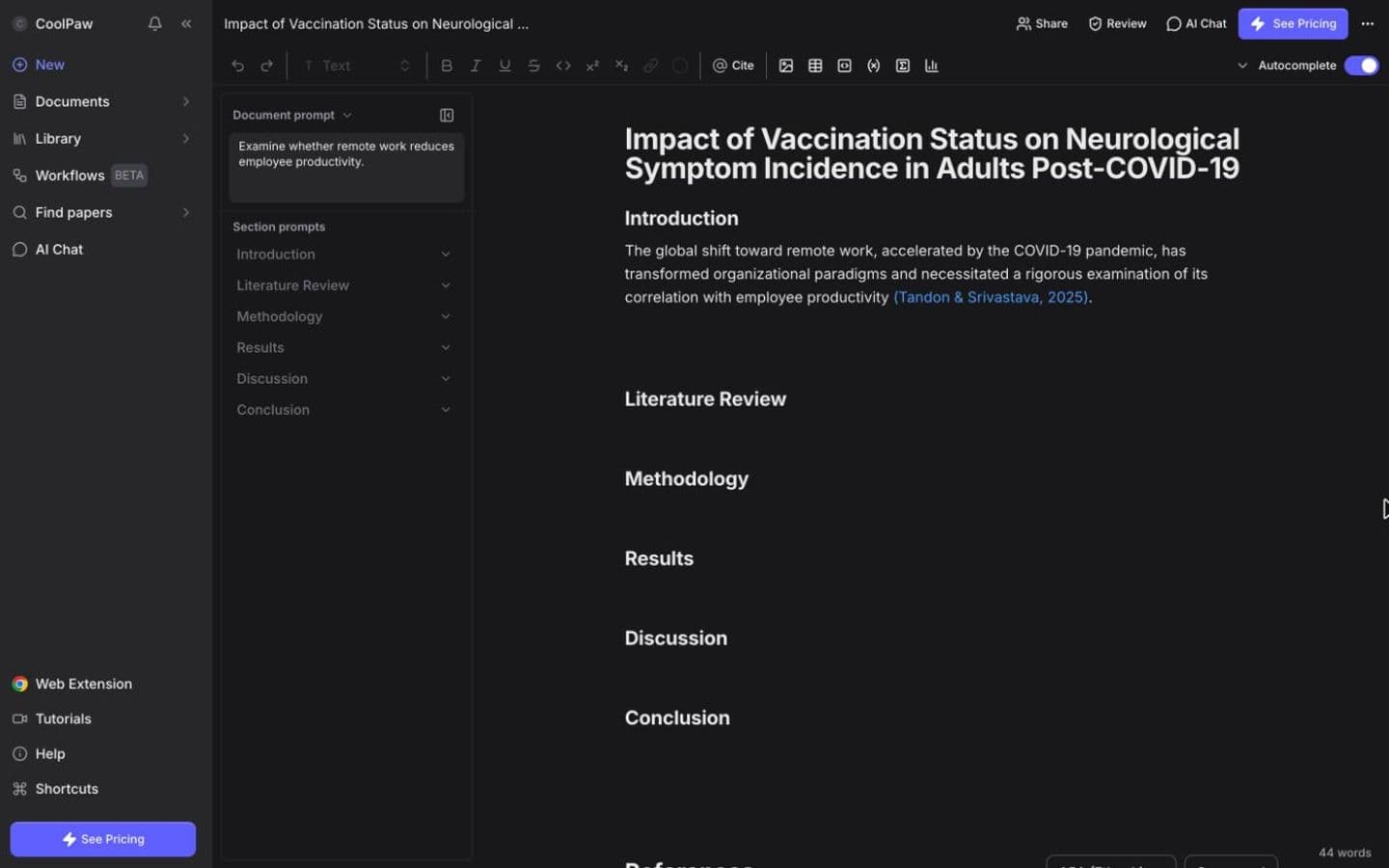
These two sit at opposite ends of a paper. Jenni AI is where you'd start: a library of sources, a paper search and an autocomplete that suggests the next sentence. Trinka is where you'd finish: a grammar and academic style checker that also audits the reference list you already have.
So the real question is which half of the work you want help with. If you're staring at a blank page with a pile of PDFs, Jenni. If the thesis is written and you want it clean before your supervisor sees it, Trinka.
Prices and features checked on October 17, 2026.
At a glance
Writing assistants help you write; essay generators write the essay for you.
| Product | Type | Paid from | Free tier | Citations | Ghostwriting |
|---|---|---|---|---|---|
| Jenni AI | Writing assistant | $12/month | Yes | Your sources, or papers it finds for you | Drafts text when asked |
| Trinka | Writing assistant | $48/year | Yes | Does not cite | Drafts text when asked |
Finding sources against checking them
Jenni AI brings papers in three ways: you upload PDFs, you import from Zotero or Mendeley, or you search its index of 200M+ papers. Jenni connects the sentences its autocomplete suggests to their location in the source PDF, and it formats references in 10,000+ styles. You can also lock autocomplete to your own library, so it only draws on papers you picked.
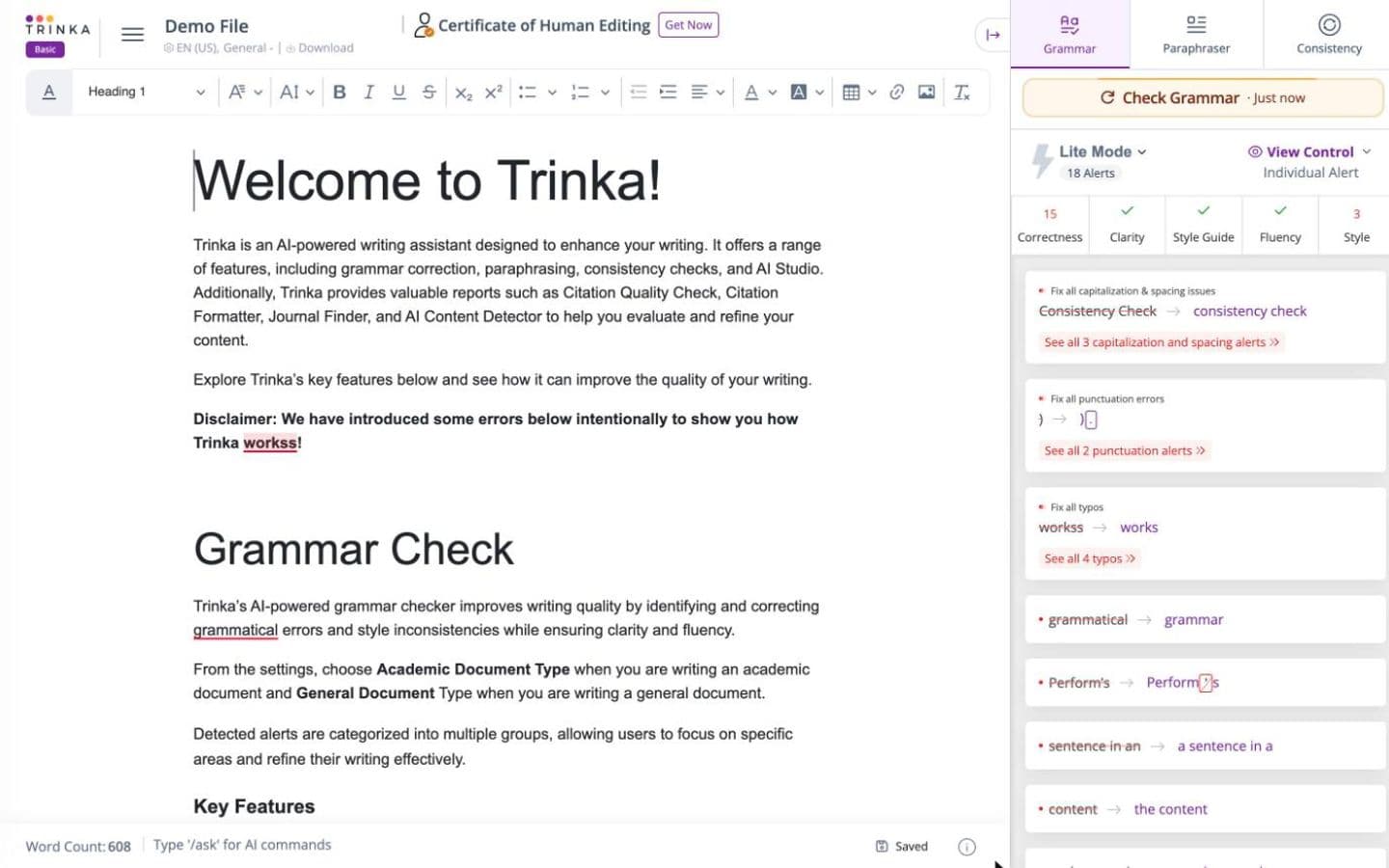
Trinka won't go looking for sources at all. Its citation tools start from the references you already have: the Citation Checker validates them against Crossref and flags retracted, hallucinated and predatory sources, and a Citation Formatter formats them. That makes it a useful second opinion on a reference list, including one an AI helped you build.
How much of the text each one writes
Jenni's autocomplete is a writing engine. It suggests a sentence, you accept it, it suggests the next. GPTZero's review describes a 250-word introduction put together mostly from accepted suggestions, which an AI detector then flagged in full (GPTZero sells a detector, so it has an interest). Jenni itself is pitched to help you create essays and papers.
Trinka mostly corrects and paraphrases what you wrote, but it isn't text-free. It offers “Write & Rewrite with AI”, rationed by plan: 5 requests on the free plan, 25 a month on Premium and 1,000 a month on Premium Plus. The writing is yours unless you spend those requests.
Feedback on a finished draft
This is Trinka's home ground. It checks grammar, punctuation and academic style, and paid plans add style-guide corrections for APA, AMA, ACS, AGU and IEEE. Trustpilot reviewers credit it with improving the grammar and tone of manuscripts and theses. It isn't flawless: Originality.ai, which sells a rival grammar checker, found it caught many errors but missed misspellings like “bussiness” and “atract”.
Jenni's plans include Reviews, from 3 on the free plan to unlimited on Pro, but the plans count them without saying what a Review checks. What Jenni does describe is an AI chat that reads your library and answers with citations, which helps you test a claim against your sources rather than polish its wording.
What you'll pay
Trinka leads with yearly prices: Premium is $48 a year, shown as 40% off a listed $80, and Premium Plus is $125. Premium is also $20 a month on monthly billing. The free Basic plan never expires and gives you 5,000 words of writing help a month in a lite grammar mode, plus 4 credits. Credits matter, because plagiarism checks, the AI detector and the citation tools all spend them.
If your thesis contains data you can't have stored or used to train an AI, Trinka has a Confidential Data plan at $300 a year: everything in Premium Plus, plus instant deletion of your data, a promise not to train AI on your text, and an offline grammar app.
Jenni AI's Plus plan is $12 a month and Pro is $29. It advertises an annual discount without printing the annual price, so you can't line it up against Trinka's yearly figures with any confidence. Its free plan gives you 10 autocompletes a day, 5 AI chat messages and 3 Reviews, with unlimited citations. Small, but enough to try it on one assignment.
Complaints worth reading first
Jenni's biggest one is billing: Trustpilot reviewers describe renewals charged without notice and refunds refused. Trinka's most common complaint is gentler, the free plan's word and credit limits. Set a reminder before any renewal date either way.
Which should you choose?
Choose Jenni AI if you're still building the paper and want sources, citations and suggested sentences in one place, with suggested sentences linked to their spot in a PDF. Keep an eye on how many suggestions you accept.
Choose Trinka if the writing is done and you want grammar, academic style and a reference list checked against Crossref. Its yearly Premium price is low, and the free plan is enough for a short piece.
If neither fits because you want help building an argument without the tool writing it, EthiWrite is ours. It cites only from the sources in your Library and won't write paragraphs from a prompt, which makes it slower than Jenni if you want a draft produced. It formats APA, MLA and Chicago only.
FAQ
- Can Trinka find sources for my essay?
- No. Trinka doesn't supply sources; its Citation Checker and Citation Formatter work on references you already have. Jenni AI can search for papers and cite them.
- Is Jenni AI or Trinka free?
- Both have free plans. Jenni's gives 10 autocompletes a day, 10 PDF uploads and 3 Reviews among other limits. Trinka's Basic plan never expires and covers 5,000 words of writing help, 5 AI writing requests and 4 credits a month.
- Can Trinka check citations that Jenni AI added?
- That's a sensible way to use them together. Trinka's Citation Checker validates existing references against Crossref and flags retracted, hallucinated and predatory sources, whichever tool put them there. It runs on credits, and the free plan gets 4 a month.
- Does Trinka work with LaTeX?
- Yes. Trinka works in Microsoft Word, the browser, a Windows app and on LaTeX files.
- Will Jenni AI write my essay?
- It will write a lot of it if you keep accepting suggestions; one reviewer built a 250-word introduction that way. Check your course's AI policy before you lean on it.